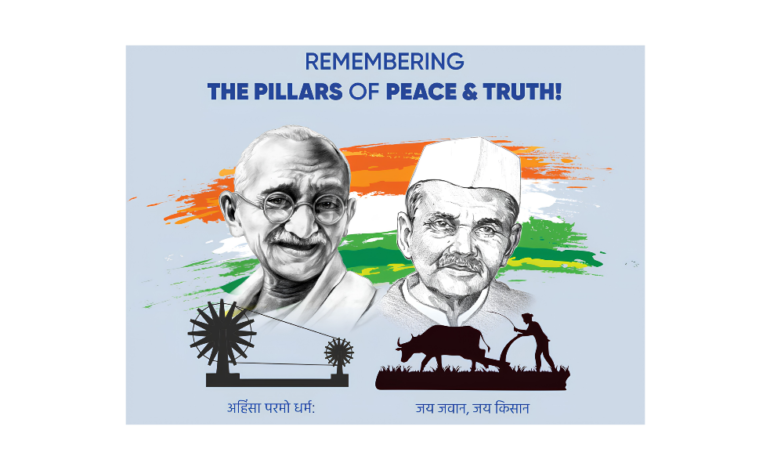
October 2: Remembering two giants of India’s history

Lal Bahadur Shastri and Mahatma Gandhi — Two Lives, Two Paths, One Enduring Legacy
October 2 is a unique day in India’s history. It is a day of celebration, remembrance and reflection as the nation observes the birth anniversaries of two extraordinary Indians — Mahatma Mohandas Karamchand Gandhi, revered as the Father of the Nation, and Lal Bahadur Shastri, India’s second Prime Minister and a symbol of simplicity, integrity, courage and patriotism.
Gandhi was born in 1869 and Shastri in 1904. Though they belonged to different generations and followed different paths, both devoted their lives to India and left legacies that continue to shape the nation.
Lal Bahadur Shastri: A Giant in a Small Frame
Lal Bahadur Shastri was a leader whose simplicity concealed extraordinary strength.
Born into modest circumstances, Shastri joined the freedom movement as a young man and spent years in British prisons. After Independence, he served in several important positions before succeeding Jawaharlal Nehru as Prime Minister in 1964.
His tenure lasted barely 19 months, yet those months tested him with some of the most difficult challenges facing the young republic.
During the 1965 India-Pakistan war, Shastri demonstrated quiet determination and national resolve. At the same time, he emphasized India’s urgent need to strengthen agriculture and become more self-reliant.
His famous call, “Jai Jawan, Jai Kisan,” captured this national priority — honoring both the soldier defending India and the farmer feeding India.
Shastri never cultivated the image of a powerful ruler. His strength came from personal integrity, humility and an extraordinary sense of duty. He remains widely remembered for these qualities.
And then came Tashkent.
Following the 1965 war, Shastri signed the Tashkent Declaration with Pakistan’s President Ayub Khan on January 10, 1966. Hours later, he died suddenly.
The official account attributed his death to a heart attack, and contemporary parliamentary records document the medical efforts made to save him. Yet questions surrounding the circumstances of his death have persisted for decades.
There have been allegations of poisoning and other theories, but they remain unproven. That distinction matters. India should neither declare an unproven theory to be fact nor dismiss legitimate historical questions. The circumstances surrounding Shastri’s death deserve transparency and, where possible, examination through credible historical evidence.
For many Indians, Shastri remains one of the finest examples of public service without personal extravagance.
Mahatma Gandhi: A Transformative Leader and Enduring Symbol
Mahatma Gandhi’s contribution to India’s freedom struggle was profound.
Through Satyagraha, non-violence, civil disobedience and mass mobilization, Gandhi helped transform the struggle against British rule into a movement involving millions of ordinary Indians. From Champaran and Kheda to the Salt March and Quit India, his methods gave India’s independence movement a powerful moral and international dimension.
His philosophy of non-violence went far beyond India and influenced later movements for civil rights and freedom around the world.
Gandhi’s political journey, however, was complex. He was not the only force behind India’s independence, nor did every nationalist agree with his methods or decisions. Leaders such as Subhas Chandra Bose and revolutionary figures such as Bhagat Singh represented different approaches to the struggle.
That diversity is important to remember because India’s freedom was the product of many streams of sacrifice and political thought.
Gandhi and Bhagat Singh: A Debate That Still Resonates
The relationship between Gandhi and Shaheed Bhagat Singh remains one of the most debated chapters of India’s freedom struggle.
Bhagat Singh represented a revolutionary tradition and believed that armed resistance could be justified against British rule. Gandhi, by contrast, remained firmly committed to non-violence and opposed revolutionary violence.
When Bhagat Singh, Rajguru and Sukhdev were sentenced to death, Gandhi did intervene. Records preserved by the Gandhi Heritage Portal show that on March 23, 1931, Gandhi wrote to Viceroy Lord Irwin asking him to reconsider the commutation of the three men’s sentences. He subsequently spoke publicly about his efforts to save Bhagat Singh.
The executions nevertheless went ahead that day.
This has produced a legitimate historical debate: Did Gandhi do everything within his political power to save Bhagat Singh? Could he have exerted greater pressure? Or were the circumstances and the authority of the British government such that his ability to change the decision was limited?
There is no need to turn this complicated episode into either an indictment or a complete defense of Gandhi. The historical record shows that he sought clemency; it also shows that he failed to prevent the executions. The debate over whether he could have done more remains part of India’s historical conversation.
At the same time, Bhagat Singh’s courage and sacrifice deserve their own place of honor. Remembering Gandhi should never mean forgetting Bhagat Singh, and honoring Bhagat Singh does not require denying Gandhi’s enormous contribution to India’s freedom movement.
India’s independence was not achieved by one individual. It was built through the sacrifices of millions — including Gandhi, Bhagat Singh, Subhas Chandra Bose, Sardar Patel, Jawaharlal Nehru, Rajguru, Sukhdev and countless others whose names may never appear in history books.
What October 2 Means to India
The lives of Gandhi and Shastri offer two different but powerful models of leadership.
Gandhi demonstrated the power of moral conviction, non-violent resistance and mass mobilization.
Shastri demonstrated the power of humility, personal integrity, national resolve and service.
Gandhi’s legacy deserves both respect and thoughtful examination. Shastri’s legacy deserves remembrance and continued inquiry into the unanswered questions surrounding his untimely death.
Neither man should be reduced to a slogan or a statue.
On October 2, we should remember the extraordinary contributions of both men while also remembering the larger story of India’s freedom — a story written by millions of Indians who sacrificed their freedom, fortunes, families and, ultimately, their lives.
History should neither be worshipped blindly nor rewritten for political convenience.
History belongs to the truth.
On this October 2, let us salute Mahatma Gandhi, the Father of the Nation, and Lal Bahadur Shastri, the epitome of simplicity, integrity, courage and service to India.
May their lives — and the sacrifices of all those who fought for India’s freedom — continue to inspire generations.
Jai Hind.