The Mirage of Vrindavan: When Faith Becomes a Closed-Door TRP Machine

By: Dr. Avi Verma | Publisher, IndoUS Tribune
Vrindavan is supposed to be a place where ego disappears. But what happens when an institution built around spirituality becomes so powerful that legitimate scrutiny becomes uncomfortable?
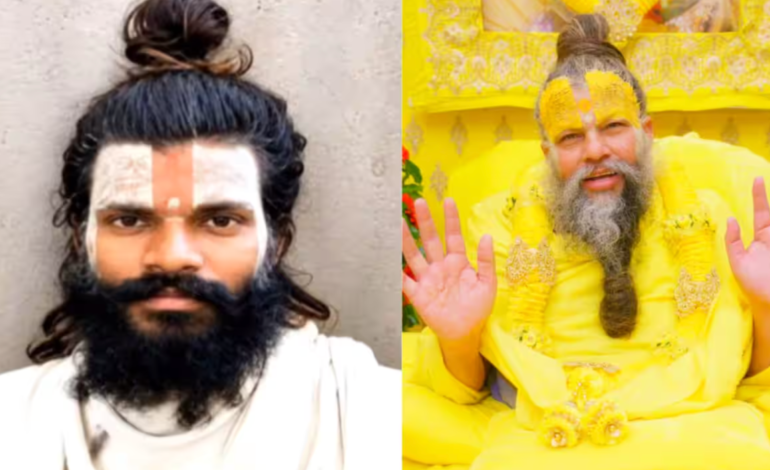
The death of Deepak Lodhi, also known as Rasik Dulari Sharan, 25, inside an ashram in Vrindavan demands precisely that scrutiny.
But scrutiny must not become speculation.
What We Know—and What We Do Not
According to reported police accounts, Deepak’s death is being treated as a suspected suicide. CCTV reportedly shows him leaving his room, reaching a terrace and subsequently falling.
That establishes a sequence—not why he acted or what preceded it.
Investigators have reportedly examined a grinder found in the room. Reports have also referred to a serious injury involving his private parts and deleted chats, photographs and videos from his phone.
These details may be relevant, but their meaning has not been publicly established.
Was the injury self-inflicted or accidental? What was the grinder used for? Can deleted material be recovered? Who was with Deepak before he left his room?
Those are matters for forensic and police inquiry.
If Deepak did take his own life, the investigation should not end with that conclusion.
What happened before he reached the terrace?
When “Suicide” Becomes the End of the Inquiry
Identifying the apparent final act is not necessarily the same as understanding the circumstances that led to it.
Investigators should establish the timeline, examine physical and forensic findings, reconstruct CCTV coverage and entries and exits, and determine what the digital record reveals.
The public does not need rumors.
It needs facts.
And Then There Is Premanand Maharaj
Swami Premanand Maharaj is widely revered and has been dealing with serious kidney disease requiring dialysis. To many devotees, he appears to be a deeply spiritual and noble soul continuing his work despite significant physical suffering.
That makes the machinery surrounding him worthy of examination.
Who controls access to the Saint? Who manages his public appearance and messaging?
Is that structure simply facilitating his spiritual mission, or could it have developed interests of its own?
I am not claiming that his life has been “hijacked,” nor that the institution is a cult. Such assertions would require further evidence.
But it is reasonable to examine whether spirituality has become intertwined with TRP, ratings, social-media buzz, influence and ultimately money.
Could an organization built around a revered and physically vulnerable leader become so powerful that the leader himself has limited control over every aspect of it?
That remains an open question.
When “No VIP Culture” Meets Personal Experience
I write this not only as a publisher, but as someone who personally experienced the system.
I once had an Ekantik appointment with Swami Premanand Maharaj. The circumstances surrounding that appointment deserve full disclosure. The token was obtained on my behalf through someone connected with the ashram, although this was outside the ashram’s published procedure. I acknowledge that without reservation.
What happened during the appointment, however, raises a separate and legitimate issue.
I was told that I would have approximately 15 minutes with Swami. After roughly five minutes, I was asked to leave because the time and space were needed to accommodate a VIP.
That is my firsthand account of what occurred.
Yet it is difficult not to notice the contrast with the publicly stated “no VIP culture.”
There is a meaningful distinction between saying:
“There is no paid VIP system.”
and saying:
“Everyone receives equal practical access.”
Those two propositions are not necessarily the same.
Because I have disclosed how my own token was obtained, I am not presenting myself as an ordinary devotee who followed the standard procedure. But that disclosure does not change what happened once I was inside the appointment.
Nor does my experience appear entirely isolated. Numerous viral reels and social-media posts have circulated accounts from devotees describing difficulties, shortened interactions or what they perceived as differential access to darshan and meetings with Maharaj. Such accounts are not, by themselves, verified evidence. Social media can amplify genuine experiences as well as incomplete, exaggerated or misleading narratives.
But when similar accounts repeatedly surface, a reasonable question follows: Are these isolated incidents, or do they indicate a broader pattern in how access is managed?
That is where transparency matters.
If the “no VIP culture” principle is consistently applied, the institution should be able to clearly explain how access is determined, how appointment time is allocated, and why circumstances may sometimes appear different for different devotees.
I am not alleging that my experience proves a systematic VIP policy. It does not. I am asking a simpler question—one that deserves a straightforward answer:
If there is no VIP culture, why did my allotted time appear to become negotiable when a VIP needed accommodation?
Spirituality by Algorithm
A pravachan becomes a Reel. A conversation becomes a Short. An emotional statement becomes a viral clip.
Followers become numbers. Numbers become influence.
Technology can carry spiritual teachings to millions. But algorithms reward attention—not necessarily context or truth.
A viral image is not accountability.
Deepak Must Not Become Another Viral Reel
A tragedy occurs. Outrage explodes. Videos circulate. Millions watch. Then attention moves elsewhere.
Deepak must not become another social-media spectacle.
His death requires something far less dramatic and far more important: a transparent, evidence-based investigation.
That means establishing the timeline, examining the physical evidence, determining the significance of the reported injury, examining the grinder, recovering digital material where possible and reconstructing the CCTV record.
None of this means accusing the ashram or any individual of causing Deepak’s death. There is no established basis in the information presented here for such a conclusion.
But unanswered matters should not be buried beneath a convenient narrative.
The Real Test of Spirituality
Faith should not require people to surrender their ability to question.
The larger issues remain:
Who decides access? Who controls the message? Who controls the cameras and social-media narrative? And when a revered spiritual leader is physically vulnerable, who is accountable for the machinery operating around him?
Deepak deserves more than speculation.
His family deserves more than a headline.
Devotees deserve more than carefully curated moments.
And the public deserves more than fragments of an unfolding investigation packaged for digital consumption.
Deepak’s final moments should not become another viral Reel.
They should become the beginning of a search for the truth.