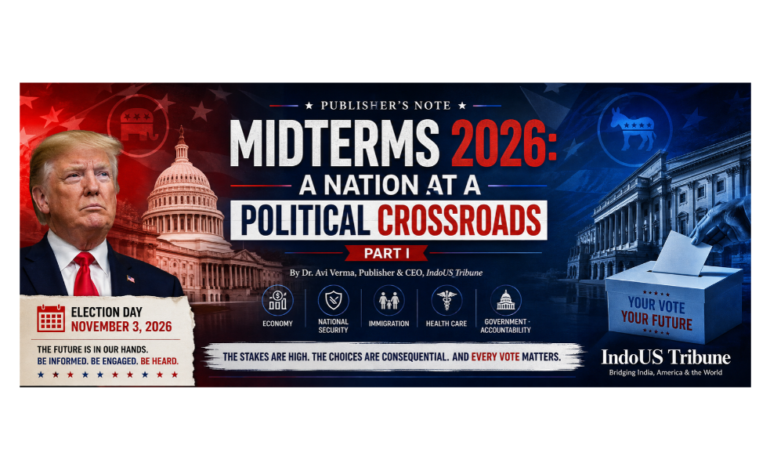
Midterms 2026: A Nation at a Political Crossroads — Part I

By: Dr. Avi Verma, Publisher & CEO, IndoUS Tribune
America is approaching a pivotal political moment. On November 3, 2026, voters will decide who controls the House of Representatives and the Senate for the final two years of President Donald Trump’s second term. The outcome will shape not only the administration’s domestic agenda but also America’s economic direction, foreign policy and standing in the world.
At IndoUS Tribune, we believe these elections deserve more than campaign slogans, partisan accusations and daily polling headlines. They demand thoughtful analysis of the issues that matter to ordinary Americans and the choices that will influence the nation’s future. This is the first installment of our continuing coverage of the 2026 midterms. In the coming weeks, we will examine the candidates, the competitive races, the issues driving voters and the possible consequences of a change in congressional power.
The Battle for Congress
Republicans enter the election cycle defending narrow majorities in both chambers of Congress. Democrats need only a small net gain to take control of the House, making it their clearest opportunity to challenge the Republican agenda. Current forecasts and political betting markets have generally favored a Democratic House victory, although predictions are not results, and individual races can still change the national picture.
The Senate presents a more complicated contest. Democrats must overcome a difficult electoral map and secure enough seats to take the majority. Several races that once appeared relatively safe for Republicans are receiving increased attention, while contests in states such as North Carolina, Maine, Ohio, Iowa and Michigan could prove decisive. The eventual outcome will depend on candidates, turnout, local concerns and how voters judge the administration’s record.
The central question is whether Republicans can retain control of Congress or whether voters will create a divided government for the remainder of Trump’s presidency.
A Referendum on Trump’s Presidency?
Midterm elections traditionally serve as a report card on the party occupying the White House. The president’s party has historically lost congressional seats in most first-term midterms, although the scale of those losses varies. President Trump now faces this familiar political challenge alongside a deeply polarized electorate.
Economic concerns could be particularly important. Families continue to pay close attention to the cost of groceries, housing, health care, transportation and other essentials. For many voters, political promises matter less than whether their paychecks stretch far enough to meet household expenses.
The administration’s economic policies will therefore face close scrutiny. Supporters will point to its priorities on taxation, border security, energy and economic growth. Critics will ask whether those policies are improving everyday life, protecting household purchasing power and creating greater economic security.
Neither party should assume that public dissatisfaction automatically translates into votes for its candidates. Voters may be unhappy with the administration without being fully convinced by the opposition. The party that offers credible answers, demonstrates competence and connects its proposals to people’s daily lives may gain an advantage.
Foreign Policy Has Domestic Consequences
International developments also carry political consequences at home. The continuing conflict involving Iran, along with its implications for energy markets and regional stability, has added another dimension to the election debate. Any sustained disruption to global oil supplies can affect fuel costs, transportation and the broader economy.
For a country whose interests extend across the globe, foreign policy cannot be separated from domestic well-being. Americans have a legitimate interest in understanding the objectives, costs and potential consequences of military involvement overseas. They also deserve clear explanations of how international developments may affect national security and household budgets.
Immigration, border enforcement, federal spending, health care and the future of democratic institutions are likely to remain central issues. Their relative importance, however, will differ across states and congressional districts.
What Is at Stake?
A Democratic victory in either chamber would significantly change the political environment in Washington. Control of the House would give Democrats greater authority over committees, investigations and legislative priorities. A Democratic Senate could complicate the confirmation of presidential nominees, including federal judges. Divided government would likely make major legislation more difficult, although it would not bring the government to a complete standstill.
Such a result could usher in two years of intensified oversight and legislative confrontation. Depending on the circumstances, it could also reopen debates over administration policies and accountability. But predictions of paralysis or sweeping political action should be treated cautiously; the actual consequences would depend on the election results and the decisions lawmakers make afterward.
Ultimately, congressional elections are not simply a contest between Democrats and Republicans. They are an opportunity for citizens to evaluate performance, question promises and express their priorities through the ballot box.
At IndoUS Tribune, our responsibility is to help readers understand these choices without partisan blinders. As Indian Americans and members of a diverse American society, we have a particular interest in policies affecting the economy, immigration, education, health care, international relations and the future opportunities available to our children and grandchildren.
This is only the beginning of our midterm series. Next week, we will take a closer look at the key Senate contests, the House districts most likely to determine control of Congress and the candidates competing for the support of an increasingly divided electorate.
The polls may offer clues, but the final verdict belongs to the voters. Between now and November 3, we will follow the issues, examine the evidence and separate political rhetoric from reality.
The stakes are high. The choices are consequential. And every vote matters.