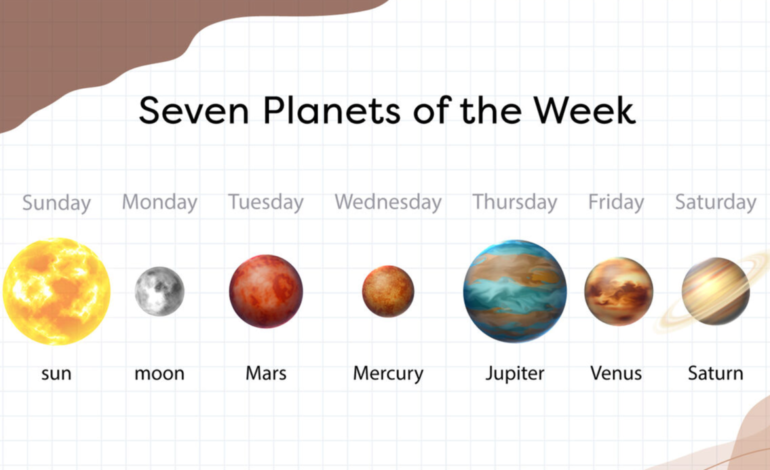
The Seven Days of the Week and Their Ruling Planets

Which Deity to Worship on Each Day and What Good Habit to Practice
By: Rajendra Kapil
In Indian culture, the seven days of the week are considered more than just dates on a calendar. Each day is traditionally associated with a particular planet, and over time, customs involving the worship of deities, chanting of mantras, charitable giving, service, and self-discipline have developed around these associations.
From Sunday to Saturday, the seven days are associated, respectively, with the Sun, Moon, Mars, Mercury, Jupiter, Venus, and Saturn. In Indian astrology and the traditional Panchang calendar, these are regarded as the planetary rulers of the seven days. The Navagraha tradition also includes Rahu and Ketu, but neither governs a separate day of the week.
One of the most meaningful aspects of these traditions is the emphasis they place on different qualities for a balanced life: confidence through the Sun, mental peace through the Moon, courage through Mars, intelligence through Mercury, wisdom through Jupiter, love through Venus, and responsibility and discipline through Saturn.
The practices described below are based on religious traditions and cultural beliefs. They may be understood as expressions of faith and as reminders to cultivate a positive lifestyle. For medical conditions, financial difficulties, legal matters, or other serious concerns, appropriate professional advice remains essential.
Sunday — Lord Surya (The Sun God)
Energy, Health, and Confidence
Sunday is traditionally dedicated to Lord Surya, the Sun God. In Indian tradition, the Sun symbolizes life, energy, inner strength, and light. Astrologically, it is associated with leadership, self-confidence, reputation, and the father.
Offering water to the rising Sun, chanting “Om Suryaya Namah,” and practicing Surya Namaskar or other forms of exercise are common traditions. Respecting parents and elders and helping those in need are also meaningful ways to reflect the positive message of this day.
Sunday’s Message: Begin your day with energy, discipline, and confidence.
Monday — The Moon and Lord Shiva
Mental Peace and Emotional Balance
Monday is associated with the Moon, which traditionally represents the mind, emotions, and sensitivity. Since Lord Shiva is depicted with the Moon adorning his head, worshipping Shiva on Monday is an important religious tradition.
Devotees chant “Om Namah Shivaya” and offer water to the Shiva Lingam. Meditation, prayer, peaceful communication with family members, and avoiding unnecessary arguments are also positive habits to cultivate.
Monday’s Message: A calm mind helps us make better decisions.
Tuesday — Mars and Lord Hanuman
Courage and Self-Control
Tuesday is associated with Mars, traditionally regarded as a symbol of energy, strength, courage, and determination. Lord Hanuman represents physical and mental strength, wisdom, devotion, and the ability to face adversity.
Reading the Hanuman Chalisa, helping those in need, and learning to control anger are important life lessons associated with this day. Those who observe a religious fast should take their individual health needs into consideration.
Tuesday’s Message: True strength lies not in controlling others, but in mastering our own anger and ego.
Wednesday — Mercury and Lord Vishnu
Intelligence, Communication, and Good Judgment
Wednesday is governed by Mercury, which is traditionally associated with intelligence, speech, writing, business, and communication. Many families worship Lord Vishnu or Lord Krishna on this day.
Chanting “Om Namo Bhagavate Vasudevaya,” helping students, donating books, and caring for plants are activities that reflect the positive values associated with Wednesday. Avoiding lies, rumors, and harsh speech is equally important.
Wednesday’s Message: Intelligence reveals its true value through sound decisions and kind communication.
Thursday — Jupiter and the Guru
Knowledge, Education, and Moral Values
Thursday is associated with Brihaspati, the Guru of the Devas, or divine teacher. In astrological tradition, Jupiter represents knowledge, education, religion, wisdom, and the guiding role of a teacher.
Worshipping Lord Vishnu, respecting teachers and parents, supporting students, and donating yellow-colored items are among the traditional practices associated with this day. More importantly, knowledge should be used for the benefit of others.
Thursday’s Message: Knowledge becomes meaningful when accompanied by humility and good character.
Friday — Venus and the Divine Feminine
Love, Family, and Prosperity
Friday is associated with Venus, traditionally regarded as a symbol of love, beauty, art, music, marital harmony, and material comforts. Worshipping Goddess Lakshmi, Goddess Durga, and other forms of the Divine Mother is common on this day.
Keeping the home and prayer area clean, lighting a lamp, donating food or clothing to those in need, and maintaining loving communication within the family are positive practices. Respecting women’s dignity, safety, and equality is a social and moral responsibility that goes beyond any religious ritual.
Friday’s Message: True prosperity is not measured by wealth alone, but also by love, contentment, and healthy relationships.
Saturday — Lord Shani (Saturn)
Karma, Discipline, and Justice
Saturday is traditionally dedicated to Lord Shani, who is associated with karma, patience, discipline, responsibility, and justice. In many traditions, devotees worship Lord Hanuman alongside Shani Dev.
Helping those in need, respecting hardworking people, paying employees fair wages, being punctual, and avoiding injustice are practical ways to put the values associated with Saturn into action.
Saturday’s Message: The lesson of Shani is not fear, but responsibility and honest work.
Is It Necessary to Fast Every Day?
Absolutely not. Fasting is a matter of personal faith and commitment. There is no requirement to observe a fast on all seven days of the week.
Children, older adults, pregnant women, and people with medical conditions should exercise caution before undertaking strict fasts. Anyone considering prolonged fasting, particularly abstaining from both food and water, should seek medical advice when appropriate.
Similarly, expensive gemstones, elaborate worship ceremonies, or costly rituals are not necessary simply in the name of appeasing the planets.
The Greatest Remedy Is Good Karma
When we look at the traditions associated with the seven days in simple terms, we find important values for everyday life:
- Sunday: Energy and self-confidence
- Monday: Mental peace and emotional balance
- Tuesday: Courage and self-control
- Wednesday: Intelligence and kind communication
- Thursday: Knowledge and morality
- Friday: Love, family, and prosperity
- Saturday: Responsibility, discipline, and justice
Making the planets favorable, therefore, need not mean relying only on worship and rituals. Respecting parents, helping those in need, honoring women’s dignity, working honestly, paying workers fairly, protecting nature, and controlling our anger are all ways to put into practice the values associated with these seven days.
Faith can give the mind strength, but good deeds give life direction. This is the simplest and most practical message of the Indian traditions associated with the seven days of the week and their ruling planets.