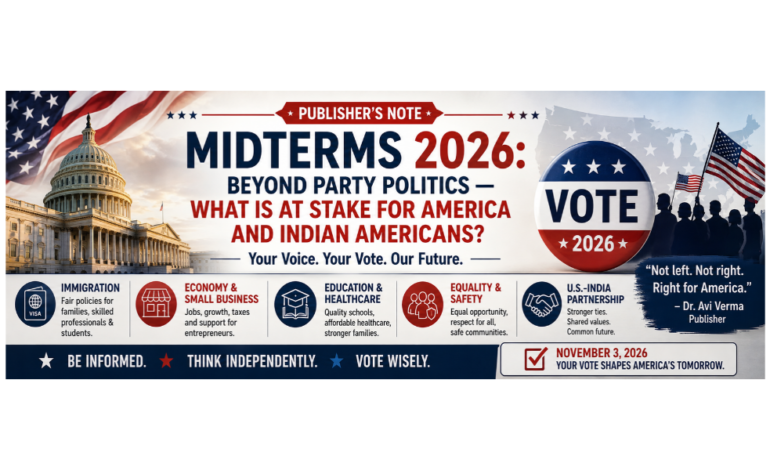
Midterms 2026: Beyond Party Politics — What Is at Stake for America and Indian Americans?

By: Dr. Avi Verma
On November 3, 2026, Americans will vote in midterm elections that could reshape the balance of power in Washington. Although President Donald Trump is not on the ballot, his policies, leadership and political future will be central to the outcome. For Indian Americans, these elections are more than a contest between Republicans and Democrats. They are an opportunity to assess which candidates and policies best serve our families, businesses, communities and the broader interests of the United States.
In the first two parts of this series, we examined the political landscape and the stakes for Congress. In this concluding note, I want to look beyond party slogans and consider what the results could mean for the country—and for our community.
Who Has the Advantage?
The battle for the House of Representatives appears more favorable to Democrats, who need a net gain of only a few seats to take control. Midterm elections often work against the party occupying the White House, particularly when voters are dissatisfied with the economy, the president’s performance or the direction of national policy.
The Senate presents a more difficult challenge for Democrats. Its electoral map, the states where seats are contested and the political composition of those states make a Democratic takeover less certain. Republicans therefore have a more realistic path to retaining the Senate than the House, although individual races could change the picture.
These are assessments, not predictions. Campaigns, turnout, candidate quality and events in the final weeks can alter the outcome. The most important question is whether voters choose divided government, continued Republican control or a Democratic Congress prepared to challenge the administration.
What If Democrats Win Both Chambers?
If Democrats gain control of both the House and Senate, President Trump would face a significantly more difficult final two years of his term. Congressional investigations would likely intensify, and the administration would face greater scrutiny over its policies, spending decisions and executive actions.
Democrats could block or reshape legislation, influence federal spending and use congressional hearings to hold the administration accountable. Major Republican legislative initiatives would encounter stronger resistance. However, a Democratic majority would not automatically reverse every Trump policy. Presidential authority, existing laws, court decisions and the need for sufficient votes would continue to matter.
A divided government can create checks and balances, but it can also produce gridlock. The responsibility would rest with both parties to determine whether oversight serves the public interest or becomes a substitute for governing.
I believe accountability is essential in a democracy. No president, regardless of party, should be beyond scrutiny. Equally, congressional opposition should offer solutions, not simply seek political advantage.
Why Indian Americans Should Pay Attention
For Indian Americans, the consequences are practical and personal.
Immigration and skilled professionals: Visa policies, employment-based immigration, family reunification and the treatment of international students affect thousands of Indian-American families and professionals. Changes in immigration enforcement and legal pathways deserve careful attention. Our community should support a system that respects the law while recognizing the contributions of skilled workers, entrepreneurs and families who help build this country.
Small businesses and the economy: Indian Americans own and operate businesses across healthcare, technology, hospitality, retail, transportation and professional services. Tax policy, inflation, interest rates, labor costs and access to capital influence whether these businesses can grow and create jobs. Candidates should be judged by the likely effects of their economic proposals, not merely by campaign promises.
Education and healthcare: Many families are concerned about education costs, school quality, university opportunities and access to affordable healthcare. These are not abstract political debates. They affect household budgets, the future of our children and the well-being of older family members.
Equal opportunity and public safety: Indian Americans should expect fair treatment, protection against discrimination and safe communities. We should also reject prejudice against any group. A strong America is one in which people can contribute, worship, work and raise their families without fear or unequal treatment.
The U.S.-India Relationship
The relationship between the United States and India is another important consideration. Cooperation in trade, technology, defense, education and regional security benefits both countries. At the same time, differences over tariffs, immigration and trade policy can create friction.
A change in congressional control could influence the tone and direction of U.S. policy, but it would not automatically transform the bilateral relationship. Congress, the administration, business interests and strategic realities all play a role.
Indian Americans can contribute by encouraging informed dialogue and supporting a relationship grounded in mutual respect and shared interests. Our responsibility is not to endorse every policy of either government, but to advocate for constructive engagement between the world’s two major democracies.
Our Community Must Think Independently
As publisher of IndoUS Tribune, I believe our community deserves political analysis that goes beyond party loyalty. Indian Americans are not a single voting bloc. Our views differ by generation, profession, personal experience and political philosophy. That diversity is a strength.
Republicans should be held accountable when their policies harm our interests, just as Democrats should be challenged when their promises fall short. We should examine candidates’ records, verify their claims and ask how their decisions will affect our families and the nation.
The November election is not a referendum on one individual alone. It is a test of public confidence in the direction of the country and of Congress’s ability to represent its citizens.
The Final Word
Whether Republicans retain control or Democrats take one or both chambers, the result should remind elected officials that public office is a responsibility, not a personal entitlement.
For President Trump, a Democratic victory in both chambers would mean stronger congressional resistance and more intensive oversight. For Democrats, winning control would bring its own test: whether they can translate opposition into credible policies and responsible governance.
For Indian Americans, the task is to remain engaged, informed and independent. We should vote on issues, character, performance and principles—not on pressure to follow a party.
Our community should not be anyone’s guaranteed vote, and our democracy should not be anyone’s permanent possession. The real winner of the 2026 midterms should be the American people.