Personal finance insights: News & Features

By: Dr K C Gupta
CONTRARIAN INDICATORS
AAII Bull-Bear Spread +21.3% (above average)
CNN Fear & Greed Index 62 (greed)
NYSE %Above 50-dMA 76.08% (overbought)
SP500 %Above 50-dMA 72.00% (overbought)
ICI Fund Allocations (Cumulative), 11/30/25
OEFs & ETFs: Stocks 61.55%, Hybrids 4.05%, Bonds 17.36%, M-Mkt 17.04%
INTEREST RATES
CME FedWatch
Cycle peak 5.25-5.50%
Current 3.50-3.75%
FOMC 1/28/26+ hold
FOMC 3/18/26+ hold
Treasury
T-Bills 3-mo yield 3.67%, 1-yr 3.55%; T-Notes 2-yr 3.59%, 5-yr 3.82%, 10-yr 4.24%; T-Bonds 30-yr 4.83%;
TIPS/Real yields 5-yr 1.43%, 10-yr 1.91%, 30-yr 2.58%
FRNs Index 3.602%
Bank Rates
www.depositaccounts.com/
Stable-Value (SV) Rates, 1/1/26
TIAA Traditional Annuity (Accumulation) Rates
Restricted RC 5.00%, RA 4.75%
Flexible RCP 4.25%, SRA 4.00%, IRA-101110+ 3.50%
TSP G Fund 4.250% (previous 4.125%)
India Fear & Greed MMI 22.89 (extreme fear)
Weekly ETFs: INDA -0.61%, INDY -0.71%, EPI -0.29%, INDH -0.26%, SPY -0.35%
The data above are as of Sunday preceding the publication date.
ECONOMY
Indian economy is growing rapidly at 6-8% (real) annually & is #4 by GDP now: #1-US, #2-China, #3-Germany, #4-India, #5-Japan. But India has low GDP per capita.
US remittance tax of 1% for “physical” money transfers via cash, cashier’s checks or money orders by noncitizens is effective in 2026. It won’t apply to “electronic/online” transfers via bank accounts, credit/debit cards, Apple Pay, Google Pay, etc. The remittance services are responsible for collecting this tax, if applicable, so ask them if in doubt.
Nonbank financials are growing in India, as elsewhere globally. The nonbank financial credit was 33% of the total credit in 2025. This global development has been in response to tighter regulations of banking post-GFC. But as banks have withdrawn from lending in certain risky areas, nonbank financials have filled in the vacuum.
FUNDS
Indian ETFs are growing rapidly. Their AUM doubled in 3 years, 10/2022 – 10/2025 & their trading volumes have risen faster. Most of the ETF AUM is in equities, some in fixed-income & 15% in gold & silver. Be careful with foreign ETFs that trade at premiums because of national restrictions on how much foreign stocks Indians can own; this premium would disappear on the day that limit is increased.
SPECIAL TOPICS
INDIAN STOCKS – DOMESIC & FOREIGN VIEWS
How is the Indian stock market doing?
It depends on who you ask.
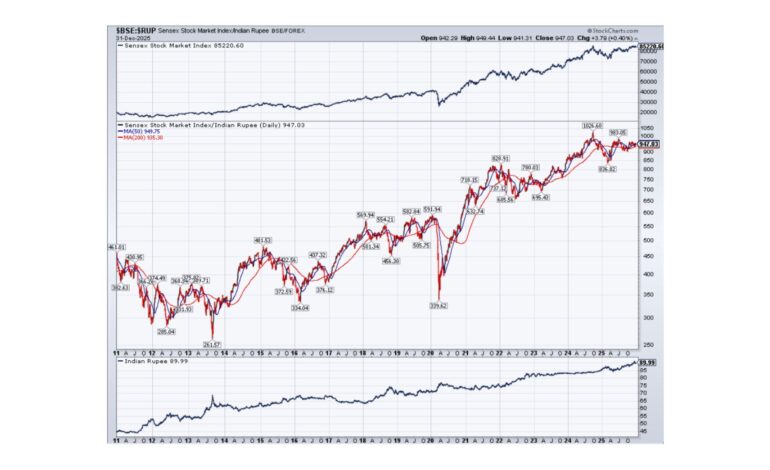
From the US charting software StockCharts, a chart with 3 panels is shown nearby for 12/31/10 – 12/31/25.
Link https://schrts.co/cHPVPjhQ
The top panel is the BSE Sensex Index in rupees as seen by investors in India ($BSE in StockCharts). This is the nominal or default view.
In the middle panel is the BSE index as seen by US investors ($BSE:$RUP in StockCharts). It’s the BSE index in rupees divided by the conversion rate for $1 to rupees; 50-dMA & 200-dMA are also shown. By changing the conversion to other currencies, e.g. euro, UK pound, Japanese yen, etc, similar charts as seen by investors in other countries can be obtained – limited space here doesn’t permit presentation of those.
The bottom panel is the rupee exchange rate for $1. A rising chart means falling rupee – as there are more rupees for $1.
Because Indian rupee is depreciating rapidly, the Indian (nominal) and US views of the Indian stock market are quite different. The nominal market reached new all-time highs in 12/2025 & that made Indian investors very happy, but for the US investors, the all-time high was in 09/2024. The experience has been similar for investors from other countries. While 2024 was a good year for both Indian & foreign investors, the rally in 2025 was only for the Indian investors, not the foreign investors.
A conundrum expressed in Indian media is why the rallying Indian stock market doesn’t attract large foreign fund flows? Falling rupee is the answer. Nonetheless, many US (& global) financial firms have entered the Indian market to serve its growing investing class. These firms’ businesses are asset-fee-based, so, good fund performance will attract more AUM (assets under management). They also hope that soon, more Indian investment funds will shift from bank accounts, gold & real estate into stocks & bonds – as has been the trend elsewhere. Indian Government has also relaxed the rules on foreign ownerships of Indian financials.
There are several India ETFs in the US, but only the newer & tiny INDH (05/2024- ; ER 0.63%) hedges rupee. It has large-cap-growth orientation with 49% in top 10 holdings & is nondiversified. Top sectors are financials, consumer cyclicals, energy, technology. The other India ETFs in US include INDA, INDY, EPI, etc.
For more information, see https://ybbpersonalfinance.proboards.com/