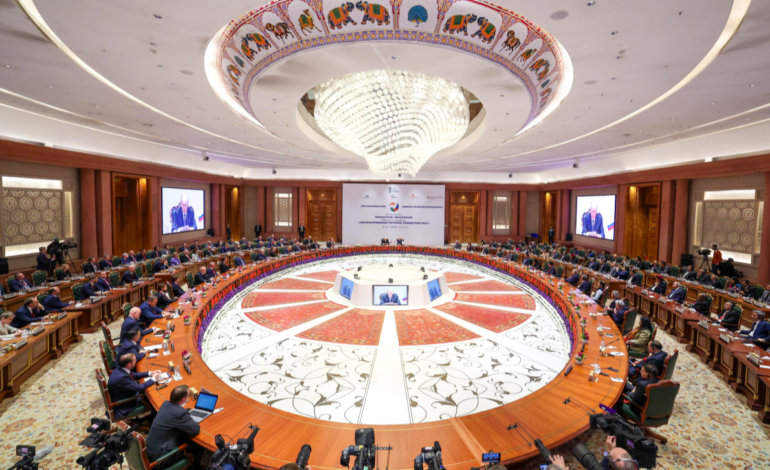
India–Russia business talks emerge as pillar of strategic partnership

High-level business discussions between India and Russia in Moscow last week are being viewed as a crucial step toward sustaining and deepening bilateral ties at a time of heightened geopolitical volatility and economic uncertainty.
The dialogue, which brought together corporate leaders and government officials from both sides, is widely seen as a follow-up to the December summit between Prime Minister Narendra Modi and Russian President Vladimir Putin in New Delhi. That meeting set the political groundwork for closer economic engagement, reaffirming that strategic cooperation between the two nations extends well beyond traditional defence ties.
Analysts say the Moscow talks reflect a shared determination to keep the partnership stable despite external pressures. For Russia, closer engagement with India has become increasingly important as it faces Western sanctions and diplomatic isolation. New Delhi, meanwhile, views Moscow as a long-standing partner that can help diversify its energy sources, technological collaboration, and global influence.
A central focus of the meeting was expanding bilateral investment, strengthening financial mechanisms for trade, and advancing joint industrial and infrastructure projects. Officials also explored alternative payment systems to facilitate transactions amid restrictions on Russian banking channels.
India’s large and growing economy has emerged as a key market for Russian crude oil, making New Delhi an essential trade partner for Moscow. At the same time, India has faced warnings from Western nations over continued energy purchases from Russia, including the threat of punitive tariffs. Despite this, New Delhi has maintained that its energy decisions are guided by national interest and affordability for its citizens.
Experts note that India is attempting a delicate balancing act—strengthening ties with Russia while simultaneously deepening economic integration with the United States and the European Union. The West remains India’s largest source of investment, advanced technology, and critical supply chains, making it impossible for New Delhi to pivot entirely away from these partners.
However, India’s growing role in global manufacturing and technology has positioned it as a strategic alternative to China in Western supply chains. Multinational companies are increasingly looking at India as a future production hub, benefiting from its young workforce, expanding infrastructure, and democratic governance.
This dynamic places India in a unique geopolitical position: it must nurture its partnership with Russia without triggering sanctions that could disrupt trade and foreign direct investment at a time when the country is on track to become the world’s third-largest economy.
The India–Russia business dialogue also highlighted cooperation in areas such as energy, fertilizers, mining, digital payments, and industrial manufacturing. Both sides emphasized that their relationship is rooted in mutual respect, shared strategic interests, and decades of diplomatic cooperation.
Officials from both countries indicated that such business forums will become more frequent, ensuring that economic ties keep pace with political engagement. There is also growing interest in expanding collaboration in emerging sectors such as green energy, Arctic shipping routes, and advanced research.
As global power shifts continue, India–Russia economic cooperation is likely to remain a defining feature of both nations’ foreign policy strategies. While challenges persist, the latest business talks signal that the partnership is not only enduring but evolving to meet new global realities.