US warns Europe over ‘mother of all trade deals’ with India as India-EU FTA set for announcement

As India and the European Union prepare to formally announce the conclusion of their long-pending free trade agreement (FTA) on Tuesday, the United States has issued a sharp warning, claiming that Europe is indirectly financing the Russia-Ukraine war by deepening trade ties with India.
US Treasury Secretary Scott Bessent criticised European nations for what he described as a contradiction in their approach to Russia. While Europe has significantly reduced direct energy imports from Moscow, Bessent argued that it continues to benefit from Russian oil indirectly by purchasing refined petroleum products from India, which sources discounted crude from Russia.
Speaking to ABC News, Bessent said the Trump administration believes Europe is “financing a war against itself” by signing what European Commission President Ursula von der Leyen has called the “mother of all trade deals” with India. His remarks came just days after Washington imposed steep tariffs on Indian goods, citing New Delhi’s continued purchase of Russian oil.
“We have put 25 per cent tariffs on India for buying Russian oil. Guess what happened last week? The Europeans signed a trade deal with India,” Bessent said. “The Russian oil goes into India, the refined products come out, and the Europeans buy the refined products. They are financing the war against themselves.”
The Trump administration has levied tariffs of up to 50 per cent on Indian exports, including a specific 25 per cent penalty linked to India’s energy trade with Russia. Bessent framed the issue as an imbalance in burden-sharing, arguing that the United States has made far greater economic and strategic sacrifices than its European allies in efforts to weaken Moscow’s war machine.
He claimed that President Donald Trump has worked consistently toward negotiating a settlement to the Russia-Ukraine conflict and reiterated that Washington has taken tougher steps to disrupt Russia’s energy revenues than Europe. Under Trump’s leadership, Bessent said, the US remains committed to eventually ending the war through pressure and diplomacy.
Despite the US criticism, India and the European Union are moving ahead with their landmark trade agreement, which has been under negotiation since 2007. The deal is expected to significantly boost bilateral trade, investment, and supply-chain cooperation at a time when global commerce is facing major disruptions due to rising protectionism and US-led tariffs.
The India-EU FTA aims to reduce or eliminate tariffs across a wide range of goods and services, improve market access, and strengthen cooperation in areas such as green technologies, digital trade, and mobility of professionals. The European Union is one of India’s largest trading partners, accounting for nearly 17 per cent of India’s total exports.
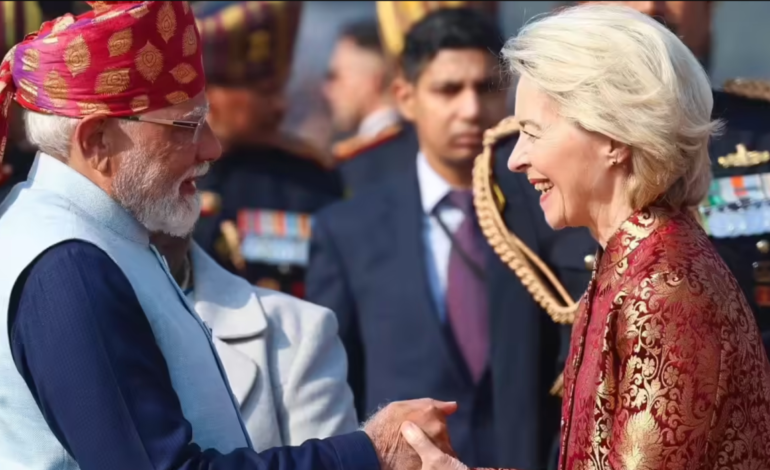
European Commission President Ursula von der Leyen, currently on a visit to India and the chief guest at the 77th Republic Day celebrations in New Delhi, has described the agreement as the most ambitious trade pact ever negotiated by the EU with a single country. She has repeatedly emphasised India’s growing strategic and economic importance in a rapidly shifting global order.
Indian officials, meanwhile, see the deal as a major vote of confidence in India’s economy and its role as a reliable global partner. The agreement is expected to create new opportunities for Indian exporters, generate jobs, and help integrate India more deeply into European value chains.
As geopolitical tensions reshape global trade and energy flows, the India-EU trade pact underscores New Delhi’s rising centrality in international economic diplomacy—while also highlighting the growing divergence between US and European approaches to trade, energy security, and the Russia-Ukraine conflict.