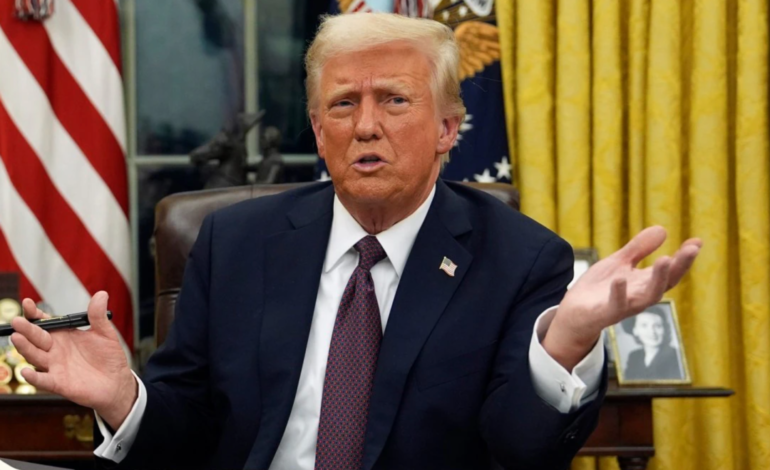
Analysis: America first, India alert: Reading the signals in Trump’s national address

By: Dr. Avi Verma
When Donald Trump delivered his State of the Union–style address, the messaging was
unmistakably domestic: affordability, border enforcement, anti-fraud crackdowns, and
declarations of economic strength. The speech was calibrated for American voters
navigating inflation anxieties, housing pressures, and political polarization.
But for India, such speeches are never merely domestic theater.
Washington’s internal priorities often radiate outward, shaping immigration frameworks,
trade rules, regulatory climates, and strategic postures that directly affect New Delhi. As
India’s partnership with the United States deepens across technology, defense, supply
chains, and the Indo-Pacific, the subtext of American political messaging matters as
much as the headline rhetoric.
Immigration: The Talent Question
Trump’s forceful language on border security primarily targets illegal immigration. Yet
history shows that restrictive atmospherics rarely remain neatly compartmentalized.
Broader visa regimes, processing timelines, and compliance scrutiny often tighten in
parallel.
For India, this is not a peripheral issue.
Indian professionals constitute one of the largest high-skilled immigrant communities in
the United States. From Silicon Valley engineers and AI researchers to physicians and
financial analysts, Indian talent is deeply embedded in America’s innovation economy.
Work visa uncertainty reverberates through India’s IT services sector, startup
ecosystem, healthcare networks, and even remittance flows that support millions of
families.
The economic logic of high-skilled migration remains strong for the U.S. economy.
However, immigration debates shaped by political pressures can produce regulatory
friction—even when policies do not formally target skilled workers.
For India, talent mobility is strategic capital. Any disruption is consequential.
Economic Messaging and Trade Undercurrents
Trump’s assertion of a “roaring economy” arrives amid mixed indicators—equity market
resilience alongside voter unease over affordability. For India, the state of the U.S.
economy is not abstract; it is a growth variable.
The United States is India’s largest trading partner. American consumer demand fuels
Indian exports in pharmaceuticals, textiles, engineering goods, and digital services. A
confident U.S. consumer translates into stronger Indian balance sheets.
Yet political emphasis on affordability often brings renewed scrutiny of trade deficits and
outsourcing narratives. If domestic pressures intensify, protectionist instincts could
resurface. India–U.S. trade relations have weathered tariff tensions before; vigilance
remains prudent.
Strong growth in the U.S. benefits India. Economic nationalism, however, complicates
the equation.
Housing Signals and Capital Flows
Trump’s reference to limiting institutional purchases of residential housing may appear
purely domestic. But it signals broader political discomfort with large-scale capital
concentration and affordability distortions.
Globally, this matters.
Real estate markets are increasingly interconnected. Regulatory shifts in the U.S.
influence investor behavior, including Indian diaspora investments in high-demand
urban centers. If scrutiny of institutional capital deepens, ripple effects could reshape
cross-border investment strategies.
The housing debate is about voters—but the capital implications are global.
Fiscal Discipline and Anti-Fraud Narratives
The announcement positioning JD Vance at the forefront of an anti-fraud push
reinforces a broader political narrative around fiscal discipline and government
accountability. While claims that fraud recovery alone could rebalance federal finances
remain contested by economists, stronger oversight frameworks can influence
international compliance standards.
India, having advanced significant digital governance and financial transparency
reforms in recent years, stands to benefit from greater global alignment on anti-
corruption enforcement and financial tracking.
Transparency, once domestic policy, increasingly shapes cross-border financial
credibility.
Strategic Alignment in a Security-Focused America
If there is an area of durable convergence, it lies in security.
Trump’s emphasis on sovereignty, national strength, and strategic deterrence intersects
with India’s own priorities in maritime security, counterterrorism cooperation, and Indo-
Pacific stability. Over the past decade, India–U.S. defense cooperation has expanded
dramatically—from joint military exercises to defense technology initiatives and supply
chain resilience efforts.
A United States focused on hard power and strategic balancing often aligns with India’s
interest in maintaining equilibrium in the Indo-Pacific.
Security continuity is one of the more stable pillars of the partnership.
Polarization and Policy Predictability
Perhaps the most consequential takeaway from the address is not any single policy
proposal, but the visible partisan divide surrounding it.
For global partners like India, American polarization introduces a structural challenge:
policy continuity. Immigration frameworks, trade priorities, environmental standards, and
technology regulations can shift with electoral cycles.
India’s diplomatic approach has historically emphasized bipartisan engagement in
Washington. That strategy becomes even more critical when domestic American politics
appear sharply divided.
Strategic partnerships require insulation from electoral volatility.
The Broader Equation
Trump’s speech underscores several trends India must monitor closely:
The tone and trajectory of immigration enforcement.
Trade signals embedded in affordability politics.
Regulatory cues affecting global capital.
Security doctrine shaping Indo-Pacific strategy.
Domestic polarization influencing policy stability.
India’s rise means its partnership with the United States is no longer secondary—it is
central to the architecture of global growth and security.
As Washington debates borders and budgets, India must respond not with reaction, but
with calibrated strategy. Engagement must remain steady, bipartisan, and rooted in
long-term interests.
American politics will evolve. India’s strategic calculus must remain anchored in
foresight, flexibility, and confidence.
The message from Washington is clear: domestic debates shape global realities. The
responsibility in New Delhi is equally clear—anticipate, adapt, and engage from a
position of strength.