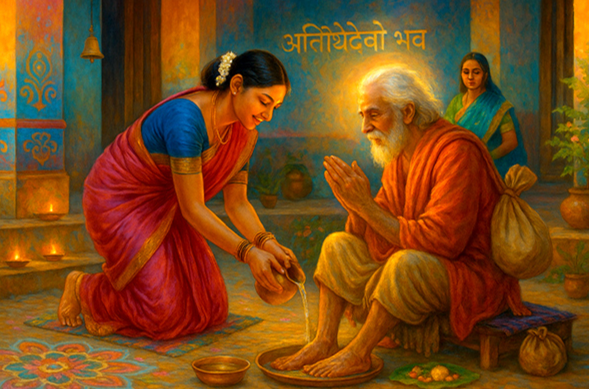
‘Atithidevo Bhava’ The simple meaning of the guest-ethic in Indian culture

The famous Upanishadic dictum “Atithidevo Bhava” teaches us that a guest is to be regarded as God. Serving a guest is considered equivalent to worshipping the Divine. According to Sage Suta, there is no duty greater than hospitality and no deity greater than a guest. Whoever comes to the doorstep of our home should be welcomed, to the best of one’s ability and circumstances—not merely as a social obligation, but as a sacred religious duty.
In Indian culture, the service of a guest is called Atithi Yajna (the sacrificial offering to a guest). It is regarded as an essential part of a householder’s daily life and is included among the Pancha Maha Yajnas (the five great daily duties). While honoring a guest, one should not consider their caste, stage of life, age, or status. A guest should be seen as a manifestation of God. Very few cultures in the world demonstrate such a high level of reverence and sanctity toward guests.
According to Maharshi Shatatapa (Laghu Shatatapa, verse 55), a true guest is one who arrives uninvited, without self-interest, at any time and from any place. A person whose arrival is pre-announced is not considered a true atithi. In the Mahabharata, the noble Vidura advises King Dhritarashtra that when a virtuous guest arrives, one should first offer them a seat, bring water to wash their feet, inquire about their well-being, and then provide food as needed.
The Vedas declare that one who honors a guest is freed from sins (Atharva Veda 9.7.8). Welcoming a guest at one’s doorstep is considered equivalent to offering oblations to the gods. According to the Mahabharata, those who provide a guest with water, oil, a lamp, food, and shelter never go to Yamaloka (the realm of death).
The scriptures further explain that by offering a seat to a guest, Brahma is pleased; by washing their hands, Shiva; by washing their feet, Indra and other deities; and by feeding them, Lord Vishnu Himself. Thus, a guest represents the combined form of all the gods. The Manusmriti states that a householder should offer the same food to a guest that they consume themselves. Hospitality brings an increase in good fortune, fame, longevity, and happiness.
The Mahabharata and Ramayana provide many inspiring examples of Atithi Dharma: King Shibi offering his own flesh to protect a dove, the sacrifice of Moradhwaja, Mother Kunti sending Bhima to protect a Brahmin, and offering one’s own meal to a starving outcaste during times of famine. The Taittiriya Upanishad even describes hospitality as a sacred vow.
In the Shanti Parva of the Mahabharata, a warning is given that if a guest leaves a home hungry and disappointed, the merit of that household is destroyed and the householder suffers. The guest takes away his merit and leaves his sins behind in that home.
The Atharva Veda clearly states that one should not eat before serving a guest, as the guest is learned in the Vedas and worthy of worship. Therefore, it is the duty of all of us to uphold Atithi Dharma and keep alive this महान (great) tradition of Indian culture.