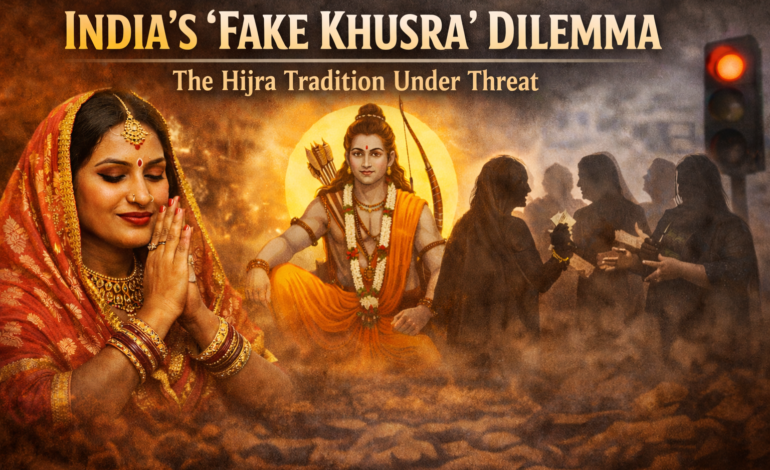
The shadow of a sacred tradition: India’s ‘fake khusra’ dilemma

By: Dr. Avi Verma
The Hijra tradition is being hijacked — and India must act now
India has long taken pride in preserving ancient traditions. Yet today, one of its most distinctive and historically significant communities—the Hijras—is facing a troubling transformation from reverence to suspicion. What was once considered sacred is increasingly viewed through discomfort, distrust, and public resentment.
This shift is no longer subtle. It is visible, widespread, and accelerating.
A cultural contract under strain
For centuries, the Hijra community has held a unique place in India’s social and spiritual fabric. Their presence at births and weddings was not merely accepted but regarded as auspicious. The badhai tradition—marked by clapping, singing, and blessings—was deeply rooted in faith and cultural meaning.
Families often offered money, gifts, and respect as part of this exchange.
Today, that cultural understanding is breaking down.
Across cities, reports have grown of individuals dressed as Hijras approaching people at traffic signals, markets, and residential areas, sometimes demanding money aggressively. What was once seen as a blessing is, for many, becoming an uncomfortable or avoidable encounter.
This is not evolution. It is erosion.
A sacred legacy rooted in the Ramayana
Understanding what is being lost requires understanding what once defined it.
A widely told narrative from the Ramayana describes Lord Rama’s exile. As he left Ayodhya, he asked all men and women to return to the city. Hijras, identifying beyond the gender binary, are believed to have stayed in devotion, awaiting his return.
When Lord Rama returned after fourteen years, he is said to have blessed them with the power to bestow shubh aashirwad—auspicious blessings—on occasions such as childbirth and marriage.
This belief shaped centuries of cultural practice, reinforcing their role in rituals and household celebrations.
Today, that legacy is increasingly diluted.
When identity becomes a tool for exploitation
The growing concern in urban India is not directed at the Hijra community itself, but at individuals misusing its identity.
Law enforcement reports suggest cases of impersonation, where groups pose as Hijras to extract money. Many of these operate outside traditional deras, which historically maintained structure and discipline within the community.
Unlike genuine groups who appear during specific cultural occasions, impersonators often act opportunistically in public spaces, relying on pressure and social hesitation.
The result is confusion, frustration, and growing mistrust.
Most citizens cannot distinguish authenticity from impersonation. When that distinction collapses, an entire community is affected.
The real victims of the crisis
The harsh reality is that the greatest victims are not the public.
They are genuine members of the Hijra community.
A historically marginalized group that once commanded cultural respect is now increasingly viewed with suspicion. Their traditional role in society is being questioned, and their presence is no longer automatically associated with blessings but uncertainty.
This erosion of trust is deeply unjust, as the actions of a few are damaging the dignity of many.
From colonial disruption to modern neglect
This crisis cannot be separated from history.
The marginalization of Hijras was intensified under British colonial rule, particularly through the Criminal Tribes Act of 1871, which labeled entire communities as criminal by nature. This entrenched stigma pushed them further to the margins of society.
Even after legal recognition through the Transgender Persons (Protection of Rights) Act, 2019, lived realities remain difficult. Discrimination in employment, housing, and healthcare continues to restrict opportunities.
However, exclusion does not justify exploitation. One reflects systemic failure. The other is abuse of identity.
Why silence is no longer an option
India’s response so far has been largely passive. That is no longer adequate.
A meaningful response requires two parallel actions:
First, stronger enforcement against impersonation and extortion, with mechanisms that protect dignity while ensuring accountability.
Second, genuine pathways for economic inclusion through education, skill development, and employment opportunities for transgender individuals.
Cultural dignity cannot survive without economic dignity.
Reject misinformation, protect clarity
Public discourse must also remain responsible.
Unverified narratives linking this issue to specific migrant or external groups are circulating, but they are misleading and harmful. They distract from the real issue and risk deepening social divides.
This is not about identity politics.
It is about safeguarding a tradition from misuse.
Restoring what is sacred
India now faces a defining choice.
It can allow a sacred tradition to erode under misuse and public mistrust, or it can act decisively to restore its integrity.
The answer is not rejection.
The answer is protection.
Because the image of a Hijra blessing a newborn or a wedding is not merely cultural—it is deeply civilizational. It reflects an India where identity, spirituality, and society coexist in layered harmony.
But that image cannot survive in an atmosphere of fear and confusion.
If India truly values its traditions, it must defend their authenticity.
Not later.
Now.