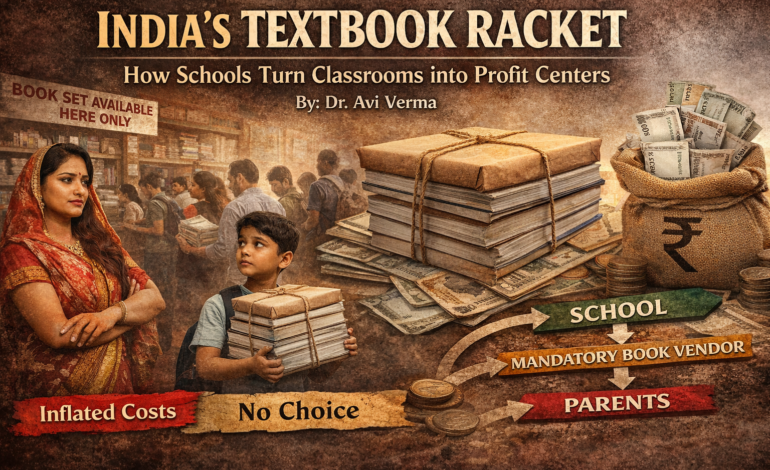
India’s textbook racket: How schools turn classrooms into profit centers

By: Dr. Avi Verma
Every academic year in India begins with a familiar ritual: parents lining up to buy textbooks. What should be a routine purchase has evolved into a deeply flawed system marked by inflated pricing, restricted access, and institutional profiteering. Behind neatly packaged book bundles lies an ecosystem increasingly shaped by control rather than choice.
Let’s call it what it is: a structure that extracts money from parents under the guise of education.
From commissions to coercion
For years, publishers operated in a gray zone, offering schools commissions in exchange for textbook prescriptions. These once ranged between 10 to 25 percent.
That system has since escalated.
Today, publishers report pressure to offer discounts as high as 60 to 70 percent of the printed price. To absorb this burden, many inflate the maximum retail price, passing the cost directly to families. The result is predictable: parents often pay two to three times the actual production cost of textbooks.
A broken supply chain
Traditionally, textbooks moved through a simple pipeline: publisher to distributor to bookseller to parent. That model allowed competition and pricing variation.
In many private schools, that structure has now been replaced by a closed chain:
Publisher → School administration → Authorized seller → Parent
Schools increasingly act as gatekeepers, prescribing “mandatory” books and directing where they must be purchased. In some cases, vendors operate directly on or near school premises.
The consequences are clear: no comparison, no competition, and no meaningful consumer choice.
Silence driven by dependence
Publishers privately acknowledge that current demands are unsustainable and margins artificially distorted. Yet most remain silent.
The reason is structural dependency. Schools control access to large student populations. Refusal to comply often means removal from official book lists and loss of entire markets.
What emerges is not a free market, but a controlled system shaped by institutional leverage.
The burden on families
The financial impact on parents is significant:
- ₹3,000–₹7,000 for kindergarten
- ₹5,000–₹10,000 for primary classes
- ₹8,000–₹15,000 for higher grades
These costs often exclude workbooks and “customized editions” available only through designated channels, further limiting access and increasing dependency.
The NCERT contradiction
India’s public education system promotes affordable NCERT textbooks, widely regarded as academically strong and low-cost.
Yet many private institutions avoid them.
The reason is not academic preference, but financial incentive. NCERT books do not generate commercial margins for intermediaries.
Regulation without enforcement
While guidelines discourage forced purchasing from specific vendors, enforcement remains weak. As a result, the system operates with minimal accountability.
Without oversight, regulatory intent loses practical meaning.
What reform requires
Meaningful change would require:
- Ending exclusive vendor arrangements
- Ensuring price and procurement transparency in schools
- Strengthening oversight of essential educational materials
- Expanding mandatory adoption of NCERT textbooks where feasible
Education or exploitation?
At its core, this is not only a pricing issue but a question of institutional trust.
Schools are not retail spaces. Parents are not captive consumers. Yet each academic year reinforces a system where choice is limited and costs are controlled by intermediaries.
The consequences go beyond economics. They reflect a deeper erosion of fairness within education itself.
If education is to remain a public good in principle as well as practice, this system demands urgent correction.