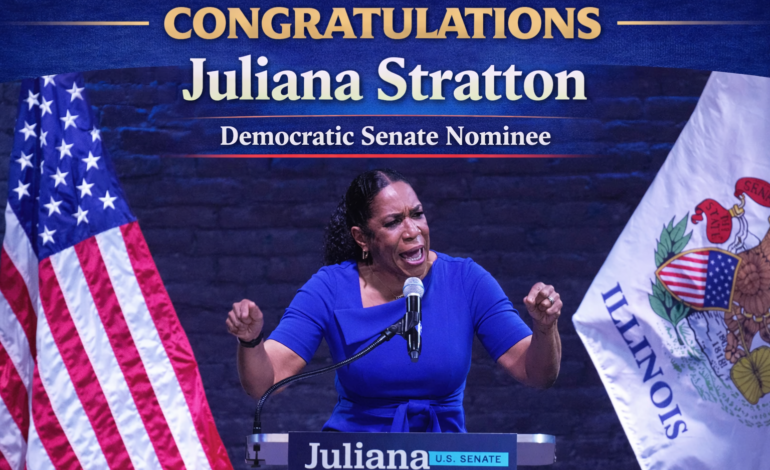
Juliana Stratton wins Illinois Democratic Senate primary, sets up general election battle with Don Tracy

By: Dr Avi Verma
Juliana Stratton’s decisive win in the 2026 Democratic primary for the U.S. Senate marks a significant moment in Illinois politics. The state’s lieutenant governor emerged victorious on March 17, 2026, defeating two veteran U.S. House members—Raja Krishnamoorthi and Robin Kelly—in a crowded contest to replace retiring Senator Dick Durbin. Stratton’s success sets the stage for a general election face‑off with Republican nominee Don Tracy this November.
The Dynamics of a Competitive Democratic Primary
Stratton’s primary victory was not a foregone conclusion. She faced formidable opponents: Krishnamoorthi was a five‑term incumbent and a prolific fundraiser, while Kelly brought her own congressional experience and relationships within key Democratic constituencies. Despite her competitors’ profile, Stratton secured the nomination with about 40.1% of the vote, compared with Krishnamoorthi’s roughly 33% and Kelly’s under 20%.
A factor that distinguishes Stratton’s win is not just the margin, but the context of her rise. Early in the race, Stratton lagged behind in recognition and fundraising compared to Krishnamoorthi. Polling from earlier phases showed Krishnamoorthi leading in initial name recognition and contributions. Yet stratified voter engagement metrics indicated that Stratton’s favorability grew significantly as voters became more familiar with her platform and leadership record—suggesting she built momentum rather than relying solely on early frontrunner status.
Strategic Campaign Elements
1. Coalition Building Across Diverse Voter Groups
Stratton’s campaign crafted a broad coalition that blended traditional Democratic strongholds with energized grassroots segments. Her experience as lieutenant governor allowed her to forge ties with suburban voters while reinforcing her credibility in Chicago and inner‑city communities. She drew support from segments of the electorate seeking a blend of progressive policy commitment and pragmatic governance—an alignment that benefitted her when voters were assessing readiness for statewide leadership.
Her messaging on issues such as economic fairness and progressive priorities resonated with a Democratic base concerned about inequality and national challenges—an emphasis that became particularly salient as the primary evolved.
2. Organizational Advantages and Endorsements
Stratton benefited from significant institutional backing, most notably from Governor JB Pritzker, whose support arguably helped stabilize her standing among establishment and moderate Democrats. This support was manifested through endorsements and targeted political action committee spending, which helped amplify Stratton’s message in key media markets.
Endorsements from national figures—including Senator Tammy Duckworth and support from various Democratic organizations—reinforced her credibility across different constituencies. Strategically, these endorsements helped neutralize criticisms that she lacked congressional experience comparable to her opponents while also projecting confidence in her ability to represent Illinois on the national stage.
3. Messaging and Policy Positioning
Stratton differentiated herself by articulating clear policy priorities that appealed to broad swaths of Democratic primary voters. She embraced progressive agendas such as expanded healthcare access and workers’ rights, while also signaling alignment with broader Democratic goals on civil rights, abortion access, and economic equity. This positioned her as both a pragmatic leader and a representative of Democratic values at a time when the national dialogue was highly polarized.
Moreover, Stratton capitalized on shifting sentiment around federal policies—especially immigration and enforcement issues—where her stance contrasted with Krishnamoorthi’s more moderate approach. These distinctions helped her grow appeal among voters seeking stronger progressive commitments.
Overcoming Financial and Competitive Challenges
Stratton entered the race with a notable fundraising disadvantage. Krishnamoorthi raised tens of millions of dollars and drew significant outside spending, including from cryptocurrency‑related groups and major donors that fueled a heavy media presence. Nonetheless, Stratton’s campaign effectively leveraged targeted spending and messaging to maximize impact.
Rather than flooding every market, her campaign focused resources on high‑density Democratic regions and key suburban areas, helping her build a statewide plurality. This strategic allocation of limited funds highlights disciplined campaign management and an understanding of electoral geography.
The Road Ahead: Stratton vs. Don Tracy
Looking forward to the November 2026 general election, Stratton will face Republican Don Tracy, a former chair of the Illinois GOP who secured his party’s nomination. Illinois’s Senate seat has not been held by a Republican since 2010, giving Democrats structural advantage heading into the general election.
However, the general election will test whether Stratton can expand her coalition beyond Democratic primary voters to include independents and moderate Republicans wary of extremes on either side. Tracy’s profile as a moderate business figure could resonate with some voters uncomfortable with polarized national rhetoric, but the state’s Democratic lean suggests Stratton enters the contest as the favored candidate.
Conclusion: A Victory with Broader Implications
Juliana Stratton’s primary victory is more than a personal milestone—it reflects broader currents within Illinois and national Democratic politics. Her ability to unify diverse voter groups, strategically navigate a competitive primary field, and overcome financial disadvantages demonstrates political acumen and organizational strength.
As she prepares for a general election campaign that will shape Illinois’s role in the U.S. Senate, Stratton’s win underscores both the resilience and dynamism of Democratic politics in a state long regarded as reliably blue. Whether she can maintain that momentum against Republican opposition will be a defining question of the 2026 midterm cycle.