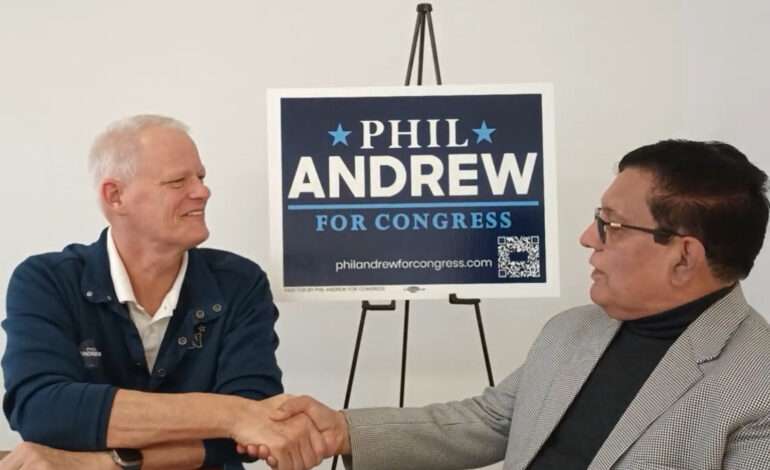
Phil Andrews brings crisis leadership and FBI experience to high-stakes IL-9 congressional race

A former FBI agent, crisis negotiator, and community advocate outlines his vision for one of Illinois’ most competitive Democratic primaries
By IndoUS Tribune Staff
In a detailed conversation with IndoUS Tribune Publisher Dr. Avi Verma, Chicago entrepreneur and community leader Phil Andrews laid out his vision for Illinois’ 9th Congressional District as he officially enters what is expected to be one of the most competitive Democratic primaries in the state. The seat, long held by retiring Congresswoman Jan Schakowsky, has drawn a crowded field, but Andrews believes his leadership record, public service career, and pragmatic policy approach uniquely position him to guide the district during a period of rising national and local challenges.
A career shaped by crisis and public service
Phil Andrews, a former FBI agent, attorney, hostage negotiator, and survivor of the 1988 Winnetka mass shooting, is considered among the leading contenders to succeed Congresswoman Schakowsky. In his interview, he emphasized how more than two decades of work across counterterrorism, counterintelligence, public corruption, violent crime, and crisis negotiation shape his approach to governance.
After retiring from federal service, Andrews founded PAX Group, a conflict management and crisis response consultancy operating internationally. He credits surviving the Maury Dan shooting as the moment that created a lifelong commitment to preventing violence, a mission that guides his public policy views.
A diverse district facing rising hate
Andrews describes IL-09 as one of the most diverse districts in the country, home to Jewish, Muslim, Hindu, Sikh, South Asian, East Asian, Black, LGBTQ+, and immigrant communities. With hate crimes rising nationally, he argues that the district needs a coordinated strategy grounded in prevention, reporting, enforcement, and education.
Calling hate crimes “terrorism at the community level,” Andrews supports modernized reporting systems, multilingual hotlines, community-based reporting, and stronger training for police, prosecutors, judges, and schools. He has helped develop LEAD, an evidence-based training initiative at the Illinois Holocaust Museum. He also advocates increased federal security grants for synagogues, mosques, LGBTQ+ centers, and immigrant institutions as well as stronger civil-rights enforcement through specialized prosecutors and joint task forces.
He stresses survivor-centered support through culturally competent counseling, legal aid, trauma services, and long-term investments in Holocaust education, anti-bias curricula, and interfaith youth programs. He believes IL-09 can become a national model for preventing hate.
Foreign policy priorities
On the Israel–Hamas war, Andrews draws on extensive Middle East experience, stating that Israel has the right to defend itself while emphasizing that humanitarian aid for Palestinians is necessary to reduce future violence. His crisis-negotiation background informs his call for policies that combine stability, hope, and long-term security.
He strongly supports Ukraine and noted that his team trained civilians to document war crimes after Russia’s invasion. He also highlighted the strategic importance of the United States–India partnership, shaped in part by his work on the FBI response to the 2008 Mumbai attacks. He criticized recent actions by the current administration that he says damaged trust with India, calling for deeper intelligence sharing, training, and values-aligned diplomacy.
Immigration and economic opportunity
Andrews believes current immigration and visa systems are confusing and harmful to families and employers. He supports a stable H-1B visa process, clear timelines, protections for dependents, and pathways that reduce exploitation. He prioritizes enforcement against serious criminals while rebuilding trust between immigrant communities and law enforcement, which he says was eroded by aggressive ICE actions.
He connects affordability, housing, and economic opportunity, pointing to rising costs, aging infrastructure, and uneven development across the district. His proposals include transit-linked affordable housing, permitting reform, commercial revitalization, and new career pipelines connected to institutions such as Northwestern and the Illinois Innovation Network. He notes that immigrant communities, including large South Asian and East Asian populations, are central to the region’s economic strength.
Public safety and democratic stability
Drawing on his crisis-management background, Andrews supports intelligence-informed public safety strategies that include early-threat detection, school-based violence prevention, behavioral analysis tools, and police partnerships that focus on community trust. Reflecting on the 43-day government shutdown, he criticized Democrats for ending it without enforceable healthcare protections, adding that attacks on institutions and the rule of law endanger democracy.
Why he believes voters should choose him
Andrews argues that his combination of FBI experience, legal training, crisis leadership, and global coordination prepares him to navigate the district’s most urgent challenges. He has lived in the district his entire life, raised four children there, and says he understands its concerns. His campaign has gained early momentum, outraising most first-time candidates.
“People are tired of career politicians,” he told IndoUS Tribune. “They want leaders who are ethical, experienced, and serious about solving real problems. That is what I have done my entire life, and that is what I will do for the 9th District.”