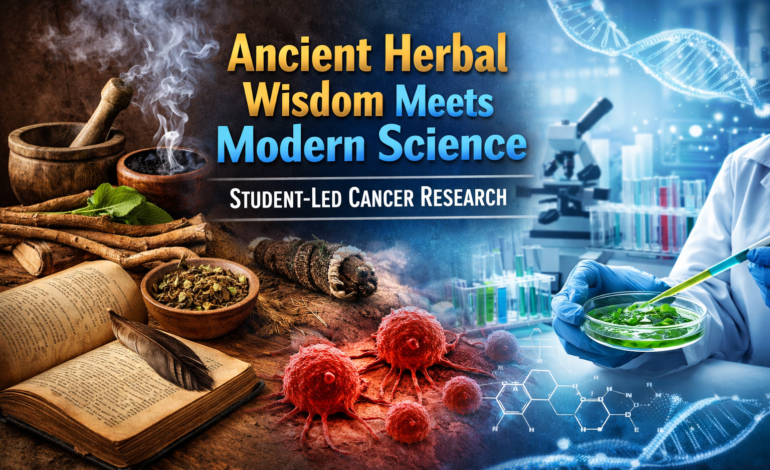
Ancient wisdom meets modern scienceStudent research explores herbal compounds in cancer study

By: Dr. Avi Verma
A recent student-led research project exploring traditional Native American herbal knowledge has drawn attention for its scientific curiosity and cultural relevance, while also underscoring the importance of cautious interpretation in early-stage medical findings.
What the study found
A 17-year-old high school student earned recognition at a national science fair for studying the effects of a traditional herbal blend, commonly associated with Indigenous healing practices, on cancer cells in a laboratory setting. The formulation reportedly included botanicals such as burdock root, slippery elm, and sheep sorrel, herbs long valued for their anti-inflammatory and antioxidant properties.
According to project summaries and science fair reports, the student tested the mixture on cultured human cancer cells in vitro, meaning outside the human body in a laboratory environment. The results suggested the preparation may have induced apoptosis, a process in which damaged or abnormal cells self-destruct.
Experts emphasize that in vitro results are only a preliminary step. Many substances can show effects on cancer cells in petri dishes without demonstrating safety or effectiveness in humans.
Clarifying the “chemotherapy comparison”
Claims that the herbal mixture had effects “rivaling early-stage chemotherapy drugs” should be treated with caution. Chemotherapy undergoes years of testing, including animal studies and multi-phase human clinical trials. Student science fair projects are exploratory and not clinically validated.
Medical professionals stress that such comparisons are not scientifically equivalent and can be misleading if taken out of context.
The role of traditional knowledge
The study reflects a broader trend of integrating traditional healing knowledge into modern biomedical research. Many widely used medicines originate from plant-based or traditional remedies. For example, aspirin was developed from compounds found in willow bark, and paclitaxel, a cancer drug, was derived from the Pacific yew tree.
These examples highlight how cultural knowledge can inspire scientific discovery when studied rigorously and ethically.
Expert perspective
Scientists reviewing similar research often commend the initiative but caution against overinterpretation. Key limitations include the fact that laboratory conditions do not replicate the complexity of the human body, while dosage, toxicity, and long-term effects remain unknown. Interactions with other treatments are also untested.
Before any therapy reaches patients, it must undergo extensive validation to ensure safety and efficacy.
A promising beginning, not a cure
The student’s work is best seen as early exploratory research rather than a medical breakthrough. It highlights the value of investigating traditional remedies while reinforcing the need for scientific rigor in how findings are communicated.
Bottom line
The project reflects curiosity, cultural respect, and scientific effort. However, no herbal mixture has been proven to cure or replace established cancer treatments based on current evidence.
Disclaimer: This article is for informational and educational purposes only. It does not constitute medical advice. Always consult qualified healthcare professionals for diagnosis and treatment decisions.