Global progress in regenerative cardiology Japan leads with first commercial stem cell heart repair; what it means for the US and India

By: Dr. Avi Verma
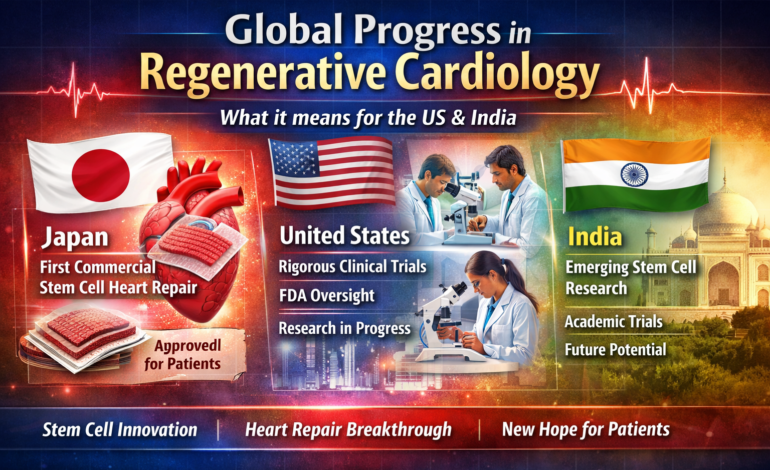
Regenerative medicine has reached a historic milestone as Japan officially approved the commercial use of bio-engineered heart muscle sheets derived from induced pluripotent stem (iPS) cells. This breakthrough, developed by a Tokyo-based medical venture, represents the first time a lab-grown cellular product for heart repair has moved from experimental trials to the commercial market.
These “Myocardial Repair Sheets” are grafted directly onto a failing heart. Once applied, they release growth factors that stimulate new blood vessel formation and physically reinforce the heart wall, offering a lifeline to those with severe heart failure.
The status in the United States: Rigorous trials underway
While Japan has granted a “provisional license” to fast-track this technology, it is not yet commercially available in the United States. The U.S. Food and Drug Administration (FDA) maintains a different regulatory pathway, requiring large-scale Phase III clinical trials before commercial sale.
However, the U.S. is a global hub for this research:
- Active research: Institutions like Stanford University and the University of Wisconsin-Madison (where iPS research was pioneered alongside Japan) are conducting advanced human trials.
- Current availability: In the US, patients can currently only access these specific iPS-derived cardiac treatments by enrolling in FDA-sanctioned clinical trials. Several American biotech firms are working on “off-the-shelf” universal stem cell patches that would not require a patient’s own cells, potentially lowering costs.
The status in India: A rising frontier in stem cells
In India, regenerative heart therapy is in a stage of rapid clinical evolution, though it has not yet reached the level of commercial approval seen in Japan.
- Institutional leadership: The International Centre for Cardio Thoracic and Vascular Diseases in Chennai and the All India Institute of Medical Sciences (AIIMS) in Delhi have been at the forefront of stem cell research for cardiac repair.
- Regulatory environment: The Indian Council of Medical Research (ICMR) has established strict guidelines for stem cell therapy. While bone-marrow-derived stem cell treatments have been used in some Indian hospitals for years, the specific iPS cell technology used in Japan is currently restricted to academic research and limited clinical studies in India.
- Future outlook: India is positioning itself as a cost-effective destination for stem cell research, with several startups in Bangalore and Hyderabad working on cardiac regenerative patches aimed at the South Asian genetic profile.
A new era for heart patients
The move in Japan provides a roadmap for both the US and India. By transforming specialized adult cells into versatile building blocks, doctors are moving closer to a future where heart damage is no longer “irreversible,” but can be physically mended using the body’s own cellular potential.
Health corner: Understanding the science
A glossary of regenerative medicine
To help our readers navigate the latest medical breakthrough in heart repair, here is a simplified guide to the terminology used in this field:
- iPS cells (Induced pluripotent stem cells): These are “reprogrammed” cells. Scientists take a regular adult cell (like a skin or blood cell) and use genetic instructions to turn back its internal clock. This transforms it into a “blank slate” cell that can become any type of tissue in the human body.
- Regenerative medicine: A branch of medicine focused on “regrowing” or replacing human cells, tissues, or organs to restore normal function. Instead of just treating symptoms, it aims to physically mend the underlying damage.
- Myocardial repair sheets: Thin, lab-grown layers of living heart muscle cells. These are grafted onto the surface of a patient’s heart. They act like a “living bandage,” secreting proteins that help the heart grow new blood vessels and pump more efficiently.
- Provisional license: A fast-track regulatory approval (common in Japan) that allows a life-saving treatment to be sold commercially while the company continues to collect long-term data on a larger group of patients.
- Differentiation: The biological process by which a “blank slate” stem cell turns into a specialized cell, such as a beating heart cell (cardiomyocyte) or a nerve cell.
- Off-the-shelf therapy: Medical products created from a universal donor’s cells rather than the patient’s own. This allows the treatment to be ready immediately for emergencies, rather than waiting weeks to grow the patient’s specific cells in a lab.
Disclaimer: The information provided in this article is for informational purposes only and does not constitute medical advice, diagnosis, or treatment. This technology is currently commercially available only in Japan. Always seek the advice of your physician or a qualified health provider in the USA or India regarding your specific medical condition or participation in clinical trials.