Blatter urges FIFA World Cup boycott over Trump administration policies

Former FIFA chief joins global chorus questioning US suitability as 2026 World Cup host
Former FIFA president Sepp Blatter has backed growing calls for a boycott of the 2026 FIFA World Cup matches scheduled to be held in the United States, citing concerns over the policies and conduct of President Donald Trump and his administration. The tournament is set to be co-hosted by the US, Canada, and Mexico from June 11 to July 19, 2026.
Blatter’s intervention adds weight to mounting criticism from politicians, football officials, legal experts, and civil society figures who argue that current US domestic and foreign policies undermine the country’s credibility as a World Cup host.
In a post on social media platform X, the 89-year-old former FIFA chief endorsed remarks by Swiss lawyer and anti-corruption expert Mark Pieth, who urged football fans to avoid travelling to the US for the tournament. “I think Mark Pieth is right to question this World Cup,” Blatter wrote, amplifying concerns over travel restrictions, immigration enforcement, and political interference surrounding the event.
Travel bans and immigration concerns fuel backlash
Criticism of the US hosting role has intensified following the Trump administration’s expansion of travel bans and stricter immigration enforcement. Fans from several footballing nations, including Senegal, Ivory Coast, Iran, and Haiti—countries whose teams have qualified or are expected to qualify—face potential entry barriers unless they already hold valid US visas.
The administration has justified the measures by citing “screening and vetting deficiencies,” but critics argue that such policies directly contradict FIFA’s commitments to inclusivity, free movement of fans, and global participation.
Pieth warned that fans could face arbitrary treatment at US borders, saying visitors risk being “put straight on the next flight home” if they fail to satisfy authorities. “You’ll see it better on TV anyway,” he remarked in an interview with Swiss daily Der Bund.
Global football voices question US as host
Blatter is not alone in questioning the US role. Oke Göttlich, vice-president of the German Football Association and president of FC St. Pauli, said the time had come to “seriously consider” a boycott. He compared the current situation to Cold War-era Olympic boycotts, arguing that the geopolitical and human rights risks today are even greater.
“Qatar was criticised for being too political. Are we now pretending everything is apolitical?” Göttlich asked, pointing to what he described as double standards in global football governance.
South Africa’s opposition leader Julius Malema has also called for African teams to withdraw, drawing parallels between Trump-era US policies and apartheid-era South Africa. British lawmakers and Dutch football supporters have echoed similar sentiments, with over 100,000 fans in the Netherlands signing a petition urging their national team to boycott the tournament.
Trump’s expanding role sparks unease
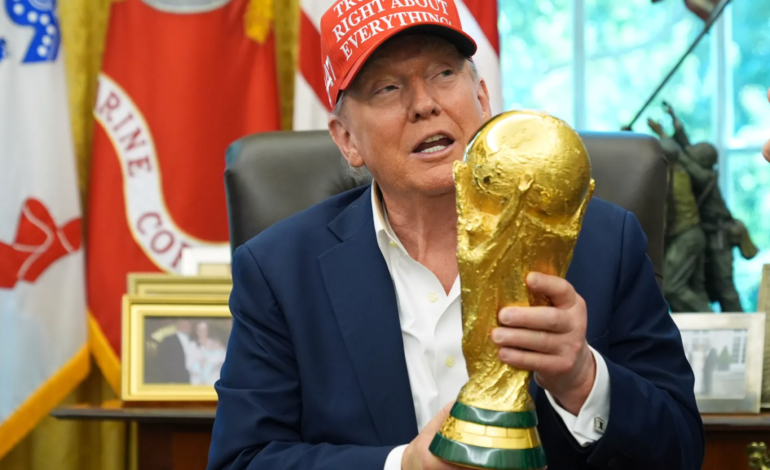
Concerns have also grown over President Trump’s visible involvement in FIFA-related events and announcements. Trump has been present at multiple high-profile football engagements and has floated proposals linking global sporting platforms to broader political agendas, including peace initiatives and territorial claims.
Critics argue that such politicisation risks undermining FIFA’s stated neutrality and threatens the credibility of the World Cup as a unifying global event.
FIFA and national federations remain cautious
Despite the growing backlash, FIFA President Gianni Infantino and several national football associations have so far resisted boycott calls, citing contractual obligations and concerns over penalising players.
However, as geopolitical tensions rise and travel restrictions widen, pressure on FIFA is expected to intensify in the lead-up to 2026, raising fundamental questions about sport, values, and global governance.