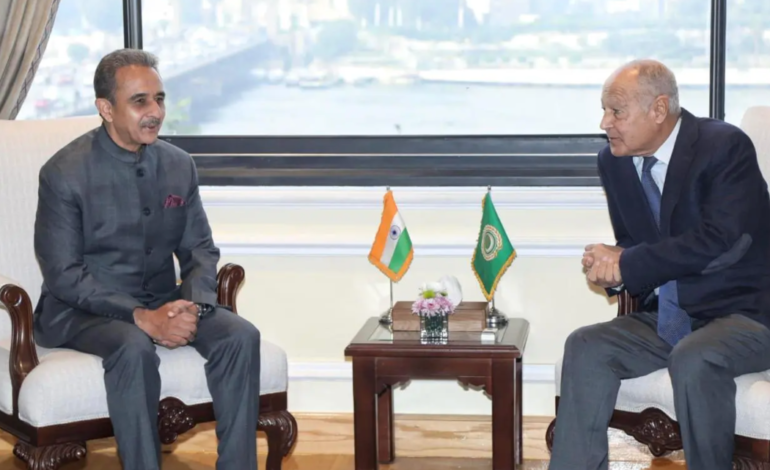
India, Arab League review political, economic and cultural cooperation ahead of foreign ministers’ meet

India and the League of Arab States (LAS) on Thursday reviewed their expanding political, economic and cultural engagement during a meeting between Minister of State for External Affairs Kirti Vardhan Singh and Arab League Secretary General Ahmed Aboul Gheit.
The discussions focused on strengthening cooperation across multiple sectors and reaffirmed the shared commitment to deepen India–Arab relations. Both sides also welcomed the upcoming 2nd India–Arab Foreign Ministerial Meeting, scheduled to be held in New Delhi later this month, which is expected to further institutionalize dialogue and collaboration.
“Pleased to meet H.E. Ahmed Aboul Gheit, the Secretary General of Arab League,” Singh posted on X following the meeting. “Held productive discussions on India’s wide-ranging political, economic and cultural engagement with the Arab League. We also welcomed the upcoming 2nd India–Arab Foreign Ministerial Meet scheduled to take place in New Delhi at the end of the month.”
The engagement reflects the growing importance both sides attach to structured dialogue at the regional level, particularly at a time of shifting global economic and geopolitical dynamics. India and the Arab League share common perspectives on several international and regional issues and continue to explore opportunities for closer coordination.
Efforts to strengthen India–Arab League ties have been ongoing. In November last year, Neena Malhotra, Secretary (South) at the Ministry of External Affairs (MEA), chaired a consultation meeting with Arab ambassadors in New Delhi. The meeting focused on enhancing cooperation between India and the League of Arab States across political, economic and people-to-people domains.
MEA spokesperson Randhir Jaiswal said at the time that the discussions centered on “efforts to further strengthen cooperation between India and the League of Arab States,” underscoring New Delhi’s emphasis on sustained engagement with the Arab world.
India shares long-standing and friendly relations with the countries that make up the Arab League. These ties date back centuries, when traders, scholars and diplomats traveled between India and the Arab world via maritime routes across the Arabian Sea and overland corridors connecting South Asia with West Asia and the Arabian Peninsula. These interactions facilitated exchanges of goods, ideas and knowledge, laying the foundation for enduring civilizational links.
Shared cultural heritage, including linguistic and religious connections, continues to reinforce these historic bonds. The Arab League, headquartered in Cairo, was established in 1945 with seven founding members and now comprises 22 member states spanning North Africa and the Middle East.
The Arab League countries form an integral part of India’s extended neighborhood. Strong economic and commercial ties, shared views on key international developments, and strategic connectivity underline the relationship. A significant portion of India’s external trade passes through critical maritime routes such as the Suez Canal, the Red Sea and the Gulf of Aden, highlighting the region’s strategic importance.
According to the MEA, while India has emerged as one of the world’s major economies with growing global influence, the Arab League and its member states remain key players in the international economic landscape, offering substantial opportunities for partnership.
Over the past decade, India and Arab countries have entered a new phase of economic transformation and cooperation, contributing to sustainable growth and reinforcing the strategic depth of India–Arab relations.