India warns against rise of ‘parallel’ platforms challenging UN authority

India has voiced strong concern over the growing emergence of “parallel” and plurilateral platforms that seek to influence global peace and security outside the framework of the United Nations, arguing that such trends risk weakening international rule of law at a time when the UN Security Council itself is facing paralysis.
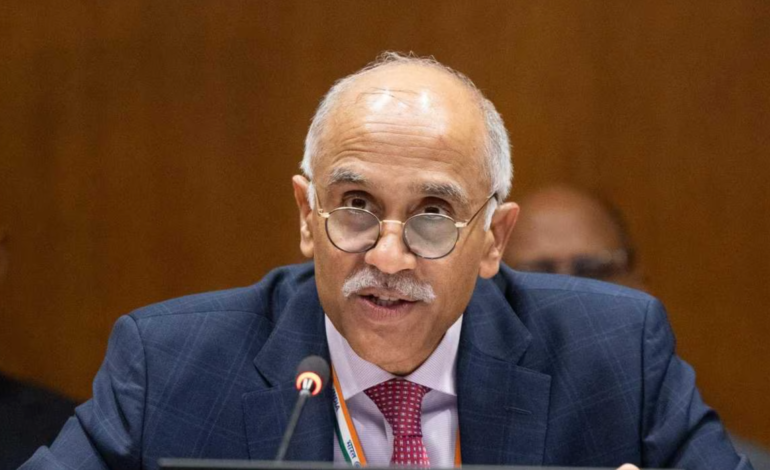
Speaking during a high-level Security Council debate on reaffirming international rule of law, India’s Permanent Representative to the UN, Ambassador P. Harish, cautioned that critical discussions on peace and security are increasingly shifting away from the UN system.
“Security conversations and discussions have moved on to parallel plurilateral frameworks, some even involving private sector actors, to bring about outcomes on peace and security outside the United Nations,” Harish said, stressing that this development underscores the urgent need for comprehensive reform of the Security Council.
Echoing these concerns, UN Secretary-General António Guterres emphasised that no organisation, coalition, or ad hoc arrangement can replace or override the authority of the Security Council under the UN Charter. He reiterated that the Council alone has the legal mandate to make binding decisions on international peace and security, including authorising the use of force.
“Only the Security Council can authorise the use of force under international law, as set out in the Charter,” Guterres said, adding that its responsibility is “singular” and its obligation “universal.” He argued that strengthening the Council’s credibility and effectiveness requires urgent reform, particularly to enhance representation and decision-making capacity.
Although neither Harish nor Guterres explicitly named specific initiatives, their remarks were widely interpreted as a response to the recently announced “Board of Peace” proposed by US President Donald Trump. The initiative, unveiled as part of a broader Gaza reconstruction and peace framework, has been perceived by many diplomats as a potential challenge to the UN’s central role in maintaining international peace and security.
Speaking at the World Economic Forum in Davos, Trump had remarked that once fully formed, the Board could “do pretty much whatever we want to do,” while later adding that it would operate in conjunction with the United Nations. Despite this caveat, critics argue that the initiative signals a dilution of the UN’s exclusive authority under the Charter.
The proposed Board reportedly includes more than twenty members, among them Pakistan, with participation linked to financial contributions. So far, most Western nations have refrained from joining, while a majority of members are from Muslim-majority countries. Belgium remains the notable Western participant.
Ambassador Harish underscored that the proliferation of such parallel mechanisms reflects deeper structural weaknesses within the UN system. He pointed to the Council’s inability to act decisively on major conflicts, including Gaza and Ukraine, largely due to veto-induced deadlock among permanent members.
“Paralysis and lack of effectiveness in tackling conflicts remain a significant shortcoming, testing the credibility of the United Nations,” he said. Harish argued that without meaningful reform, multilateralism itself risks losing legitimacy.
India reiterated that global governance structures must evolve to reflect contemporary realities, noting that while the world has transformed dramatically since the UN’s founding, the Security Council remains anchored in outdated power structures. Changes in geopolitics, demographics, and the nature of global threats demand an expanded and more representative Council, including reforms to both permanent and non-permanent membership.
Calling reform essential to restoring confidence in international law, India maintained that strengthening the UN—not bypassing it—is the only sustainable path to preserving global peace and security.