Nepal and India agree to expand agricultural cooperation with new action plans

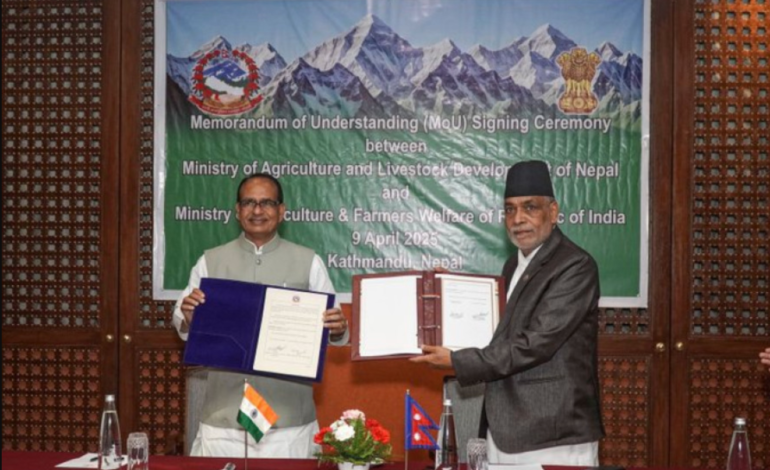
Nepal and India have agreed to significantly deepen bilateral cooperation in the agriculture sector by formulating and implementing a biennial action plan within the next three months, aimed at converting existing agreements into tangible outcomes.
The decision was taken during the ninth meeting of the Nepal–India Joint Agriculture Working Group, held over two days in Kathmandu. According to Nepal’s Ministry of Agriculture and Livestock Development, the meeting focused on strengthening institutional collaboration, improving market access, and advancing sustainable agricultural practices.
A key outcome of the discussions was the agreement to enhance cooperation between agricultural universities and research institutions in both countries. This includes closer coordination between the Indian Council of Agricultural Research (ICAR) and the Nepal Agricultural Research Council (NARC) through separate, structured action plans designed to promote joint research, knowledge exchange, and technology transfer.
The two sides also agreed to broaden collaboration in the livestock, poultry, and fisheries sectors under a separate memorandum of understanding. These sectors are seen as critical to rural livelihoods, food security, and income generation in Nepal.
Improving logistical and regulatory coordination emerged as another major focus. Both countries committed to streamlining processes to ensure the smooth supply of chemical fertilizers, strengthening agricultural infrastructure, and maintaining regular communication between relevant agencies to address technical issues related to food quality standards and quarantine regulations.
India reiterated its intention to expand agricultural cooperation with Nepal in line with its “Neighbourhood First” policy, emphasizing support in agricultural research, infrastructure development, and the adoption of modern farming technologies.
Reviewing the progress of ongoing cooperation, Nepali officials highlighted the success of a livestock development initiative launched following an agreement during former Prime Minister Pushpa Kamal Dahal’s visit to New Delhi in 2023. Under the program, India provided 15 high-quality Murrah male buffaloes, which have since contributed to the production of 92,766 doses of semen to improve native buffalo breeds in Nepal.
Nepal acknowledged the significant impact of this support on livestock productivity and breed improvement and expressed gratitude to the Indian government for its continued assistance.
During the meeting, Nepal also welcomed India’s recognition of laboratory testing for eight categories of Nepali agricultural products and urged the expansion of this list. In April, India formally recognized test certificates issued by Nepal’s National Food and Feed Reference Laboratory, enabling the export of select Nepali food products tested domestically. Nepal further sought unhindered access for its agricultural produce to the Indian market.
The discussions extended to emerging areas of cooperation, including digital agriculture, climate-resilient farming, natural farming systems, and food security, reflecting shared concerns over climate change and sustainable development.
Both sides agreed that the tenth meeting of the Joint Agriculture Working Group will be held in India on dates to be decided through mutual consultation. The meeting was co-chaired by Hari Bahadur K.C., Joint Secretary at Nepal’s Ministry of Agriculture and Livestock Development, and Pramod Kumar Meherda, Additional Secretary at India’s Ministry of Agriculture and Farmers’ Welfare.