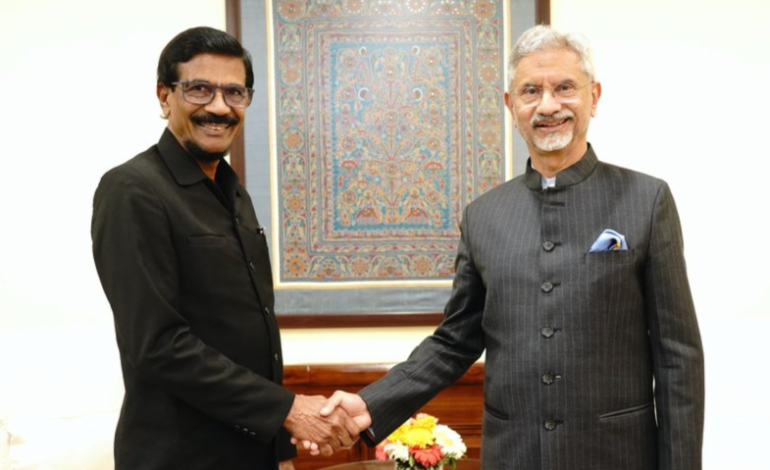
Lankan leader Silva’s India visit carries symbolic and practical significance: report

The recent visit of Tilvin Silva, general secretary of the Janatha Vimukthi Peramuna (JVP) led by President Anura Kumara Dissanayake, to India has drawn attention for both its symbolic and practical implications, according to a report by the Trinco Centre for Strategic Studies (TCSS).
The visit, conducted under the Indian Council for Cultural Relations’ Distinguished Visitors Programme from February 5 to 12, 2026, marked Silva’s first official engagement in India. During his stay, he met External Affairs Minister S. Jaishankar and toured Gujarat and Andhra Pradesh, states often cited as examples of India’s economic growth and technological advancement.
The TCSS report noted that the visit highlighted a nuanced blend of opportunity and challenge in Sri Lanka–India relations. According to Silva, India focused its discussions on development and innovation rather than applying political pressure regarding Sri Lanka’s long-delayed Provincial Council elections.
His remarks sparked wider debate about Sri Lanka’s future governance model. Drawing comparisons between India and China, Silva observed that while India promotes technological innovation, implementation sometimes encounters social and cultural considerations. In contrast, he suggested that China’s governance model operates with fewer such constraints.
The report also pointed to ambiguity surrounding Silva’s stance on Provincial Council elections. While in India, he clarified that he was speaking in his capacity as JVP general secretary rather than representing the Sri Lankan government. However, his longstanding criticism of the provincial council system as ineffective has raised questions about whether his comments signal a broader policy direction.
According to TCSS, the key issue is not external pressure from India but whether Sri Lanka will independently move forward with elections. The report stated that if the JVP seeks to function as a responsible governing entity, it must ensure elections are conducted while promoting balanced economic development across all provinces.
The analysis further emphasized that India’s interest in Tamil rights stems from its own demographic realities, with more than 85 million Tamil-speaking citizens in South India. Ensuring equitable rights in Sri Lanka, India argues, ultimately supports Sri Lanka’s own stability and progress.
The report concluded that for a multilingual democracy like Sri Lanka, inclusive power-sharing may offer a sustainable path forward, in contrast to more centralized governance models.