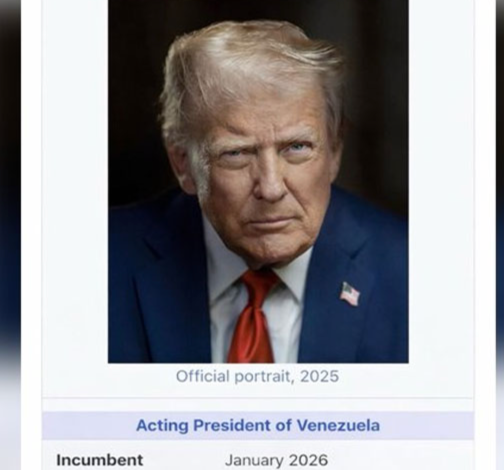
Trump declares himself ‘Acting President of Venezuela’ after Maduro’s capture

US President Donald Trump triggered a fresh international controversy after sharing a digitally altered image on social media declaring himself the “Acting President of Venezuela,” just days after the United States captured Venezuelan President Nicolás Maduro.
The image, posted on Trump’s social media platform, carried his official 2025 presidential portrait with a caption identifying him as “Acting President of Venezuela, Incumbent January 2026,” alongside his designation as the 45th and 47th President of the United States. The post immediately drew global attention, disbelief, and criticism from political leaders, legal experts, and international observers.
The declaration comes in the aftermath of a dramatic US operation that led to the capture of Maduro and his wife, Cilia Flores, earlier this month. Washington has described the operation as a necessary intervention, while Caracas has condemned it as an illegal abduction and a violation of Venezuelan sovereignty and international law.
Venezuela’s Supreme Tribunal of Justice, citing constitutional provisions, swiftly moved to ensure administrative continuity by appointing Vice President Delcy Rodríguez as interim president. Rodríguez rejected Trump’s claim outright, demanded Maduro’s immediate release, and accused the United States of attempting to impose external control over Venezuela’s political future.
Legal analysts have noted that there is no basis in international law for a sitting US president to assume executive authority over another sovereign nation. Unlike historical cases of monarchs ruling multiple realms or revolutionary leaders holding authority across borders, Trump’s declaration lacks constitutional legitimacy or international recognition.
Adding to the controversy, Trump later shared another post appearing to joke about US Secretary of State Marco Rubio becoming the “President of Cuba,” further fuelling accusations that the administration was trivialising sovereignty and international norms.
In public remarks following Maduro’s capture, Trump claimed the United States would temporarily “run” Venezuela to stabilise the country and “get the oil flowing,” reinforcing concerns that control over Venezuela’s vast energy resources was a central motivation behind Washington’s actions. The administration has since announced sweeping measures to control Venezuelan oil revenues, placing them under US custodial authority while blocking courts and creditors from accessing the funds.
Secretary of State Marco Rubio has attempted to soften the narrative, stating that the US does not intend to directly administer Venezuela and that decisions regarding governance would ultimately rest with Venezuelans. However, protests have erupted in several global capitals, including Caracas, London, Paris, and Seoul, with demonstrators accusing Washington of imperial overreach and economic exploitation.
Maduro’s arraignment in a US federal court has further heightened tensions. Venezuelan authorities insist his detention violates sovereign immunity and international legal principles, while the US maintains that its actions are justified on national security grounds.
As diplomatic fallout continues to unfold, Trump’s self-declared title has become a flashpoint in an already volatile crisis, raising serious questions about the future of US–Latin America relations, the limits of executive power, and the resilience of the global rules-based order.