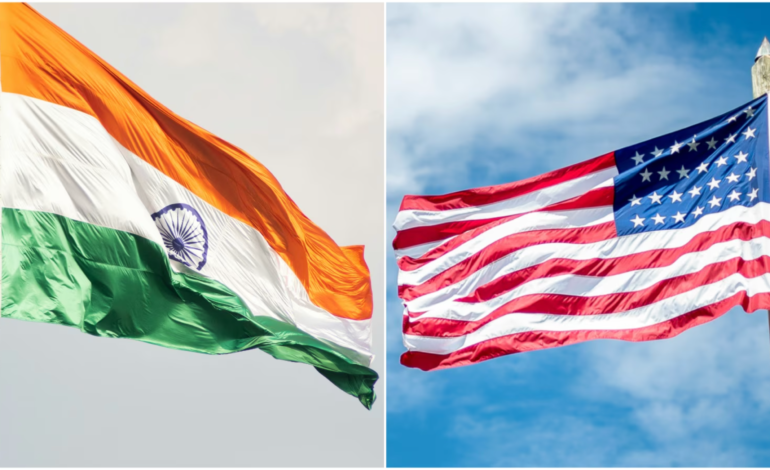
US sees India as a key partner in Pax Silica push for AI and tech supply chains

The United States is positioning India as a central partner in a new economic security framework designed to safeguard global supply chains for artificial intelligence and advanced technologies, a senior US official said on Friday.
Speaking at the Hudson Institute in Washington, US Under Secretary of State for Economic Affairs Jacob Helberg said the Biden administration is preparing to expand its “Pax Silica” initiative, an emerging coalition focused on semiconductors, critical minerals, logistics networks, and AI infrastructure. He confirmed that Washington “looks forward to welcoming India next month” as part of the partnership, reflecting New Delhi’s growing importance in global technology and supply-chain discussions.
Helberg said the global technology environment has changed dramatically over the past decade, forcing Washington to rethink long-standing assumptions. Silicon, once viewed as a neutral commercial commodity, has now become a central arena of geopolitical competition.
“The hardware of our modern life — the silicon that powers everything from smartphones to advanced weapons systems — has become the primary theatre of strategic competition,” Helberg said. Supply chains, he added, are no longer simply economic systems but instruments of strategic power.
According to Helberg, the US views the global race for artificial intelligence leadership as a contest on three interconnected fronts: innovation, market diffusion, and supply-chain security. Weakness in any one of these areas, such as shortages of semiconductors, critical minerals, or logistics infrastructure, could slow progress across the entire technology ecosystem.
“Winning the AI race means winning on all three fronts,” he said.
Helberg pointed to what he described as a resurgence of the US economy, citing growth of 5.4 per cent and noting that the world’s ten largest companies by market capitalisation are currently American, most of them in the technology sector. He credited this performance to President Donald Trump’s economic agenda and said the administration is determined to ensure that American-led technological systems become the global default.
Pax Silica, Helberg explained, is intended to translate that ambition into coordinated action among trusted partners. The initiative brings together technologically capable economies that collectively represent a dominant share of global semiconductor manufacturing capacity. In addition to India’s expected participation, recent partners include Qatar and the United Arab Emirates, with discussions underway with countries across Europe, Asia, and the Western Hemisphere.
The initiative will operate along three main lines of effort: membership, policy coordination, and projects. On the policy front, partners are working toward shared definitions of sensitive technologies and critical infrastructure, as well as discussions on anti-dumping practices. On projects, the focus will be on strengthening industrial capacity and logistics, with pilot efforts launched on a bilateral or plurilateral basis rather than through a single multilateral framework.
Helberg stressed that the private sector would remain central to the initiative’s success. Governments, he said, should focus on reducing regulatory barriers, protecting intellectual property, and creating incentives, rather than attempting to run projects directly.
Addressing China, Helberg said Pax Silica is “not a China strategy” but “an America strategy,” aimed at ensuring reliable and competitive access to minerals, manufacturing, and logistics. He added that the US would adopt a “trust but verify” approach with partners, avoiding rigid purity tests that could undermine cooperation.