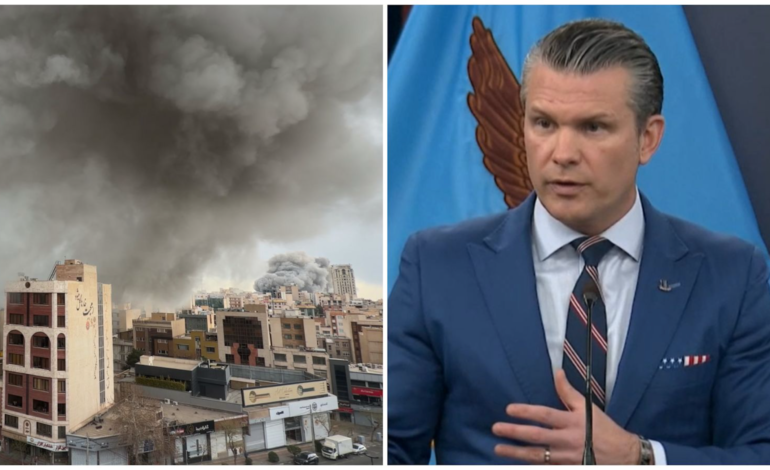
US warns Iran of “death, fire and fury” if Strait of Hormuz oil flow is disrupted

The United States issued a stern warning to Iran on Tuesday, cautioning that any attempt to disrupt oil shipments through the Strait of Hormuz would trigger overwhelming military retaliation.
US Defence Secretary Pete Hegseth said President Donald Trump was prepared to respond with force if Tehran tried to block the strategic waterway, which is one of the world’s most critical routes for global energy supplies.
“But I would reiterate also… the President posted last night about that saying if Iran does anything to stop the flow of oil within the Strait of Hormuz, they will be hit by the United States of America 20 times harder than they have been hit thus far,” Hegseth said during a briefing.
Also See: ‘Modi doctrine’ needed to counter China’s ambitions in Indian Ocean region: Report
He added a stark warning to Tehran: “Death, fire, and fury will rain upon them.”
The warning came as Hegseth and Joint Chiefs of Staff Chairman Dan Caine provided an update on the ongoing military campaign against Iran, known as Operation Epic Fury.
According to US officials, the operation remains focused on reducing Iran’s missile and drone capabilities, damaging its naval forces, and targeting key elements of its military-industrial infrastructure.
Caine said US forces have already struck more than 5,000 targets since the campaign began.
He noted that Iranian ballistic missile attacks have declined significantly as a result of the strikes.
“Ballistic missile attacks are down about 90 percent from where they started,” Caine said, adding that one-way attack drones have fallen by 83 percent since the beginning of the operation.
The chairman also said the US military is evaluating options to protect commercial shipping in the region if required.
“If tasked to escort, we’ll look at the range of options to set the military conditions to be able to do that,” Caine explained, noting that military planners would assess resources, command structures, and risks before presenting recommendations to the President.
Hegseth criticized Iran for escalating the conflict by targeting neighboring countries earlier in the confrontation.
“Big mistake by the Iranian regime to start targeting its neighbours right away,” he said, accusing Tehran of reckless actions that exposed its intentions.
Despite rising tensions, Hegseth pushed back against suggestions that the conflict is expanding.
“I see media banners that say war expanding or spreading — it’s actually the opposite. It’s quite contained,” he said.
He emphasized that the US administration does not intend to allow the campaign to evolve into a prolonged war.
“This is not endless. It’s not protracted. We’re not allowing mission creep,” Hegseth said.
The Strait of Hormuz, located between Iran and Oman, connects the Persian Gulf to the Arabian Sea and is one of the world’s most strategically important maritime chokepoints. Nearly one-fifth of global oil consumption passes through the narrow waterway, making any disruption there a major concern for global energy markets and major importers such as India.
Also See: US strikes over 5,500 targets in Iran, destroys more than 60 ships in Operation Epic Fury