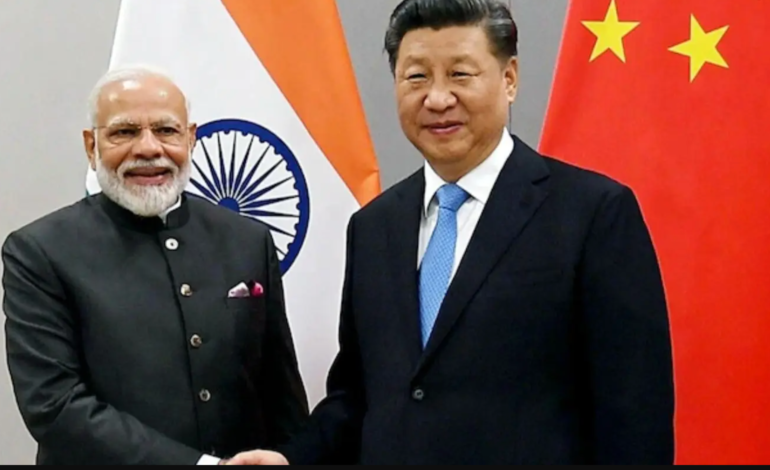
‘Let the dragon and elephant dance together’: Chinese President Xi greets India on Republic Day

Chinese President Xi Jinping on Monday extended Republic Day greetings to President Droupadi Murmu as India marked its 77th Republic Day, underscoring the importance of dialogue, confidence-building measures, and cooperative engagement between Asia’s two largest nations.
In a congratulatory message conveyed through Chinese Ambassador to India Xu Feihong, President Xi emphasised that peaceful coexistence and partnership remain the right strategic choice for both countries.
“President Xi Jinping sent a congratulatory message to Indian President Droupadi Murmu on India’s 77th Republic Day,” Ambassador Xu posted on social media platform X. “It should be the right choice for China and India to be good-neighbourly friends and partners that help each other succeed, and have the dragon and the elephant dance together.”
The symbolic reference to the “dragon and elephant” — often used to describe China and India — reflects Beijing’s stated preference for stability and cooperation between the two Asian powers amid regional and global shifts.
Ambassador Xu also attended the Republic Day celebrations in New Delhi earlier in the day, sharing visuals from the event. “Glad to join the 77th Republic Day celebrations of India,” he wrote, signalling diplomatic goodwill and continued engagement.
The Republic Day greeting comes at a time when both countries have been cautiously working to stabilise bilateral relations following years of strain. Officials from both sides have repeatedly stressed the need to prioritise dialogue, manage differences responsibly, and prevent tensions from escalating.
Last November, Ambassador Xu Feihong reiterated China’s willingness to expand high-level practical cooperation with India, particularly in economic and technological domains. Speaking at a seminar on China’s 15th Five-Year Plan: New Blueprint for China’s Development, New Opportunities for China-India Cooperation, he outlined China’s long-term economic strategy and its potential implications for bilateral collaboration.
According to Xu, China’s 15th Five-Year Plan will focus on strengthening the real economy, accelerating high-level scientific and technological self-reliance, and expanding high-standard opening-up. He noted that these initiatives could generate new opportunities for cooperation with India and other countries.
“We will upgrade traditional industries such as chemicals and machinery, unlocking about $1.4 trillion in new market space over the next five years,” Xu said. He also highlighted China’s push into emerging sectors such as new energy and advanced materials, expected to create multiple trillion-dollar growth engines, as well as future-oriented investments in bio-manufacturing and sixth-generation mobile communication technologies.
Referring to India’s own development initiatives, Xu said China is keen to align practical cooperation with programmes such as Make in India to expand shared economic interests.
“At present, India is advancing major strategies such as ‘Make in India’. China is ready to deepen practical cooperation with India to make a bigger pie of common interests, so that people in both countries will benefit more from development outcomes,” he said.
Diplomatic engagement between the two countries has also continued at the leadership level. In August last year, Prime Minister Narendra Modi and President Xi Jinping met in Tianjin on the sidelines of the Shanghai Cooperation Organisation (SCO) Summit, where they discussed ways to strengthen bilateral ties and build upon recent progress in India–China relations.
As India celebrates its Republic Day, President Xi’s message highlights Beijing’s stated intent to pursue neighbourly relations rooted in cooperation, even as both nations navigate complex geopolitical realities. Whether the dragon and the elephant can truly “dance together” will depend on sustained trust-building and concrete steps to address longstanding differences.