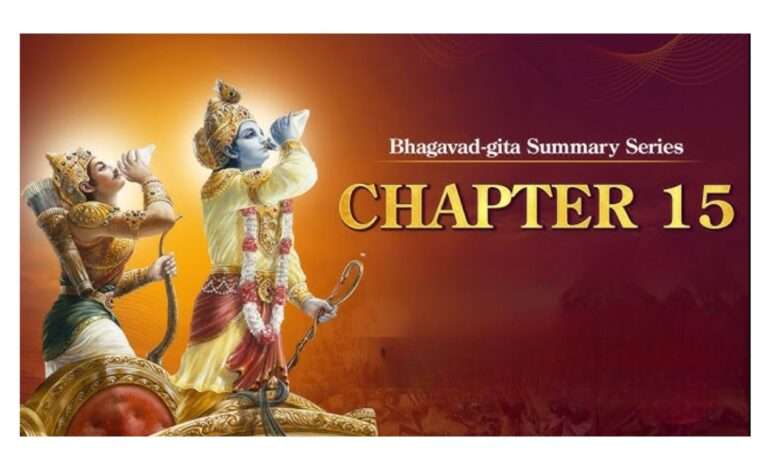
Gita Swadhyaya – In My Understanding, Chapter Fifteen – Purushottama Yoga

By: Rajendra Kapil
This chapter of the Bhagavad Gita reveals a profound and unique secret—one that is supremely excellent. Because this excellence belongs only to the Supreme Lord, He is called Purushottama. And the yogi who strives to attain Him through this knowledge is considered a seeker of Purushottama Yoga.
In the very first shloka, the Lord describes this extraordinary nature. He says, “O Arjuna, this world is like an inverted tree.” Its roots are above and its branches extend downward. How are the roots above? Because the roots represent the foundation of any tree, and the foundation of this entire world is the Lord Himself—who exists above. Thus, the roots are above, symbolizing the eternal Brahman, the supreme, indestructible source. The branches below represent this world, created by the Lord’s threefold Maya. Every type of sensory pleasure resides within it.
Shri Bhagavan Uvacha
“Urdhvamoolam adhashaakham ashvattham praahuravyayam
Chhandamsi yasya parnani yas tam veda sa vedavit” (1)
Meaning: The Lord said—O Arjuna! This world is described as an eternal tree, with its roots above and its branches below. The Vedic hymns are its leaves. One who truly knows this tree is the knower of the Vedas.
The branches of the worldly tree are driven by desires. All three gunas (sattva, rajas, tamas) fill it completely. This cosmic tree is so vast that its beginning and end cannot be perceived. Yogis dwelling beneath it often lose their way. But the wise understand its reality—they recognize its hidden defects and do not become entangled in them. Such yogis partake of worldly experiences with detachment and move forward. These devotees remain free from delusion and ego. Rising above the dualities of joy and sorrow, gain and loss, they strive only for the Supreme Truth—God—and seek the eternal abode. What is this divine abode like?
“Na tad bhasayate suryo na shashanko na paavakah
Yad gatva na nivartante tad dhaama paramam mama” (6)
The glory of that realm is extraordinary. The sun, which illuminates the world, cannot light that abode. The moon, which beautifies the night, cannot brighten it either. All these are parts of nature, but the Supreme Abode lies far beyond nature. It is illuminated only by the divine radiance of the Lord Himself.
“Mamaivamsho jeevaloke jeevabhootah sanaatanah
Manah shashthaaneendriyaani prakritisthaani karshati” (7)
“Shareeram yad avaapnoti yacchaapyutkraamatishwarah
Griheetvaitaani samyaati vaayur gandhaan ivaashavaat” (8)
Meaning: O Arjuna! Every living being in this world carries My eternal fragment as the soul, which works through the mind and senses, influenced by nature. When the embodied soul leaves one body and enters another, it carries with it the impressions of the mind and senses—just as the wind carries fragrance from one place to another.
The Lord explains that He exists as life-force within every being. When the body dies, He guides that soul to another body—or to His divine abode. This subtle movement is possible only through His grace, just as wind carries fragrance effortlessly.
“Utkrāmantam sthitam vāpi bhuñjānam vā gunānvitam
Vimūḍhā nānupaśyanti paśyanti jñāna-chakṣhuṣaḥ” (10)
The ignorant cannot understand this mysterious cycle of birth and death. Absorbed in desires, they mistake worldly pleasures for life’s true purpose and waste their precious existence. But true yogis, whose eyes are opened by divine knowledge, do not get entangled. They perform all duties selflessly and dedicate everything to the Lord, seeking only His eternal abode.
“Yad āditya-gataṁ tejo jagad bhāsayate ’khilam
Yac chandramasi yac cāgnau tat tejo viddhi māmakam” (12)
“Gām āviśhya cha bhūtāni dhārayāmy aham ojasā
Puṣhṇāmi chauṣhadhīḥ sarvāḥ somo bhūtvā rasātmakaḥ” (13)
Meaning: O Arjuna! The radiance in the sun that lights up the entire world, the shine of the moon, and the brilliance of fire—all arise from Me alone. I enter every realm and sustain all living beings. As the essence of the moon, I nourish all vegetation.
The Lord repeatedly reminds Arjuna that He is the creator of this universe. Through His Maya, He becomes the sun and illuminates the world, the moon that infuses fragrance into flowers and sap into plants. He becomes the senses that allow beings to experience the world. He becomes digestive fire, enabling beings to transform food into energy. He is memory, wisdom, and even forgetfulness. He alone is worth knowing, the essence of all Vedas—the sustainer and the destroyer of the universe.
“Yasmāt kṣharam atīto ’ham akṣharād api chottamaḥ
Ato ’smi loke vede cha prathitaḥ puruṣhottamaḥ” (18)
“Yo mām evam asammūḍho jānāti puruṣhottamam
Sa sarva-vid bhajati māṁ sarva-bhāvena Bhārata” (19)
Meaning: Because I am beyond both the perishable and the imperishable, I am celebrated in the world and in the Vedas as Purushottama. O Arjuna, one who knows Me without doubt as the Supreme Person worships Me wholeheartedly and in every way.
Thus, Lord Krishna revealed His Purushottama form to Arjuna and explained that He alone is worth knowing, loving, and trusting. This supreme knowledge has blessed not only Arjuna but all of us. We offer countless salutations to this compassionate Lord. May we avoid the traps of worldly flaws and continue moving toward His divine abode.
With this hope—
Jai Shri Krishna!