King Parikshit and the Age of Kali: An Eternal Message on Dharma, Time, and Human Consciousness

In the Indian spiritual tradition, Puranic narratives are not merely religious stories; they serve as mirrors reflecting the profound psychological, moral, and social truths of human life. The story of King Parikshit belongs to this category. It teaches us that the preservation of dharma is not the responsibility of kings or sages alone, but depends upon the consciousness and conduct of every individual.
King Parikshit was the grandson of the great archer Arjuna and the son of the valiant Abhimanyu. After the Pandavas ascended to heaven, he ruled the kingdom based on dharma, justice, and truth. He was an ideal ruler — his subjects were content, sacred rituals were performed, and social order prevailed. Yet history and scripture repeatedly remind us that the wheel of time is ever-changing. With the departure of Krishna from the earth, the Dvapara Yuga ended and the Kali Yuga began — an age in which only truth remains from the four pillars of dharma.
The Dialogue of Dharma and Earth: A Symbol of Changing Times
During his conquests, King Parikshit witnessed a striking scene — a bull (Dharma) standing on one leg and a cow (Mother Earth) weeping. Three legs of Dharma — compassion, austerity, and purity — had been broken. This was not merely symbolic; it represented the decline of moral values in society. Mother Earth’s sorrow signified that when humanity distances itself from divine consciousness, truth, compassion, and righteousness begin to fade.
The Arrival of Kali and the Abodes of Adharma
The king then saw a cruel man tormenting the cow and the bull. He revealed himself as Kali, the spirit of the age. The king sought to banish him, but Kali begged for a place to reside. Ultimately, King Parikshit granted him five abodes: gambling, intoxication, illicit relations, violence, and unjust wealth (gold).
This decision holds deep symbolic meaning: wherever greed, lust, violence, and falsehood reside, Kali thrives.
A profound spiritual truth emerges here — Kali Yuga is not an external force but a mental state that enters human tendencies.
The Allure of Gold and the Decline of Discernment
After granting Kali residence in gold, King Parikshit wore a golden crown that had long been kept in the treasury and never worn by the Pandavas. Gold here represents not merely metal, but greed and ego. Upon wearing the crown, the king’s intellect became clouded, and he went hunting — an act contrary to his nature. This episode illustrates how unethical wealth and pride can erode human judgment.
A Moment of Anger that Changed Destiny
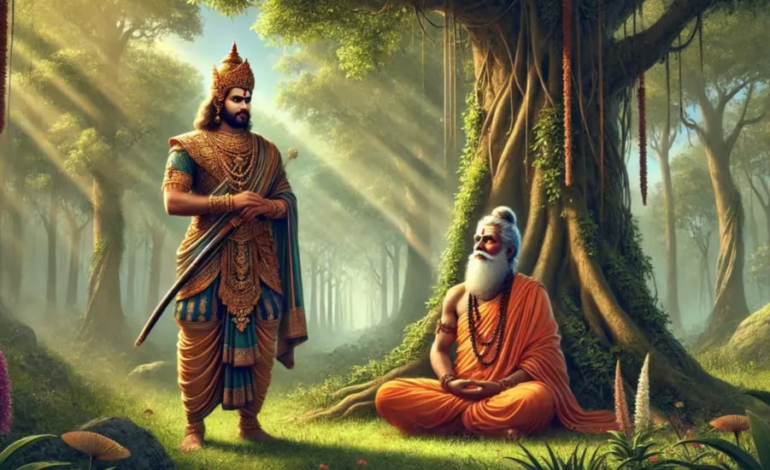
In the forest, thirsty and exhausted, the king arrived at the hermitage of a sage absorbed in meditation. Receiving no response, he placed a dead snake around the sage’s neck in anger. This momentary lapse altered the course of his life. The sage’s son cursed the king: within seven days, he would die from the bite of Takshaka, the serpent king.
This incident teaches that anger may be momentary, but its consequences can be grave and long-lasting.
From Repentance to Renunciation
When the king removed the crown, his clarity returned. He repented deeply and accepted the curse as divine grace. Renouncing his kingdom, he went to the banks of the Ganga and resolved to dedicate his final seven days to remembrance of God and pursuit of spiritual knowledge. This transformation shows that repentance is the first step toward inner purification.
The Question of Death and the Answer to Life
Gathered sages assembled by the Ganga, the king posed a universal question: What should a person do when death is near? This question belongs not only to Parikshit, but to all humanity. At that moment, the great sage Shukadeva appeared and narrated the Bhagavata Purana over seven days. Through this sacred discourse, the path of devotion, knowledge, and renunciation became clear.
King Parikshit was granted seven days; we do not even know how much time we have. This is the spiritual core of the narrative.
The Great Blessing of Kali Yuga
Though Kali Yuga is called the age of decline, it contains a great blessing — remembrance of the Divine Name alone can lead to liberation. In earlier ages, severe austerities and elaborate rituals were required; in Kali Yuga, faith and the chanting of God’s name are sufficient.
Relevance of the Story in Modern Life
Today’s society stands at the peak of technological progress, yet mental unrest, greed, violence, and moral crises are increasing. Gambling has moved to digital platforms, intoxication enjoys social acceptance, violence has entered thought and speech, and unethical wealth is often equated with success. In this context, the story of King Parikshit warns us that Kali Yuga is not merely a period in time, but a state of inner consciousness.
Dharmic Lessons for Life
This narrative teaches us that:
• Truth and compassion are the foundations of dharma
• Greed destroys discernment
• Anger corrupts judgment
• Respect for sages and wisdom is essential
• Awareness of death gives meaning to life
• Chanting the Divine Name and spiritual fellowship purify the self
Conclusion: The Preservation of Dharma Begins Within
The story of King Parikshit teaches that humans may err, but repentance, knowledge, and devotion can guide them back toward light. The decline of dharma does not begin outside; it begins within the human heart. Likewise, its revival must also begin within.
If in the age of Kali one establishes truth, compassion, and remembrance of the Divine in daily life, that very age becomes a path to liberation.
Dharma is protected not by weapons, but by character.
And in Kali Yuga — remembrance of the Divine Name is the simplest path to spiritual realization