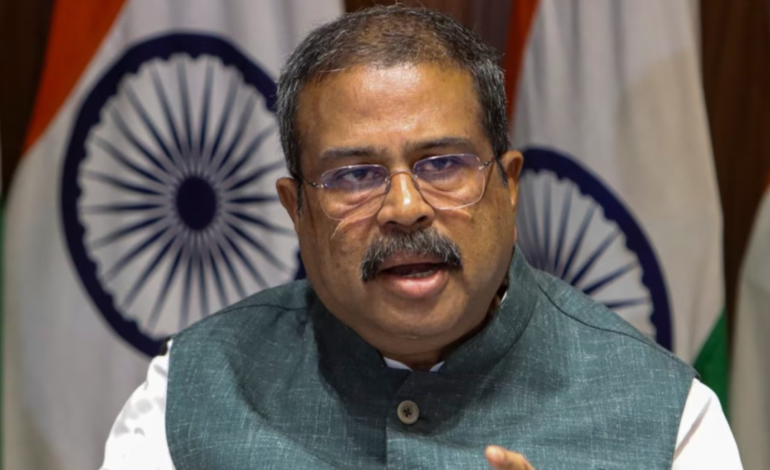
Dharmendra Pradhan resigns as education minister amid NEET paper leak protests

Union Education Minister Dharmendra Pradhan resigned from the Union Council of Ministers on Saturday amid nationwide protests over the alleged NEET-UG 2026 paper leak and growing demands for accountability.
In a letter addressed to the country’s youth, Pradhan said he had submitted his resignation to Prime Minister Narendra Modi in view of the ongoing demonstrations at Jantar Mantar and across the country. He said his decision was intended to ensure that the issue was not exploited by anti-national elements and that students’ futures remained protected.
Pradhan, who has been associated with education and public service for more than four decades, said he has always believed that a strong and inclusive education system is the foundation of a strong nation. He thanked Prime Minister Modi for giving him the opportunity to serve the country and reaffirmed his commitment to the aspirations of India’s youth.
Referring to the NEET-UG controversy, Pradhan said the government acted promptly after irregularities in the examination held on May 3, 2026, came to light. According to him, the investigation was handed over to the Central Bureau of Investigation (CBI), the examination was cancelled, and a fresh examination was announced. He also noted that beginning next year, the exam will be conducted in Computer-Based Test (CBT) mode to improve transparency and security.
Pradhan said he accepted responsibility from the outset and remained committed to ensuring that deserving students did not suffer because of the actions of examination mafias. He maintained that the NEET-UG results announced on July 16 reflected the success of many meritorious students from economically weaker backgrounds.
However, he alleged that some individuals in positions of responsibility attempted to mislead students and create unnecessary confusion. Calling the developments of the past several days deeply distressing, Pradhan said his resignation was not about personal reputation but about safeguarding students’ interests and preserving public confidence in the education system.