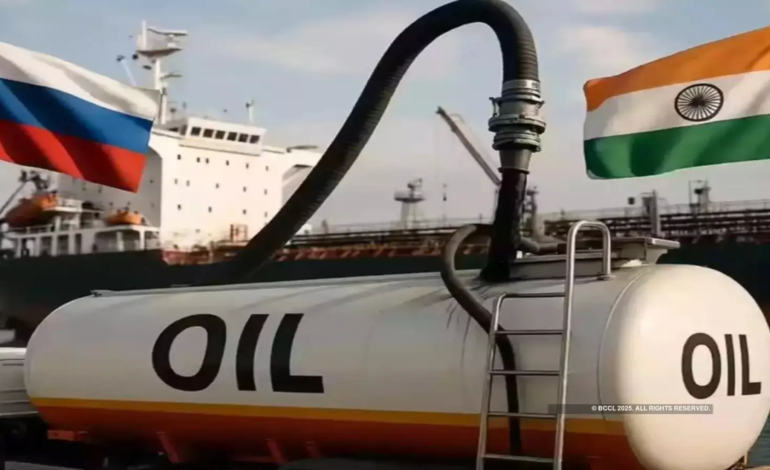
India’s cut in Russian oil imports likely temporary, Moscow expects rebound

Russia expects its oil exports to India to recover soon and views the recent dip in supplies as a short-lived phase triggered by Western sanctions, Kremlin spokesman Dmitry Peskov said, signaling confidence in the resilience of India–Russia energy ties.
Speaking to Indian journalists via a virtual press conference organized by Sputnik, Peskov dismissed the decline in crude shipments as “insignificant and temporary.” He stressed that Russia remains committed to supplying energy to India at competitive prices, describing the oil trade as mutually beneficial for both countries.
“There can be, for a very brief period of time, insignificant decreases in the volume of oil trade,” Peskov said, adding that Moscow expects exports to India to rise again.
The remarks came ahead of Russian President Vladimir Putin’s planned visit to India, during which energy cooperation and trade mechanisms are expected to feature prominently. Peskov reiterated that Russia rejects the sanctions imposed by the United States and European Union, calling them illegal and politically motivated.
“We do not accept these limitations, and we are doing our best to ensure that we continue our trade and guarantee the supply of oil and oil products,” he said, claiming that Russia has been managing alternative trade and logistics arrangements “quite successfully.”
India became the world’s largest buyer of Russia’s seaborne crude following the outbreak of the Ukraine conflict, taking advantage of discounted supplies as Western nations sharply reduced imports. However, Indian refiners have recently scaled back purchases after the United States imposed sanctions on major Russian energy companies, including Rosneft and Lukoil. Europe has since announced additional restrictions targeting petroleum products refined from Russian crude.
Major Indian refiners have responded cautiously to the evolving sanctions landscape. Reliance Industries said in October that it would comply with European Union guidelines governing refined fuel imports into Europe, while also reaffirming that it would follow any directives issued by the Indian government. State-owned refiners such as Mangalore Refinery and Petrochemicals Ltd and Hindustan Petroleum Corp have paused purchases of Russian crude. At the same time, Indian Oil Corporation has continued sourcing Russian oil from non-sanctioned entities.
Despite these adjustments, Moscow believes long-term cooperation remains intact. Peskov said both sides are working to insulate bilateral trade from pressure exerted by third countries. He noted that payment mechanisms and alternative settlement systems would be discussed by leaders to ensure uninterrupted trade.
Addressing concerns over the widening trade imbalance, Peskov acknowledged that Russia currently exports far more to India than it imports. In the 2023–24 financial year, bilateral trade was valued at $65.7 billion, with Indian exports accounting for $4.26 billion and imports, largely energy-related, totaling $61.44 billion.
“There is a real imbalance in our trade, and we are aware of it,” Peskov said. “We know that our Indian friends are concerned. We are actively exploring opportunities to increase imports from India and want to buy more Indian goods.”
The Kremlin’s comments underline Moscow’s strategic view of India as a critical long-term energy and trade partner, even as sanctions reshape global oil flows. Analysts say that while India may tactically reduce Russian crude intake to manage risk exposure, a complete shift away remains unlikely given pricing dynamics and India’s growing energy demand.