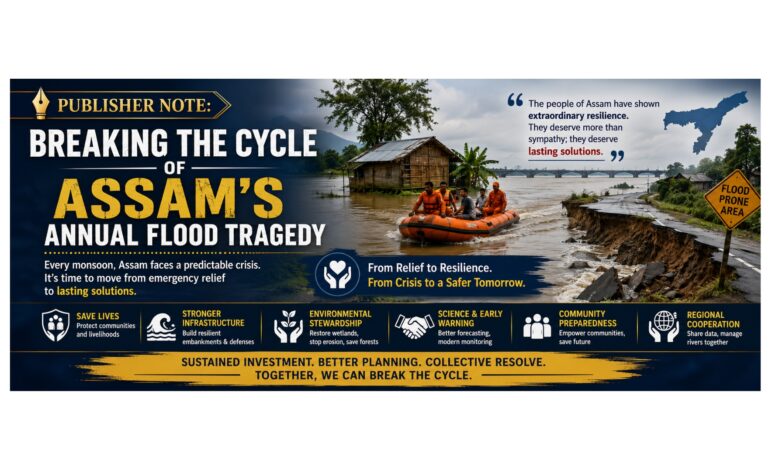
Breaking the cycle of Assam’s annual flood tragedy

By: Dr Avi Verma
Every monsoon, Assam braces for what has become an almost predictable humanitarian crisis. Yet predictability should never breed complacency. The devastating floods that have swept through the state once again have claimed dozens of lives, displaced hundreds of thousands of people, and submerged villages, roads, schools, and farmland. As of late July, official reports indicated that more than 600,000 people across multiple districts had been affected, with Upper Assam districts such as Sivasagar, Charaideo, Jorhat, and Golaghat experiencing some of the worst flooding in decades.
The Brahmaputra is one of the world’s most dynamic rivers. Fed by Himalayan glaciers and intense monsoon rainfall, it carries enormous volumes of water and sediment into Assam’s floodplains. Annual flooding is a natural part of this ecosystem and even replenishes fertile agricultural land. However, changing rainfall patterns, riverbank erosion, heavy siltation, encroachment on wetlands, deforestation in upstream catchments, and expanding human settlements in flood-prone areas have transformed a natural phenomenon into a recurring disaster.
Assam has invested heavily in embankments over the decades, but many of these structures are aging and require continuous maintenance. When embankments fail, floodwaters can remain trapped for days, worsening damage to homes, crops, and infrastructure. Riverbank erosion, another major challenge, continues to displace thousands of families every year, often permanently.
To its credit, the government has mobilized the National Disaster Response Force (NDRF), State Disaster Response Force (SDRF), armed forces, and other agencies for rescue and relief operations. The Ministry of Home Affairs has also deployed central assessment teams and continues to coordinate with the India Meteorological Department and the Central Water Commission for early warnings.
Long-term solutions, however, require far more than emergency relief. The Assam Integrated Flood and Riverbank Erosion Risk Management Investment Program (AIFRERMIP), supported by the Asian Development Bank, seeks to strengthen embankments, improve riverbank protection, and introduce community-based flood management and modern monitoring systems. These initiatives deserve sustained political commitment and adequate funding.
The challenge is not Assam’s alone. The Brahmaputra is an international river system flowing through China, India, and Bangladesh. Effective flood forecasting, scientific river management, environmental conservation, and cross-border hydrological data sharing must become regional priorities. Climate change is expected to intensify extreme rainfall events, making resilient infrastructure and better planning even more urgent.
Meanwhile, organizations such as the Assam Foundation of North America are helping bridge immediate humanitarian needs by raising funds for food, drinking water, medicines, and emergency supplies. Their efforts remind us that compassion knows no borders.
The people of Assam have demonstrated extraordinary resilience for generations. They deserve more than annual sympathy after every flood. They deserve lasting solutions grounded in science, environmental stewardship, and long-term public policy. Breaking the cycle of misery will require sustained investment, better planning, and collective resolve. Until then, the waters will continue to rise—but so must our commitment to ensuring that the same tragedy does not repeat itself year after year.