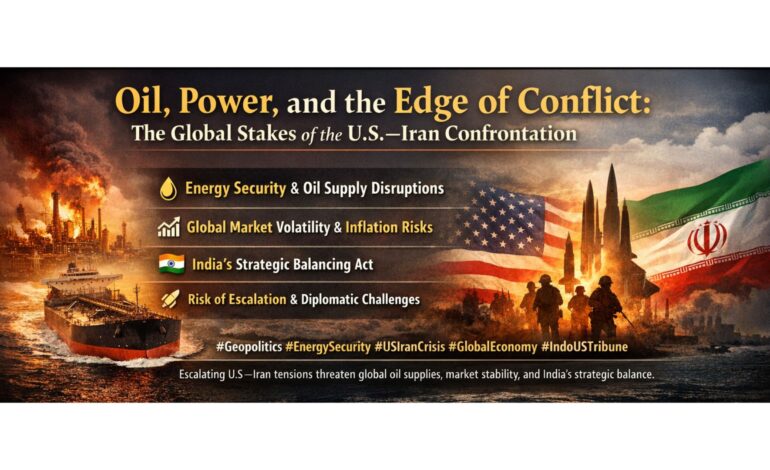
Oil, power, and the edge of conflict: the global stakes of the U.S.–Iran confrontation

The escalating confrontation between the United States and Iran has once again placed the world at the crossroads of geopolitics and energy security. What might initially appear as another Middle Eastern military flashpoint has quickly evolved into a crisis with profound implications for global resources, economic stability, and the delicate architecture of international diplomacy.
At the center of this unfolding drama is a familiar but increasingly dangerous equation: energy, power, and strategic geography.
For decades, the Persian Gulf has been the artery through which the lifeblood of the global economy flows. Roughly one-fifth of the world’s oil supply moves through the Strait of Hormuz, a narrow maritime corridor that connects Gulf oil producers to global markets. When tensions rise in this region, the world feels it almost immediately—in rising fuel prices, shaken markets, and growing geopolitical uncertainty.
Today, the stakes are even higher.
Following intensified hostilities between the United States and Iran and the transition of power after the death of Ali Khamenei, Iran’s leadership has entered a new phase under Mojtaba Khamenei, the country’s newly elevated supreme authority. His emergence signals a harder ideological line and a readiness to use Iran’s strategic geography and energy leverage as tools of resistance against Western pressure.
In Tehran’s strategic calculus, controlling pressure points in global supply chains—especially energy routes—is a powerful equalizer against militarily superior adversaries.
The Weaponization of Energy
Oil has long been a political instrument, but the current crisis underscores how deeply energy and security have become intertwined. With threats to shipping lanes and the potential disruption of tanker traffic through the Strait of Hormuz, global markets have already reacted with alarm.
Energy analysts warn that prolonged instability in the Gulf could trigger one of the most severe supply disruptions in decades. Oil prices have surged past the psychological threshold of $100 per barrel, reviving fears of inflation and economic slowdown across major economies.
This is not merely a regional issue. Energy markets are among the most interconnected systems in the modern global order. A tanker delayed in the Gulf can ripple through supply chains in Europe, Asia, and North America. Fuel prices influence everything—from airline tickets to fertilizer costs to food inflation.
The modern economy runs on energy stability. When that stability is threatened, the consequences cascade rapidly across sectors.
A New Phase in Iran’s Strategic Doctrine
Iran’s leadership transition has added a new layer of unpredictability to the crisis. Under Mojtaba Khamenei, Tehran appears poised to double down on a strategy of asymmetric pressure—leveraging regional proxies, maritime chokepoints, and energy infrastructure to counterbalance Western military superiority.
This approach is rooted in decades of Iranian strategic thinking. If direct confrontation with the United States is untenable, Iran can still exert enormous influence by targeting vulnerabilities within the global economic system.
Shipping routes, pipelines, ports, and energy infrastructure become instruments of geopolitical negotiation.
In effect, the battlefield extends far beyond the Middle East. It reaches into financial markets, energy exchanges, and the strategic calculations of governments across the world.
India’s Strategic Balancing Act
For India, the implications of this conflict are immediate and complex.
As the world’s third-largest oil consumer, India imports nearly 85–90 percent of its crude oil. A significant share of that supply originates in or transits through the Gulf region. Any prolonged disruption in shipping lanes or energy exports would place immense pressure on India’s economy.
Higher oil prices translate into a heavier import bill, inflationary pressures, and stress on fiscal balances. In a country where fuel costs ripple through transportation, agriculture, and manufacturing, the economic consequences could be far-reaching.
But India’s challenge is not only economic—it is diplomatic.
New Delhi maintains strategic relationships across the geopolitical spectrum. It shares an expanding strategic partnership with the United States, while also maintaining historical ties with Iran. India has invested heavily in the Chabahar Port project in southeastern Iran, a key corridor designed to connect India to Afghanistan and Central Asia while bypassing Pakistan.
At the same time, India has deepened defense and technological cooperation with Israel, another key player in the region’s evolving security dynamics.
Navigating these overlapping relationships requires careful diplomatic balancing. India cannot afford to alienate Iran, given its strategic geography and energy resources. Yet it must also maintain alignment with Western partners who play an essential role in technology, trade, and security cooperation.
This delicate balancing act has become a defining feature of India’s foreign policy in the twenty-first century.
Global Economic Reverberations
The ripple effects of the U.S.–Iran confrontation extend far beyond energy markets.
Financial markets have already begun to show signs of anxiety. Stock indices have fluctuated sharply amid fears of supply disruptions and geopolitical escalation. Insurance premiums for shipping in the Gulf have risen, increasing the cost of transporting goods across global trade routes.
If the crisis intensifies, several global consequences could follow:
• Energy inflation: Higher oil and gas prices feeding global inflation.
• Trade disruption: Increased shipping costs and delays across maritime routes.
• Economic slowdown: Rising fuel costs dampening industrial growth.
• Geopolitical polarization: Major powers aligning with competing blocs.
The world economy remains fragile after years of pandemic recovery, supply-chain disruptions, and regional conflicts. Another prolonged energy shock could test the resilience of that recovery.
The Risk of Strategic Miscalculation
Perhaps the most dangerous aspect of the current crisis is the risk of escalation through miscalculation.
History is replete with examples where regional confrontations spiraled into broader conflicts. When military operations intersect with critical economic infrastructure—oil terminals, shipping lanes, refineries—the stakes become global almost overnight.
A missile strike on an energy facility or a blockade of shipping routes could transform the crisis from a geopolitical dispute into a full-scale economic emergency.
Diplomacy, therefore, remains the only sustainable path forward.
Yet diplomacy in today’s polarized international environment is increasingly difficult. Rivalries between major powers complicate mediation efforts, while domestic political pressures within each country limit room for compromise.
A World at an Inflection Point
The unfolding confrontation between the United States and Iran represents more than a regional conflict. It is a reminder that global stability remains deeply dependent on fragile geopolitical balances—especially in regions that control vital resources.
Energy security, maritime freedom, and geopolitical influence have once again converged in the waters of the Persian Gulf.
For India and other major economies, the lesson is clear: diversification of energy sources, strategic reserves, and resilient supply chains are no longer optional policies—they are national security imperatives.
The coming months will determine whether the current crisis stabilizes through diplomacy or deepens into a prolonged geopolitical confrontation.
In an era already marked by shifting alliances and contested power, the world now watches the Gulf with renewed anxiety.
For what unfolds there will not remain confined to the Middle East.
It will reverberate across the global order.