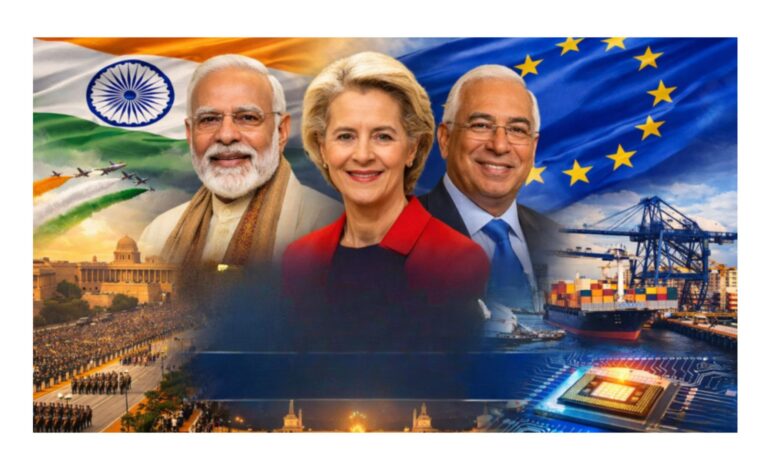
India at Davos, the India–EU breakthrough, and the spirit of January 26

By: Dr Avi Verma
As India marked its 77th Republic Day on January 26, reaffirming the strength of its Constitution, democratic institutions, and national unity, the country also projected growing influence on the global stage. That same week at the World Economic Forum Annual Meeting in Davos, Indian leaders, ministers, state officials, and corporate representatives underscored the nation’s economic resilience, strategic engagement, and growing role in shaping global discourse.
India’s presence at Davos this year was notable for its size and diversity, and for advancing its narrative as more than an “emerging economy.” Delegates highlighted India’s robust growth trajectory, underpinned by structural reforms, infrastructure expansion, and digital public infrastructure that supports long‑term growth rather than short‑term stimulus. Indian officials and business leaders engaged with counterparts on issues ranging from artificial intelligence applications at scale to resilient supply chains and clean energy transitions.
A defining moment of the week was the landmark India–European Union Free Trade Agreement, often described by officials on both sides as the “mother of all trade deals.” After nearly two decades of negotiations, India and the European Union concluded a comprehensive pact that will eliminate or cut tariffs on most goods traded between the two economies and liberalize market access in key sectors. The deal is projected to create a free trade area covering approximately two billion people and nearly a quarter of global gross domestic product, significantly expanding opportunities for Indian exports and European investment. Leaders said it will strengthen trade in textiles, leather, gems and jewellery, engineering goods, and agricultural products, while boosting job creation and deepening economic ties. The agreement was hailed as a major strategic and economic milestone, reflecting a shared commitment to rules‑based trade and cooperation amid global market uncertainties.
The timing of the trade breakthrough alongside Republic Day celebrations lent added symbolism. At home, January 26 celebrated India’s constitutional values and democratic continuity; abroad, Davos amplified India’s message that these values now underpin a nation with global economic weight and strategic influence. Together, these moments told a unified story: India is navigating a fragmented world by strengthening partnerships and reinforcing its role as a constructive force in shaping global economic and strategic architecture.
Looking ahead, the challenge for India will be translating its expanding global stature into inclusive prosperity at home as it approaches the centenary of independence in 2047. But for this moment, India stands tall, celebrating its Republic, forging pivotal alliances, and asserting a durable place in the future world order.