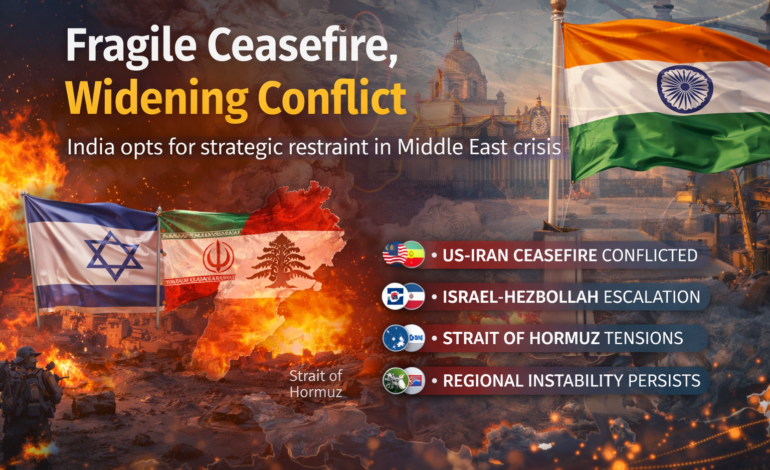
Fragile ceasefire, widening conflict India opts for strategic restraint in Middle East crisis

By: Dr Avi Verma
India’s decision to stay outside direct mediation efforts reflects a calculated and cautious approach in a volatile geopolitical environment. With strong ties to the United States and Israel, alongside energy and historical links with Iran, New Delhi is prioritizing quiet diplomacy over visible intervention. Given the lack of clarity over the ceasefire itself, entering talks without a stable framework could risk diplomatic capital without meaningful influence. India’s approach is therefore framed as strategic restraint rather than disengagement.
State of the ceasefire: Limited, informal, and contested
As of April 9, 2026, the so-called United States–Iran ceasefire is best described as an informal de-escalation understanding. It has resulted mainly in a pause in direct strikes between the two sides. However, there is no formal agreement, no monitoring mechanism, and no clearly defined terms, making its legal and operational status uncertain.
Conflicting interpretations: A ceasefire in name only
The fragility of the arrangement is reflected in sharply differing interpretations. The United States views it as limited strictly to direct conflict with Iran. Israel says it is not bound by it. Iran argues the pause should extend to regional allies, while Pakistan has echoed a broader interpretation. These competing positions have created a ceasefire in name, but not in consistent practice.
Lebanon flashpoint: Core of the escalation
Lebanon has emerged as the central arena of escalation. Israel has intensified strikes against Hezbollah, saying Lebanon was never part of any understanding with Iran. Iran views Hezbollah as central to its regional strategy and considers Israeli operations a violation of de-escalation. As a result, even if direct United States–Iran tensions have eased, wider regional conflict continues.
Strait of Hormuz: Escalation beyond the battlefield
Iran’s reported move to restrict activity in the Strait of Hormuz following Israeli strikes in Lebanon has widened the crisis into the economic domain. As a critical global energy route, any disruption carries immediate international consequences, turning a regional conflict into a global economic concern.
Underlying causes: Structural drivers of conflict
The crisis is driven by long-standing structural rivalries. Israel continues targeting Iran-aligned groups such as Hezbollah, while Iran seeks to maintain regional influence without direct full-scale war. The United States is attempting to balance deterrence with avoiding deeper military involvement. These competing objectives ensure that temporary pauses do not resolve underlying tensions.
Pakistan’s role: Optics and diplomatic positioning
Pakistan has attempted to position itself as a facilitator in regional dialogue. However, there is limited evidence of a substantive role in core negotiations among major stakeholders. Its involvement appears more symbolic, focused on diplomatic visibility rather than direct influence over outcomes.
Broader geopolitical reality: Interconnected conflicts
The Middle East is increasingly defined by overlapping conflicts involving state and non-state actors. Ceasefires remain partial and fragile, while escalation can quickly spread across military and economic domains. This makes durable stability difficult without addressing deeper structural rivalries.
Conclusion: India’s caution validated
India’s restrained approach is reinforced by current realities. The ceasefire remains limited and contested, failing to prevent escalation in Lebanon or disruptions in strategic maritime routes. In this environment, caution reflects strategic clarity, as the region continues to operate in a state of managed instability where diplomacy and conflict coexist.
Prime Minister Narendra Modi, Dr. S. Jaishankar (@DrSJaishankar), White House, Donald Trump