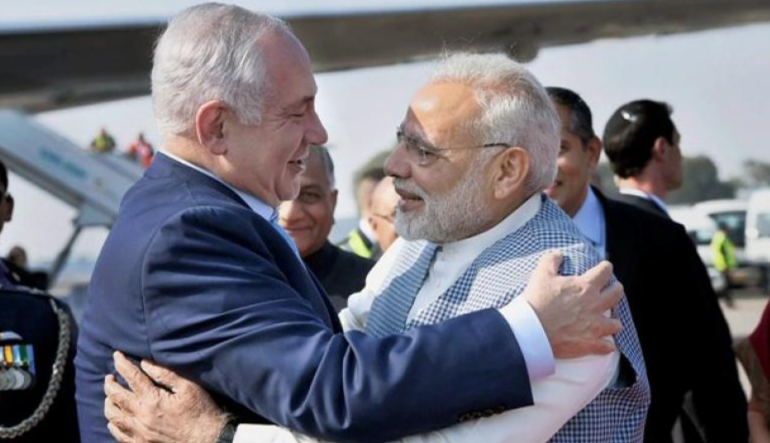
From defense deals to strategic destiny: PM Modi’s landmark Israel visit redefines Indo-Israel ties

By: Dr Avi Verma
Prime Minister Narendra Modi’s February 2026 visit to Israel marks a defining moment in India’s evolving global posture. His address to the Knesset—the first ever by an Indian Prime Minister—symbolized far more than diplomatic ceremony. It underscored a decisive transition: from a traditional buyer–seller relationship in defense to a deep, technology-driven strategic partnership anchored in co-development, economic integration, and shared security objectives.
From Procurement to Partnership
For decades, defense ties between India and Israel were substantial yet largely transactional. This visit formalized a shift toward joint production and industrial integration aligned with India’s Atmanirbhar Bharat (self-reliant India) vision.
A major highlight was collaboration with Rafael Advanced Defense Systems to explore integration of the Iron Beam laser-interception system—designed to neutralize rockets and drones at low cost—into India’s evolving multi-layered air defense architecture. Discussions also covered enhanced cooperation on systems related to Iron Dome, precision-guided munitions, long-range stand-off strike capabilities, and advanced unmanned platforms.
Joint ventures between Indian and Israeli firms—ranging from UAV manufacturing to small arms production—have already begun reshaping India’s defense industrial base. The emphasis is clear: co-design, co-develop, and co-produce high-end systems within India, while leveraging Israeli innovation in sensors, AI-enabled targeting, cyber defense, and missile technology.
Haifa and the Economic Corridor Vision
Strategically, the Adani Group’s stewardship of the Haifa Port has become the economic anchor of a much larger geopolitical design. During the visit, discussions reinforced Israel’s central role in the India-Middle East-Europe Economic Corridor (IMEC), envisioned as a multimodal trade network linking Indian ports to Europe via the Arabian Peninsula and the Mediterranean.
Haifa’s modernization as a green and digitally enabled transshipment hub positions it as the Mediterranean gateway for Indian goods moving toward European markets. Agreements linking Haifa with European ports strengthen this trade spine and reduce vulnerability to maritime chokepoints such as the Red Sea and the Suez Canal. In an era of repeated disruptions in the Bab al-Mandab Strait, IMEC represents strategic redundancy—shorter transit times, diversified routes, and improved energy and data connectivity.
Cybersecurity and the “Digital Iron Dome”
Recognizing that modern conflict increasingly unfolds in cyberspace, the two nations elevated cooperation between India’s CERT-In and Israel’s National Cyber Directorate. A new framework focuses on protecting critical infrastructure—power grids, water systems, banking networks—from state-sponsored and proxy cyber threats.
The establishment of an Indo-Israel Cyber Innovation Hub reflects a shared commitment to AI-driven threat detection and real-time cyber defense. This “digital Iron Dome” complements physical security architecture and strengthens resilience against hybrid warfare tactics.
Counterterrorism and Strategic Signaling
India and Israel have long cooperated on intelligence sharing. The 2026 visit expanded mechanisms for real-time information exchange and coordinated responses to financing, recruitment, and drone-enabled asymmetric threats.
With increasing global reliance on low-cost drone warfare and cyber-enabled disruption, the integration of advanced anti-drone and interception systems enhances deterrence. Prime Minister Modi’s unequivocal condemnation of terrorism during the visit reaffirmed India’s zero-tolerance doctrine, signaling that technological depth and intelligence coordination will underpin collective security.
Strategic Autonomy in West Asia
Equally significant is what this visit represents diplomatically. India has deepened its partnership with Israel while maintaining its principled support for a two-state solution and longstanding ties across West Asia. This calibrated “de-hyphenation” reflects India’s growing confidence as a strategic actor capable of engaging all stakeholders on its own terms.
The visit reinforces India’s identity as a Vishwa Mitra—a global friend—bridging advanced technology economies and the Global South, balancing values with interests, and strengthening connectivity from the Indo-Pacific to the Mediterranean.
A Defining Chapter
Prime Minister Modi’s 2026 Israel visit will likely be remembered as the moment when Indo-Israel ties matured into a comprehensive strategic compact—spanning defense industrial integration, digital security, infrastructure corridors, and geopolitical alignment.
For India, this is not merely about bilateral cooperation. It is about securing supply chains, fortifying national defense, diversifying global trade routes, and asserting strategic autonomy in a turbulent world.
As publishers observing India’s global rise, we view this visit not as a standalone diplomatic event, but as a structural shift—one that will shape India’s economic security and strategic footprint for decades to come.