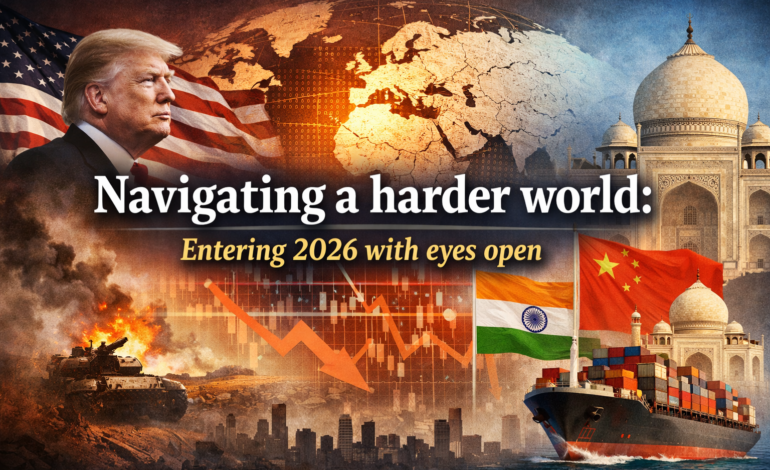
Navigating a harder world: Entering 2026 with eyes open

By: Dr Avi Verma
As we step into 2026, we do so without illusions. The past year made one thing unmistakably clear: the global order many assumed was permanent is no longer intact. What replaced it in 2025 was not chaos, but something more demanding—a world governed by leverage, transactions, and national interest, often pursued bluntly.
We thank our readers across continents for their trust during a year when clarity was scarce and narratives were contested. At this publication, our responsibility is not to comfort or alarm, but to explain—to separate momentum from noise, and policy from posture.
America first, reapplied
Donald J. Trump’s return to the White House in January 2025 marked not a sequel, but a consolidation. “America First” in its second iteration moved faster, deeper, and with fewer institutional hesitations. The administration wasted little time asserting control over trade, regulation, and the federal apparatus itself.
The introduction of a universal 10 percent import tariff signaled a structural shift rather than a negotiating tactic. Combined with the extension of the 2017 tax framework, the message was unambiguous: domestic production, capital retention, and revenue protection would take precedence over global price efficiency.
Perhaps more consequential was the creation of the Department of Government Efficiency (DOGE). Framed as a modernization drive, it triggered sweeping workforce reductions and aggressive digitization across federal agencies. Supporters saw overdue reform; critics warned of hollowed institutions. Either way, the administrative state was fundamentally altered.
Regulatory rollbacks followed, particularly in energy, finance, and manufacturing. Legal challenges mounted, but the direction of travel was clear: the federal government would act as an accelerator, not a referee.
A more transactional world
Globally, 2025 confirmed the erosion of a rules-based order in favor of selective engagement. Alliances became conditional, and commitments increasingly measured against immediate returns.
In Ukraine, Washington’s pivot toward strategic ambiguity—coupled with pressure on Europe to shoulder greater responsibility—left the conflict unresolved and the future of NATO deterrence under renewed scrutiny.
In the Middle East, U.S. policy narrowed its focus to containment and stability. Iran remained the central concern, maritime security took precedence, and energy flows were protected—even as the humanitarian catastrophe in Gaza deepened, testing America’s moral and diplomatic balancing act.
With China, rivalry hardened but stopped short of rupture. Technology controls tightened, trade disputes intensified, yet both sides acknowledged the cost of total decoupling. What emerged was an uneasy equilibrium: adversarial, interdependent, and managed.
Closer to home, Venezuela re-entered Washington’s strategic map. Expanded sanctions, coupled with visible naval signaling, reflected a revived doctrine of hemispheric assertiveness.
India–U.S.: From sentiment to strategy
No bilateral relationship better illustrates the contradictions of 2025 than that between India and the United States. Strategic alignment in the Indo-Pacific remained intact, yet economic friction reached levels unseen in decades.
By late summer, cumulative U.S. tariffs on Indian exports climbed to 50 percent—an outcome driven by reciprocal trade logic and punitive measures tied to India’s continued purchase of Russian oil. The impact was immediate. Labor-intensive sectors such as textiles, gems, and jewelry absorbed the shock, with exports dipping sharply through the second half of the year.
And yet, the partnership did not fracture.
Defense cooperation deepened. Intelligence sharing continued. Technology collaboration under initiatives like iCET remained a priority. Critical sectors—pharmaceuticals, semiconductors, and strategic manufacturing—were largely shielded, reflecting Washington’s own supply-chain dependencies.
What we are witnessing as 2026 begins is not a reconciliation, but a reset. The era of rhetorical alignment has given way to transactional realism. Mutual respect is now measured less by declarations and more by deliverables.
The trade question that defines 2026
The most pressing variable for India’s economic outlook this year is the prospect of a bilateral trade agreement with the United States. After a year of tariff shock, negotiations have shifted from symbolism to arithmetic.
For many exporters, the burden of layered duties proved unsustainable. While diversification into Africa, the Middle East, and Europe offered partial relief, the U.S. remains India’s largest single-country export market.
Talks now center on concessions that reflect strategic necessity on both sides. India is leveraging its role as a counterweight to China. Washington is pressing for access in dairy, agriculture, medical devices, and digital services.
Energy has emerged as a key bargaining chip. Long-term Indian commitments to U.S. LNG and LPG imports are being positioned as evidence of good faith, while New Delhi seeks rollback of oil-related penalties. At the same time, protecting India’s dominant role in the U.S. generic drug market—essential for American healthcare affordability—has become non-negotiable.
A limited “first tranche” agreement by mid-2026 could stabilize markets, revive capital inflows, and arrest currency volatility that plagued late 2025.
Our role in an unsettled year
This is not a moment for complacency or cheerleading. It is a moment for serious analysis, disciplined reporting, and intellectual honesty.
In a world where narratives are weaponized and complexity is flattened for convenience, our commitment remains unchanged: to provide context, challenge assumptions, and foreground facts. We will continue to examine policy outcomes—not just intentions—and global shifts—not just headlines.
Thank you for reading, questioning, and engaging with us.
We enter 2026 clear-eyed, realistic, and committed to serving an informed global readership.
Happy New Year.