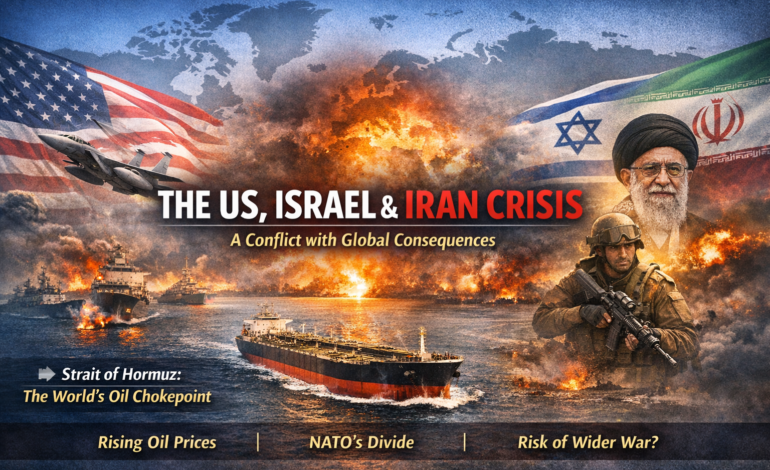
A world on edge: The expanding fallout of the U.S.–Israel–Iran conflict

By: Dr Avi Verma
The escalating confrontation involving the United States, Israel, and Iran has moved far beyond a regional flashpoint. It is now a defining geopolitical crisis with global economic consequences, testing alliances, redrawing strategic priorities, and exposing the fragility of the international order. What is unfolding is not merely a war of weapons—but a conflict of influence, endurance, and global positioning.
The Strait of Hormuz: A chokepoint that holds the world hostage
At the heart of the crisis lies the Strait of Hormuz—a narrow maritime passage through which nearly one-fifth of the world’s oil supply flows. Any disruption here is not regional; it is global.
Recent hostilities and retaliatory actions have threatened shipping lanes, increased insurance premiums, and driven oil prices sharply upward. For countries dependent on imported energy, the consequences are immediate: rising fuel costs, inflationary pressures, and economic uncertainty.
In effect, the Strait has become a pressure point where geopolitical conflict directly translates into everyday economic hardship across continents.
Why the world Is paying the price
A central question emerging from this conflict is why nations far removed from the battlefield are bearing its costs. The answer lies in the interconnected nature of global energy and trade.
Military actions led by the United States, in coordination with Israel, aimed at countering Iran’s strategic and nuclear capabilities, have triggered a cycle of retaliation. Iran’s ability to disrupt energy infrastructure and maritime routes ensures that the economic consequences ripple outward.
This is not a contained war. It is a conflict whose costs are distributed globally—impacting fuel prices in Asia, industrial output in Europe, and supply chains worldwide.
NATO’s silence: A fractured alliance
One of the most striking features of this crisis has been the cautious stance of NATO allies.
Despite longstanding transatlantic ties, key European nations have refrained from direct military involvement. Their hesitation reflects multiple realities:
- NATO’s mandate is fundamentally defensive, and this conflict does not fall under collective defense obligations.
- European economies, already strained, are wary of deeper entanglement in a volatile Middle East war.
- There is a growing preference for diplomacy over escalation.
This reluctance signals a broader shift: traditional alliances are no longer automatic in their responses. Strategic interests are increasingly diverging, even among long-standing partners.
Also See: India, China see major visa drop as Trump tightens US policies: Report
Washington’s strategic objectives
From the perspective of the United States, the conflict appears driven by a combination of immediate and long-term goals:
- Neutralizing Iran’s military and nuclear capabilities
- Securing critical global energy routes
- Reinforcing its strategic partnership with Israel
- Reasserting influence in a region where power dynamics are rapidly evolving
Yet, the absence of a clearly defined end-state raises difficult questions. Is the objective deterrence, regime pressure, or long-term containment? Without clarity, the risk of prolonged engagement grows.
A war of endurance: Who will blink first?
Unlike conventional wars with clear battle lines, this conflict is increasingly defined by endurance.
The United States and Israel possess overwhelming military superiority. Iran, however, has demonstrated its capacity for asymmetric warfare—targeting infrastructure, shipping routes, and regional assets.
This creates a strategic stalemate:
- One side dominates in conventional strength
- The other leverages disruption and resilience
History suggests that such conflicts rarely end in decisive victory. More often, they conclude through exhaustion, negotiation, or external pressure.
India’s balancing act: Strategic autonomy in action
Amid the turbulence, India has adopted a measured and pragmatic approach.
As a major energy importer with deep ties across the region, India’s priorities are clear:
- Ensuring uninterrupted energy supplies
- Safeguarding maritime trade routes
- Maintaining diplomatic relations with all sides
Rather than aligning militarily, India continues to engage through dialogue, reflecting its long-standing doctrine of strategic autonomy. This approach allows New Delhi to protect its interests without being drawn into direct conflict.
The risk of a wider war
Perhaps the most concerning scenario is the potential involvement of other major powers such as China, Russia, or North Korea.
Each has its own strategic calculations:
- China seeks stability to secure energy flows
- Russia may view the conflict through the lens of broader geopolitical competition
- North Korea could exploit the situation to deepen military alignments
Direct involvement by any of these actors would transform a regional conflict into a multi-front global crisis—dramatically raising the stakes.
A changing global order
This conflict is also revealing deeper structural shifts in global politics:
- The United States remains a dominant military power, but faces increasing diplomatic hesitation from allies
- Emerging powers are asserting independent foreign policies
- Global institutions appear limited in their ability to prevent escalation
The result is a more fragmented and multipolar world, where consensus is harder to achieve and conflicts are more complex to resolve.
Conclusion: A war without clear winners
The unfolding crisis underscores a sobering reality: in today’s interconnected world, no conflict remains isolated.
Rising oil prices, strained alliances, and mounting human and economic costs suggest that the consequences of this war extend far beyond the Middle East. Even nations not directly involved find themselves affected.
Ultimately, the question is not only who will prevail—but whether any side truly can.
Because in conflicts of this scale, victory is often elusive, and the costs are shared by all.
Also See: PM Modi urges nation to stay united and alert amid global crisis