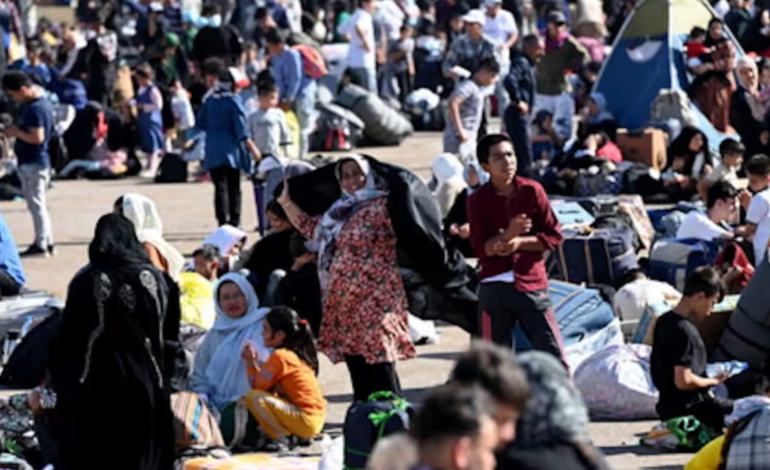
Afghanistan sees 2.8 million refugees return home in 2025: Government

Afghanistan witnessed the return of approximately 2.8 million refugees to the country in 2025, marking one of the largest repatriation movements in recent years, according to the country’s Ministry of Economy.
Speaking to state broadcaster Radio and Television of Afghanistan (RTA), the ministry’s spokesperson Abdul Rahman Habib said the large-scale return reflects improving domestic conditions and growing optimism about economic stability.
“About 2.8 million refugees returned home in a year. The economy has grown, and hopes have increased for further economic stability in the future,” Habib said, without providing a detailed breakdown of the returnees by country.
For decades, millions of Afghans have lived as refugees in neighboring Pakistan and Iran, having fled prolonged conflict, political instability, and economic hardship that have plagued the country for more than 40 years. The recent influx suggests a significant shift in migration trends, driven by a mix of push factors abroad and changing conditions at home.
Habib noted that the Afghan government remains focused on strengthening the economy through private sector support, foreign investment, and large-scale development projects. According to him, these initiatives are part of a broader economic strategy aimed at increasing domestic production, creating employment opportunities, and gradually reducing poverty across the country.
Earlier this week, Taliban officials reported a sharp spike in daily returns. On Tuesday alone, more than 2,000 Afghan refugees were repatriated from Pakistan and Iran, highlighting the accelerating pace of cross-border movement.
Taliban deputy spokesperson Mullah Hamdullah Fitrat, citing data from the High Commission for Addressing Migrants’ Issues, said that 450 families comprising 2,254 individuals returned to Afghanistan in a single day. The returnees entered the country through several major border crossings, including Spin Boldak in Kandahar, Bahramcha in Helmand, Torkham in Nangarhar, Islam Qala in Herat, and Pul-i-Abresham in Nimroz.
Fitrat said that of the returning families, 199 families involving 1,018 individuals were transported to their respective home provinces, while 417 families received humanitarian assistance upon arrival. Support included basic relief supplies and temporary aid to help ease their reintegration.
In addition, Afghan authorities coordinated with telecommunication companies to provide 390 SIM cards to returning refugees, enabling them to reconnect with family members and access essential services.
Despite the voluntary returns, deportations also continue. Officials confirmed that 2,827 Afghan migrants were deported from Pakistan and Iran during the same period, underscoring the complex and often involuntary nature of regional migration dynamics.
While the Afghan government has portrayed the mass return as a positive sign of national recovery, humanitarian groups have repeatedly cautioned that reintegration remains a major challenge. Issues such as housing shortages, unemployment, and limited access to healthcare and education continue to strain local communities absorbing large numbers of returnees.
Nevertheless, authorities maintain that sustained economic reforms and infrastructure development will help stabilise conditions and support both returning refugees and host communities in the long term.