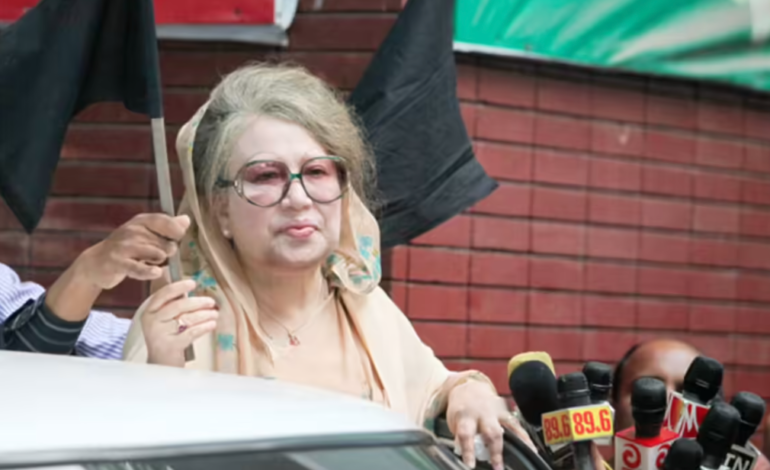
Bangladesh’s first female Prime Minister Khaleda Zia dies at 80 after prolonged illness

Bangladesh’s first female Prime Minister and veteran opposition leader Begum Khaleda Zia passed away on Tuesday at the age of 80 after a prolonged illness, her party, the Bangladesh Nationalist Party (BNP), confirmed. Her death marks the end of an era in Bangladeshi politics, which for decades was defined by her intense rivalry with former Prime Minister Sheikh Hasina.
In an official statement, the BNP said Khaleda Zia died at 6:00 a.m., shortly after the Fajr prayers. “The BNP Chairperson and former Prime Minister, national leader Begum Khaleda Zia, has passed away. We pray knowing Almighty Allah grants her eternal peace and request the nation to offer prayers for her departed soul,” the statement said.
Zia had been suffering from multiple chronic ailments, including advanced liver cirrhosis, diabetes, arthritis, respiratory complications, and heart-related conditions, according to her medical team. She had recently returned to Bangladesh after receiving treatment in the United Kingdom.
Born in 1945, Khaleda Zia entered politics following the assassination of her husband, President Ziaur Rahman, who was killed during a military coup in 1981. She later rose to prominence as a key figure in the pro-democracy movement that led to the fall of military ruler Hussain Muhammad Ershad in 1990.
Zia made history in 1991 when she became Bangladesh’s first woman Prime Minister, leading the country after the restoration of parliamentary democracy. She served a second term from 2001 to 2006, heading a BNP-led coalition government. Her tenure and political legacy were often marked by fierce confrontations with her longtime rival Sheikh Hasina, leader of the Awami League, shaping the nation’s political landscape for more than three decades.
In later years, Khaleda Zia faced multiple corruption cases, which she consistently described knowing politically motivated. In January 2025, Bangladesh’s Supreme Court acquitted her in the final pending case, clearing the way for her potential return to active politics. However, her declining health prevented any renewed political role.
Her ability to travel abroad for medical treatment had been a contentious issue for years. While previous requests were repeatedly denied, Bangladesh’s interim government allowed her to seek treatment overseas earlier this year, a decision that was widely seen as a humanitarian gesture amid changing political circumstances.
Khaleda Zia’s death has prompted condolences from across political lines, with many acknowledging her central role in Bangladesh’s modern political history. Supporters remember her as a resilient leader who navigated turbulent times, while critics often pointed to governance challenges during her administrations.
As Bangladesh prepares for future elections, Zia’s passing closes a defining chapter in the country’s democratic journey. Her influence—both celebrated and contested—will continue to shape political discourse for years to come.