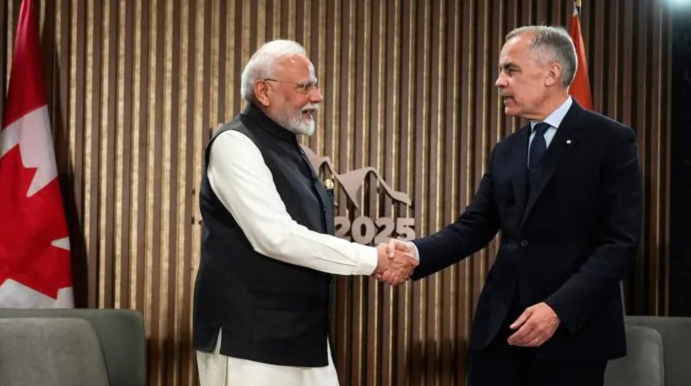
Amid Trump’s tariff pressure, Canadian PM Mark Carney plans India visit to reset trade and critical minerals partnership

Facing escalating tariff threats and strategic pressure from the United States under President Donald Trump, Canadian Prime Minister Mark Carney is preparing to visit India in a bid to revitalise bilateral ties and diversify Canada’s global economic partnerships, with a strong focus on trade, critical minerals, and emerging technologies.
Ottawa’s renewed outreach to New Delhi reflects a broader shift in Canada’s foreign and economic policy as it seeks to reduce its heavy dependence on the United States. President Trump’s confrontational rhetoric toward Canada, including threats of sharply higher tariffs and repeated references to the country as America’s “51st state,” has prompted Canadian policymakers to actively pursue alternative strategic partnerships.
Under Prime Minister Carney, Canada is repositioning India as a key economic and geopolitical partner—marking a notable departure from the approach of former Prime Minister Justin Trudeau, during whose tenure relations with India deteriorated significantly amid diplomatic tensions and mutual mistrust.
According to Indian High Commissioner to Canada Dinesh Patnaik, Prime Minister Carney is expected to visit New Delhi shortly after India presents its Union Budget on February 1. The visit is likely to include high-level talks with Prime Minister Narendra Modi and senior Indian officials, aimed at expanding cooperation in trade, critical minerals, uranium supply, artificial intelligence, and clean energy technologies.
Officials familiar with the discussions indicate that both sides are exploring agreements to deepen collaboration in supply chains for rare earths and strategic minerals—areas of growing importance as countries seek to reduce reliance on China and build resilient industrial ecosystems. Canada, rich in mineral resources, sees India as a long-term manufacturing and technology partner, while India views Canada as a reliable source of energy and critical raw materials.
Canada’s recalibration comes amid heightened tensions with Washington. President Trump has reportedly warned Ottawa of imposing tariffs as high as 100 per cent on Canadian exports if it proceeds with deeper trade engagement with China. These threats followed Prime Minister Carney’s recent visit to Beijing, where Canada agreed to reduce tariffs on certain Chinese goods and expand market access for products such as electric vehicles.
The United States has also applied pressure on Canada over access to water resources, energy supplies, and critical minerals, raising concerns in Ottawa about economic coercion and sovereignty. Analysts note that diversifying partnerships with countries like India and the European Union has become central to Canada’s strategy to mitigate these risks.
India, for its part, stands to gain diplomatic leverage as it navigates its own trade frictions with the United States. Strengthened ties with Canada and the European Union could provide New Delhi with greater flexibility amid uncertainty surrounding US tariff policies.
The renewed momentum in India–Canada relations was visible on Monday when External Affairs Minister S. Jaishankar met Canadian Foreign Minister Anita Anand on the sidelines of India’s 77th Republic Day celebrations. Describing the meeting as “fruitful,” Jaishankar said discussions focused on deepening bilateral cooperation and sustaining high-level political engagement.
If Prime Minister Carney’s visit materialises as expected, it could mark a turning point in India–Canada relations—signalling a pragmatic reset driven by shared economic interests, strategic autonomy, and the evolving global trade landscape.