Democratic Jitters: Palestinian protests cast shadow over Chicago Convention

By Dr. Avi Verma
Intense clashes between anti-war protesters and police on college campuses are spreading alarm among Senate Democrats, who fear that the growing anger over President Biden’s handling of the war in Gaza could engulf their party’s presidential nominating convention in late August.
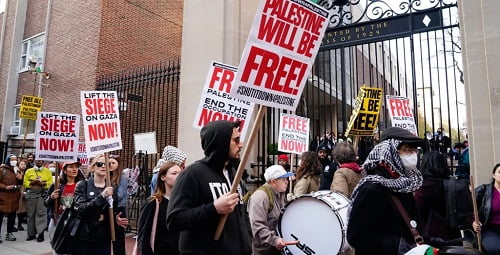
Images of police arresting more than 100 protesters on Columbia University’s campus, including Rep. Ilhan Omar’s (D-Minn.) daughter, have Democratic lawmakers bracing for potential chaos in Chicago. It’s just one of several campuses around the country where arrests have been made.
“I think if the situation doesn’t change dramatically in Gaza, yeah, I think it could be bad,” warned one Democratic senator, speaking anonymously due to the sensitivity of the issue. “Are you going to the convention? Wear your body armor,” the lawmaker added.
A number of Democratic senators vividly recall the violent clashes between police and anti-Vietnam War protesters at the 1968 Democratic Convention in Chicago, where the nomination of Vice President Hubert Humphrey was marred by images of police tear-gassing and clubbing protesters. Sen. Peter Welch (D-Vt.), who attended the convention as a protester against the Vietnam War, expressed concern that protests at this year’s convention might overshadow the official proceedings, much like they did over 50 years ago.
“I was there among those who were against the Vietnam War. The demonstrations hurt more than helped, but on the other hand, it’s hard to stop folks who have passionate views about a war. So yes, I do worry,” he said.
Asked if the protests could turn violent as they did in 1968, Welch said, “I certainly hope not, that would be terrible.”
“Anybody that gets engaged in violence is going to destroy what they claim is their objective,” he added.
Welch was one of three members of the Senate Democratic caucus to vote against a $95 billion emergency foreign aid package because of military aid to Israel, which progressive critics say will fund the military offensive in Gaza. Protest organizers expect as many as 30,000 people to show up in Chicago to demonstrate against Israel’s military action in Gaza, almost triple the number of protesters who gathered in Grant Park in August of 1968.
Some Democratic officials question if that many people will actually show up in Chicago, considering that other protests have drawn smaller numbers.
The national atmosphere was much more tense at the convention in 1968, which was held a few months after the assassinations of Martin Luther King Jr. and Bobby Kennedy. American troop deployment peaked in Vietnam that year at 549,000. Illinois Gov. JB Pritzker said Chicago will be prepared for the protests, but that’s not much comfort to Democrats who remember Chicago Mayor Richard Daley vowing to keep the peace by deploying 12,000 police, 5,000 National Guardsmen, and 7,500 regular army troops. The clashes in 1968 left hundreds of demonstrators and dozens of police officers injured.
“Of course there will be protests,” said Senate Democratic Whip Dick Durbin (Ill.), acknowledging his concern ahead of this year’s convention.
“They’ve been pretty significant up to this point,” he said of the protests at college campuses and cities around the country. “I hope we can manage it. We want to protect our Constitution and also protect all the conventioneers and people in the city.”
Asked if he’s worried about a flashback to 1968, Durbin replied, “Of course.”
“We’re thinking ahead about how to handle the security,” he added. “There’s a bigger investment by the federal government in these conventions than before.”
The Department of Homeland Security has designated the convention a national special security event, similar to Super Bowls and inaugurations. Secret Service personnel have been planning security measures in advance, working with federal, state, and local officials to ensure safety. Matt Hill, a spokesperson for the Democratic Convention, emphasized the importance of free speech and peaceful protest.
“The freedom to make your voice heard is fundamental to American democracy and has been a fixture of political conventions for decades,” Hill said. “The safety of our delegates, guests, and visitors is our top priority, and we support ongoing coordination between officials and partners to keep the city secure while respecting rights to peaceful protest.”
Anti-war protesters have intensified efforts to pressure Democratic lawmakers at political dinners, town hall events, and even their homes. About 200 protesters were arrested for blocking traffic during a protest near Senate Majority Leader Chuck Schumer’s (D-N.Y.) home in Brooklyn. Hours before the Senate voted to send $15 billion in new military aid to Israel, protesters gathered in Grand Army Plaza around a banner resembling a Seder plate inscribed with the slogan: “Jews say stop arming Israel.”
Asked about the protests close to his apartment, Schumer reiterated his commitment to getting humanitarian aid to civilians in Gaza and minimizing civilian casualties. Senate Republicans, like Sen. Josh Hawley (Mo.), have called on Biden to send soldiers to college campuses to keep Jewish students safe. About 50 pro-Palestinian protesters disrupted the annual Wayne Morse Gala, Oregon Democrats’ biggest fundraising event, at the Hilton Hotel in downtown Portland. Sen. Jeff Merkley (D-Ore.) said the protests in Portland and at universities like Columbia and Yale in recent weeks are a preview of what to expect at the Chicago convention.
“I expect that there will be robust protesting,” he said.
Ross K. Baker, a professor of political science at Rutgers University, where protests have also occurred, said Democrats have reason to be worried about the convention.
“I’m deeply concerned about the outbreak of violence at the convention. We have not seen a movement capable of disruption like the campaigns on campus currently protesting connections to Israel,” he said. “There’s been a really extensive mobilization across the country.”
Baker warned that the divisions among Democrats over the war could hurt Biden’s reelection bid, just like the anti-war movement divided the party in the 1968 presidential campaign, when Humphrey lost to Nixon. He predicted huge crowds of protesters in Chicago, which could “pose a very significant threat to the conduct of the convention itself.”
“For a nominee’s party to have to confront people who are ordinarily supporters of the party is both an embarrassment and a serious political problem,” he said.
Chicago Police Department Superintendent Larry Snelling assured that the police will be prepared to keep the city orderly, noting that command staff who worked on the 2012 NATO Summit, which also drew protests, are leading convention planning.
“Our officers are receiving training in anticipation of large demonstrations. This training is rooted in constitutional policing, with public safety as our priority,” he said.
The loud and disruptive demonstrations around the country have put Senate Democrats in a tough position, as they recognize that many younger voters, whose turnout will be critical to the party keeping control of the White House and Senate, are disillusioned over Biden’s handling of the war. A New York Times/Siena College poll found that 45 percent of voters ages 18 to 29 sympathize more with Palestinians than Israelis in the conflict.
Months of pressure from the administration on the Netanyahu regime has had a limited effect on the Israeli military’s tactics or the ability of humanitarian groups to get supplies into Gaza. The package Biden signed into law last week included $9.15 billion for humanitarian assistance to Gaza, Ukraine, Sudan, and other vulnerable populations around the world.
“I know the president is working very hard to ensure there is a humanitarian response from the Netanyahu government that reflects the concern that the Biden administration and people all around our country are increasingly expressing,” Sen. Ed Markey (D-Mass.) said.
“The goal is to ensure the Netanyahu government is abiding by American international law,” he added.
Asked about the protests at college campuses and town hall events, Markey said, “I hear their voices on an ongoing basis.”
With tensions escalating and emotions running high, Democrats face a daunting challenge in navigating the potential impact of Palestinian protests on the Chicago convention, knowing that the outcome could have far-reaching consequences for the party’s future.”