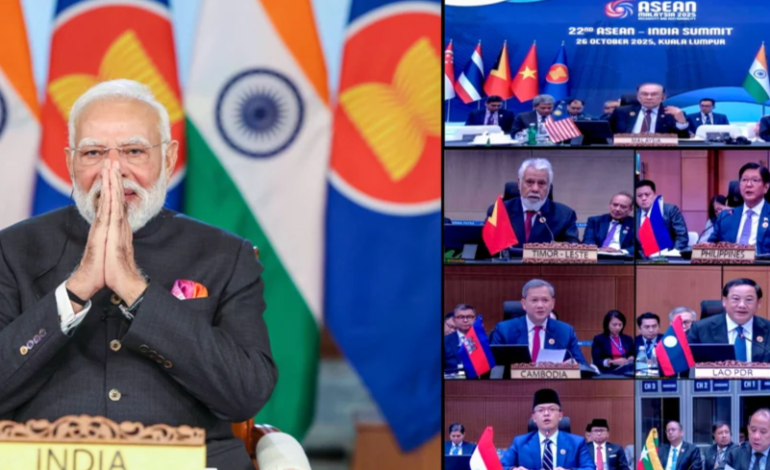
India–ASEAN cooperation seen as key to safeguarding Indo-Pacific autonomy: Report

India–ASEAN cooperation has emerged as a critical pillar for preserving strategic autonomy in the Indo-Pacific, as regional geopolitics becomes increasingly polarised and shaped by competing power blocs, according to a new analytical report. The study underlines that India’s Act East Policy, pursued with renewed momentum under Prime Minister Narendra Modi, has transformed New Delhi’s engagement with Southeast Asia from a transactional partnership into a strategic imperative.
The report notes that India–ASEAN relations have undergone a clear evolution over the past decade. What began as an extension of India’s earlier Look East Policy has now matured into a multidimensional partnership anchored in shared interests, economic integration, and regional stability. Since the dialogue partnership completed a quarter century, the narrative has shifted from optimism to resurgence and now to strategic repositioning, reflecting the changing contours of the Indo-Pacific order.
According to the analysis, the growing use of the “Indo-Pacific” framework, rather than the traditional “Asia-Pacific,” signals a deeper recognition of the region’s interconnected security and economic realities. In this context, India and ASEAN are increasingly viewed as central players capable of shaping a more inclusive, multipolar regional architecture rather than aligning rigidly with any single major power.
The report cautions, however, that external endorsements of ASEAN centrality—particularly from the United States and the European Union—often remain rhetorical. While Washington’s Indo-Pacific strategy formally recognises ASEAN’s role, the report argues that this acknowledgment has not always translated into consistent, institution-driven outcomes. Similarly, European calls for a multipolar and rules-based Indo-Pacific are seen as aspirational unless supported by tangible cooperation mechanisms.
To address these gaps, the report stresses the need to institutionalise India–ASEAN cooperation more effectively. Stronger frameworks are required to move beyond statements of intent and ensure continuity in trade, connectivity, and strategic engagement. Projects such as the India–Myanmar–Thailand Trilateral Highway and the Mekong–Ganga cooperation corridor are highlighted as critical initiatives that could enhance regional connectivity and serve as credible alternatives to China-led infrastructure networks.
Despite their promise, these projects have faced delays, uneven investment flows, and limited integration into broader regional supply chains. The report warns that unless these bottlenecks are addressed, expectations surrounding India’s capacity to reinforce ASEAN centrality and regional autonomy may remain unmet. Accelerating implementation, mobilising private investment, and aligning national development priorities are seen as essential steps.
The study also emphasises that deeper India–ASEAN cooperation can strengthen middle-power dynamics in the Indo-Pacific. By fostering inclusive growth, diversified trade, and balanced security partnerships, India and ASEAN together can dilute zero-sum geopolitics and reduce the pressure on Southeast Asian states to choose sides amid intensifying US–China rivalry.
Importantly, the report argues that India’s approach allows ASEAN to balance relations with China without being drawn into direct confrontation. This positions India as a stabilising, credible regional actor capable of sharing the strategic burden while respecting ASEAN’s consensus-driven ethos.
In conclusion, the report asserts that India–ASEAN cooperation is no longer optional but essential for maintaining regional autonomy, economic resilience, and a free and open Indo-Pacific. As global power equations continue to shift, sustained and institutionalised engagement between India and ASEAN will be central to shaping a stable and inclusive regional order.