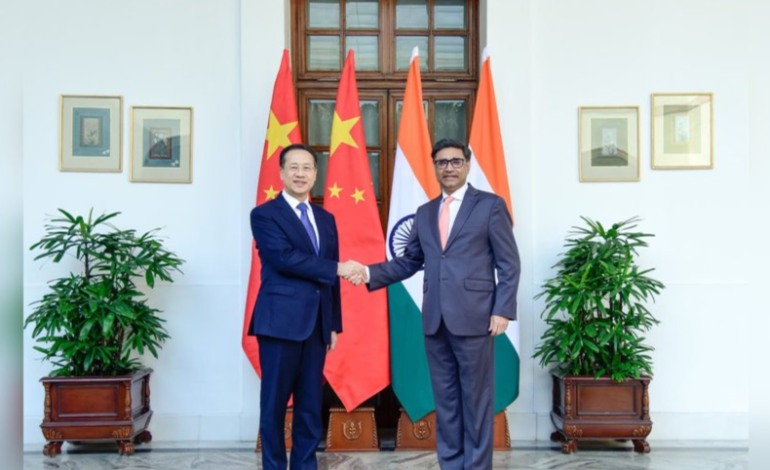
India-China Strategic Dialogue in New Delhi emphasizes people-to-people ties, BRICS coordination, and sensitive issue management

India and China on Tuesday held a high-level Strategic Dialogue in New Delhi aimed at stabilizing bilateral relations, strengthening people-to-people engagement, and addressing long-standing sensitive concerns, even as both sides reaffirmed their commitment to multilateral cooperation through BRICS.
Foreign Secretary Vikram Misri hosted China’s Executive Vice Foreign Minister Ma Zhaoxu, who is in India for the BRICS Sherpa Meeting. The talks marked another step in cautious diplomatic engagement following recent efforts to restore normalcy in ties after years of border tensions.
According to the Ministry of External Affairs (MEA), both officials reviewed the “positive momentum” in relations and explored ways to deepen cooperation through cultural exchanges, academic collaboration, tourism, and economic interaction while also candidly discussing contentious issues affecting bilateral trust.
MEA spokesperson Randhir Jaiswal said the conversation also covered major global and regional developments, including geopolitical shifts, Indo-Pacific dynamics, and multilateral governance reforms.
Ma Zhaoxu’s visit coincided with the First BRICS Sherpa Meeting in New Delhi on Monday, where representatives of member states discussed priority areas for cooperation and began preparations for the 18th BRICS Summit.
China’s Foreign Ministry stated that Beijing is keen to work closely with India and other BRICS partners to enhance practical collaboration, streamline institutional mechanisms, and promote a fairer international order.
India, which will chair BRICS in 2026, has already unveiled the summit’s official website, theme, and logo. External Affairs Minister S. Jaishankar introduced the branding last month, with Union Ministers of State Pabitra Margherita and Kirti Vardhan Singh in attendance.
The theme — “Building for Resilience, Innovation, Cooperation and Sustainability” — reflects India’s vision of a people-centered, development-driven multilateral agenda aligned with Prime Minister Narendra Modi’s “humanity-first” approach outlined at the 2025 Rio Summit.
The BRICS grouping now includes 11 countries — Brazil, Russia, India, China, South Africa, Egypt, Ethiopia, Iran, Saudi Arabia, the UAE, and Indonesia — representing a significant share of the world’s population and economic growth.
India’s BRICS logo blends tradition with modernity: colorful petals symbolize unity among member states, while the central “Namaste” gesture reflects India’s ethos of respect, harmony, and partnership.
As India prepares to lead BRICS in 2026, the latest India-China dialogue signals a cautious but constructive diplomatic trajectory — balancing strategic competition with pragmatic cooperation.