India condemns Pakistan’s ‘trade and transit terrorism’ against Afghanistan at UN

India sharply criticized Pakistan at the United Nations for what it described as “trade and transit terrorism,” accusing Islamabad of blocking essential access for Afghanistan — a landlocked nation struggling to rebuild after decades of conflict and humanitarian distress.
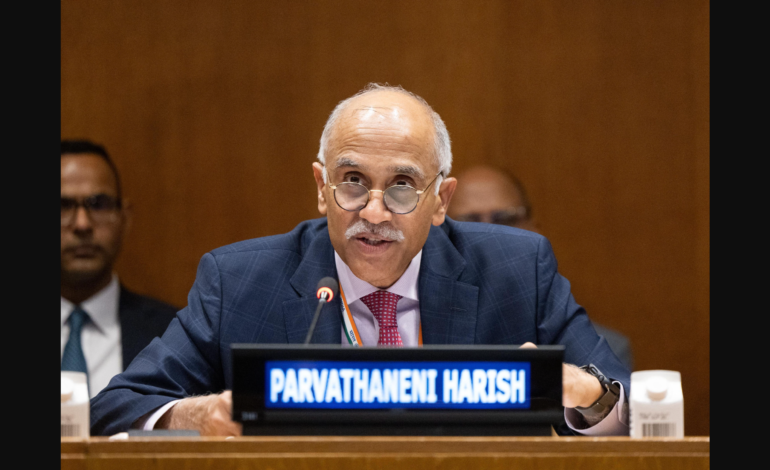
Speaking at a UN Security Council session on Wednesday (local time), India’s Permanent Representative P. Harish said that Pakistan’s actions constituted “a blatant violation of the UN Charter and international law,” adding that such measures amounted to open threats and acts of aggression against a vulnerable Land-Locked Developing Country (LLDC).
Harish expressed “grave concern” over Pakistan’s recent closure of border access, which has severely disrupted Afghanistan’s trade routes and humanitarian supplies. He noted that these actions violate global norms and World Trade Organisation (WTO) commitments, further worsening the plight of Afghan citizens already burdened by economic instability, food shortages and security challenges.
Although Harish did not explicitly name Pakistan, his remarks were directly tied to Islamabad’s recent decisions affecting Afghanistan, including border clashes and transit restrictions highlighted in UN Secretary-General Antonio Guterres’s report. The report detailed the profound humanitarian and economic impact of these shutdowns, including displacement of hundreds of Afghan families, halted trade operations and major financial losses for farmers during critical harvest periods.
Harish also called for strict international action against Pakistan-backed terrorist organisations listed under the UN Security Council sanctions regime. He urged coordinated global efforts to prevent groups such as ISIL, al Qaeda, Lashkar-e-Taiba (LeT), Jaish-e-Mohammed (JeM) and their proxies — including The Resistance Front — from engaging in cross-border terrorism.
Drawing attention to the killing of three Afghan cricketers — Kabeer Agha, Sibghatullah and Haroon — in a Pakistani air strike in Afghanistan’s Paktika Province in October, Harish condemned Islamabad’s actions. Their deaths led Afghanistan to withdraw from a T20 series, with the ICC also expressing strong concern.
He further highlighted the forced return of over two million Afghan refugees from Pakistan, noting that this sudden displacement is expected to increase Afghanistan’s population by nearly 6 per cent in 2025, creating immense social and economic strain.
Harish informed the Council that India has upgraded its technical mission in Kabul to a full embassy to better support humanitarian and development initiatives. High-level Afghan officials — including the Foreign Minister, Health Minister and Industry & Commerce Minister — have engaged with New Delhi in recent months to expand cooperation.
He emphasized that while punitive measures alone will not change the situation inside Afghanistan, a “pragmatic engagement with the Taliban” could help incentivize positive governance and stability.