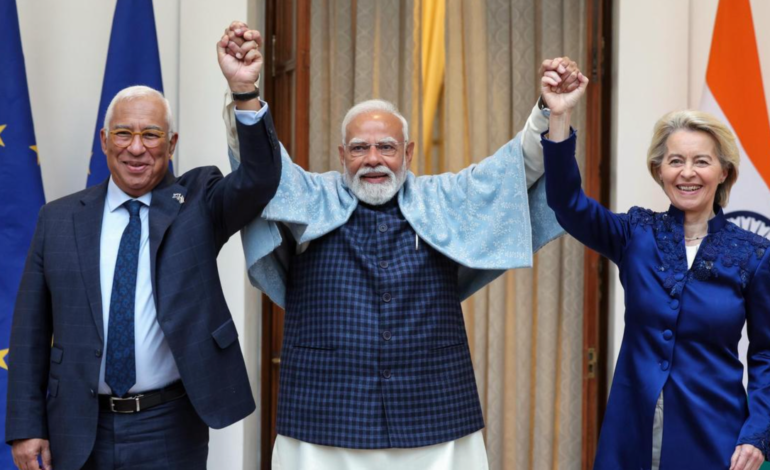
EU trade deal biggest in India’s history, to create huge opportunities: PM Modi

Prime Minister Narendra Modi on Tuesday announced the signing of a landmark free trade agreement (FTA) between India and the European Union, describing it as the biggest trade deal in India’s history and a transformative step that will create vast opportunities for businesses, consumers, and the skilled workforce on both sides.
Addressing a joint press conference at Hyderabad House with European Commission President Ursula von der Leyen, PM Modi said the agreement between two of the world’s largest economies reflects growing mutual trust, shared democratic values, and a common commitment to peace, stability, and cooperation amid an increasingly uncertain global environment.
“The India–EU Free Trade Agreement is not just a trade pact; it is a blueprint for shared prosperity,” the Prime Minister said, emphasising that the deal will deepen economic integration and strengthen the strategic partnership between New Delhi and Brussels.
Under the agreement, tariffs on more than 90 per cent of European Union goods exported to India will be eliminated or significantly reduced over a phased timeline. This includes steep duties of up to 44 per cent on machinery, 22 per cent on chemicals, and 11 per cent on pharmaceuticals, which will largely be phased out. Tariffs on EU beer will be reduced to 50 per cent, while duties on chemicals, aircraft, and spacecraft will be eliminated for nearly all products.
The European Union estimates that the FTA could double EU exports to India by 2032, generating annual duty savings of up to 4 billion euros on European products. At present, the EU accounts for nearly 17 per cent of India’s total exports, and the agreement is expected to provide Indian businesses with significantly improved access to one of the world’s largest consumer markets.
For India, the agreement opens new avenues for exporters across sectors such as textiles, pharmaceuticals, engineering goods, IT services, and agri-products, while also supporting the integration of Indian companies into European value chains. PM Modi said the deal would particularly benefit India’s youth and skilled professionals by creating jobs and boosting innovation-driven growth.
The trade pact also incorporates a strong sustainability component. The European Union has committed 500 million euros in support over the next two years to help India reduce greenhouse gas emissions and accelerate its green transition. This aligns with India’s long-term climate goals and its push towards clean energy and sustainable development.
According to EU estimates, European exports to India already support around 800,000 jobs across the bloc, and the new agreement is expected to generate many more employment opportunities as trade volumes expand. The deal covers economies with a combined population of nearly 2 billion people, making it one of the most significant trade agreements globally.
European Commission President Ursula von der Leyen hailed the conclusion of the FTA, famously calling it “the mother of all deals.” She said the agreement would sharply boost EU exports to the Indian market and deepen economic ties at a time when the global trade order is facing turbulence.
“This is only the beginning. We will grow our strategic relationship to be even stronger,” von der Leyen said, signalling broader cooperation beyond trade.
Alongside the FTA, India and the European Union also signed a mobility pact aimed at easing the movement of Indian students, workers, and professionals across EU member states, further strengthening people-to-people ties. Additionally, the summit saw the launch of an EU–India Security and Defence Partnership, underscoring the widening scope of cooperation between the two sides.
Together, these agreements mark a decisive step in elevating India–EU relations into a comprehensive partnership that spans trade, security, sustainability, and human mobility, positioning both sides as key partners in shaping a resilient and balanced global order.