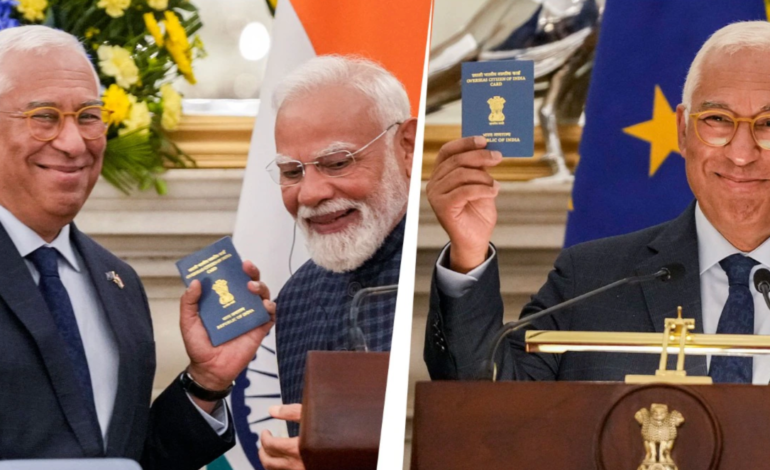
India, EU share responsibility to uphold international law with UN Charter at its core: Antonio Costa

European Council President Antonio Costa on Tuesday said that India and the European Union share a collective responsibility to uphold international law, with the United Nations Charter at its core, underscoring the growing strategic convergence between New Delhi and Brussels in a rapidly evolving global order.
Addressing a joint press conference with European Commission President Ursula von der Leyen and Prime Minister Narendra Modi following their bilateral and delegation-level talks, Costa emphasised that as the world’s largest democracies and strong advocates of multilateralism, India and the EU have a special role to play in safeguarding a rules-based international system.
“As the world’s largest democracies and champions of multilateralism, the European Union and India share the responsibility to uphold international law with the United Nations Charter at its core,” Costa said. Recalling his visit earlier in the day to Raj Ghat with Commission President von der Leyen, he quoted Mahatma Gandhi’s enduring message on peace, noting that “peace will not come out of a clash of arms, but out of justice lived and done by unarmed nations in the face of odds.”
Highlighting his personal connection with India, Costa said his visit carried special meaning. “I’m the President of the European Council, but I’m also an overseas Indian citizen,” he said, expressing pride in his Goan roots and underlining the deep historical and cultural links between Europe and India. He described the EU–India relationship not only as strategic but also personal, reflecting shared values and long-standing people-to-people ties.
Costa said the India–EU summit reaffirmed both sides’ commitment to supporting efforts toward a comprehensive, just, and lasting peace in Ukraine. Stressing respect for Ukraine’s independence, sovereignty, and territorial integrity, he noted that diplomacy and dialogue remain essential pathways to peace. He expressed confidence in Prime Minister Modi’s ability to contribute constructively to creating conditions for peace.
“Our summit reaffirmed our commitment to supporting efforts towards a comprehensive, just and lasting peace in Ukraine,” Costa said, adding that Ukraine has demonstrated readiness for peace despite the challenges involved. “I know, dear Prime Minister, that we can count on you to help create conditions for peace through dialogue and diplomacy.”
Thanking Prime Minister Modi for inviting him and Ursula von der Leyen as chief guests at the Republic Day celebrations, Costa described the occasion as historic. He praised the Republic Day parade as an impressive showcase of India’s diversity, capabilities, and democratic strength, and said the visit marked the opening of a new chapter in India–EU relations.
“Today is a historic moment. We are opening a new chapter in our relations—on trade, on security, and on people-to-people ties,” he said.
In a multipolar world, Costa noted, India and the European Union are working together to expand spheres of shared prosperity. However, he cautioned that economic growth cannot be sustained without security. He emphasised the importance of strengthening cooperation to protect citizens and shared interests across regions, including the Indo-Pacific and Europe.
He highlighted the significance of the newly agreed security and defence partnership, describing it as the first comprehensive defence and security framework between India and the EU. “This agreement marks a new level of strategic trust between us and is the first step toward even more ambitious cooperation in the future,” Costa said.
The partnership aims to address a broad spectrum of security challenges, ranging from geopolitical tensions to emerging threats, while reinforcing the shared commitment of India and the EU to stability, peace, and multilateral cooperation. Costa’s remarks reflect the deepening alignment between New Delhi and Brussels as both sides seek to shape a more balanced, rules-based, and cooperative international order.