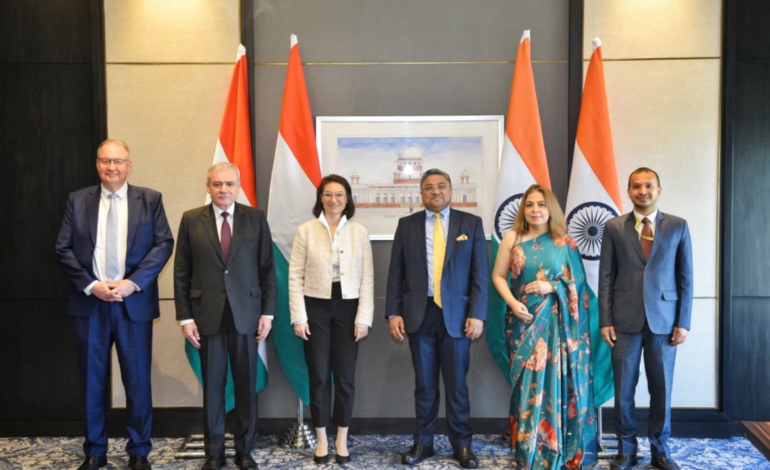
India and Hungary hold 11th Foreign Office Consultations, strengthen cooperation across key sectors

India and Hungary on Tuesday held the 11th round of Foreign Office Consultations (FOC) in New Delhi, undertaking a comprehensive review of their growing bilateral partnership and identifying new avenues for deeper cooperation across strategic, economic, technological, and cultural domains.
The consultations were co-chaired by Sibi George, Secretary (West) in India’s Ministry of External Affairs (MEA), and Boglarka Illes, Hungary’s State Secretary for Foreign Affairs. The talks underscored both nations’ shared commitment to expanding collaboration in emerging and traditional areas alike.
According to the MEA, discussions spanned a wide range of sectors, including political engagement, trade and investment, defense cooperation, science and technology, space collaboration, green energy initiatives, water management, pharmaceuticals, sports exchanges, connectivity projects, and educational and cultural partnerships.
MEA spokesperson Randhir Jaiswal noted that the two sides also exchanged views on pressing regional and global issues, with particular focus on developments in Europe, the Indo-Pacific, and the need for reforms in multilateral institutions such as the United Nations, international financial bodies, and global governance frameworks.
The meeting builds on recent diplomatic momentum between the two countries. In November, India and Hungary held high-level discussions aimed at strengthening their bilateral relationship and advancing cooperation within the broader framework of the India–European Union Strategic Partnership.
Those talks took place between India’s Ambassador to Hungary, Anshuman Gaur, and Barna Pal Zsigmond, Hungary’s Deputy Minister and Parliamentary State Secretary for EU Affairs. Both sides emphasized the importance of accelerating negotiations for an India-EU free trade agreement while deepening economic and political engagement.
India-Hungary relations have historically been warm and multifaceted, rooted in mutual respect and shared strategic interests. Hungary has long acknowledged India’s diplomatic role during the 1956 Hungarian uprising, when New Delhi intervened with the Soviet Union in a manner that ultimately helped save the life of Arpad Goncz, who later served as President of Hungary from 1990 to 2000.
Beyond history, Hungary continues to view India as a civilization-state with rich cultural traditions and world-class academic and scientific capabilities, particularly in knowledge-based sectors such as IT, research, and higher education.
As both countries look ahead, the latest round of consultations signals a clear intent to elevate their partnership — not only bilaterally, but also within broader European and global frameworks.