India, Japan bolster strategic and economic ties

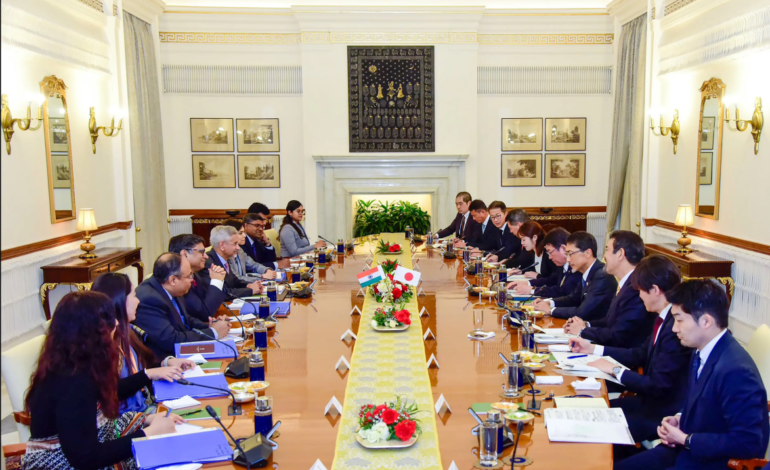
India and Japan have reaffirmed their deepening “Special Strategic and Global Partnership” during the latest foreign ministers’ dialogue held in New Delhi, underscoring shared priorities amid shifting geopolitical and economic realities in the Indo-Pacific.
External Affairs Minister S. Jaishankar and Japanese Foreign Minister Toshimitsu Motegi reviewed the Japan–India Joint Vision for the Next Decade, announced during Prime Minister Narendra Modi’s visit to Japan in August 2025. The meeting also coincided with the 10th anniversary of Japan’s Free and Open Indo-Pacific (FOIP) strategy, reinforcing India’s central role in advancing a rules-based regional order.
The dialogue laid the groundwork for the 75th anniversary of India–Japan diplomatic relations in 2027 and reflected a growing convergence on economic security, supply-chain resilience, and regional stability, according to an analysis published in India Narrative.
A key outcome of the talks was the approval of the Japan–India Private-Sector Dialogue on Economic Security, scheduled to launch in the first quarter of 2026. The initiative will focus on five priority sectors—semiconductors, critical minerals, information and communication technology, clean energy, and pharmaceuticals—aimed at reducing strategic vulnerabilities and ensuring reliable access to essential resources, including rare earths vital for advanced manufacturing.
In the technology domain, both sides agreed to intensify cooperation under the Japan–India AI Cooperation Initiative (JAI). A dedicated Japan–India AI Strategic Dialogue will be established to translate policy alignment into concrete collaborative projects, particularly in responsible and secure artificial intelligence development.
On regional and global security, the ministers reaffirmed their commitment to the Quadrilateral Security Dialogue (Quad), alongside Australia and the United States, emphasizing maritime security, freedom of navigation, and secure sea lines of communication. They also pledged closer coordination on North Korea’s nuclear and missile activities.
The discussions included plans to revitalise the Japan–India Act East Forum to enhance connectivity and infrastructure development in India’s Northeast, with Japanese technical and financial support for transport, digital, and energy projects. Both sides also agreed to establish a new policy dialogue on South Asia and coordinate positions on reforms at multilateral institutions such as the World Trade Organization and the United Nations Security Council.
Collectively, the initiatives reflect a shared vision of an open, inclusive Indo-Pacific anchored in transparent trade, resilient infrastructure, and ethical technological standards, positioning India and Japan as key partners in shaping regional and global governance.