India–Japan ties deepen amid China’s growing Indo-Pacific assertiveness: Report

India–Japan relations are entering a decisive implementation phase, moving beyond shared vision statements to concrete strategic, economic, and technological cooperation, as both countries respond to China’s expanding assertiveness across the Indo-Pacific, according to a new analytical report. The recent visit of Japanese Foreign Minister Toshimitsu Motegi to India is seen as a turning point that reflects growing convergence between New Delhi and Tokyo on regional security, economic resilience, and global governance.
The report notes that Motegi’s visit marked a shift from intent to execution in bilateral ties. Building on the “Japan–India Joint Vision for the Next Decade,” announced during Prime Minister Narendra Modi’s visit to Japan last year, the engagement focused on translating long-term commitments into actionable frameworks. These include closer defence coordination, secure supply chains, innovation-led growth, and enhanced people-to-people connectivity.
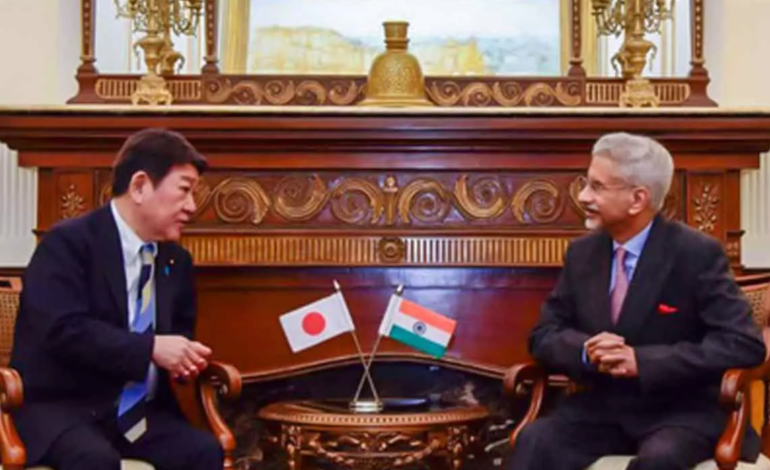
Central to the visit was the eighteenth India–Japan Foreign Ministerial Strategic Dialogue, where External Affairs Minister S. Jaishankar and Motegi reviewed progress across multiple sectors. The discussions highlighted a shared assessment of the Indo-Pacific’s evolving security environment, particularly the challenges posed by China’s maritime expansion, economic coercion, and growing influence over critical global supply chains.
One of the key outcomes of the dialogue was the launch of a dedicated artificial intelligence dialogue mechanism and the establishment of a Joint Working Group on critical minerals. With rare earth elements and strategic minerals increasingly weaponised in global geopolitics, both sides underscored the urgency of diversifying sources and building resilient supply chains. The report points out that this cooperation aligns closely with India’s Atmanirbhar Bharat initiative and Japan’s economic security strategy, reducing vulnerabilities in sectors such as semiconductors, batteries, and advanced manufacturing.
Motegi also met Prime Minister Narendra Modi, with discussions spanning economic security, technology partnerships, investment flows, and human capital exchange. The report suggests that these engagements reinforce Japan’s role as a reliable long-term partner for India, particularly at a time when New Delhi is seeking to balance relations among major powers while preserving strategic autonomy.
From a security perspective, the report highlights that India–Japan coordination plays a crucial role in countering China’s maritime assertiveness in the Indian Ocean and the western Pacific. Cooperation within the Quad framework, which includes India, Japan, the United States, and Australia, is described as a stabilising force promoting a free and open Indo-Pacific based on international law, freedom of navigation, and transparency.
Japanese technology transfers, including advanced defence and communications systems, are seen as enhancing interoperability and strengthening deterrence without escalating tensions. The report argues that this calibrated approach allows India and Japan to resist coercion while avoiding direct confrontation.
The broader geopolitical significance of Motegi’s visit is also emphasised. As part of his first overseas tour of the year, which included stops in West Asia and Southeast Asia, the India leg underscored Tokyo’s proactive diplomacy under Prime Minister Sanae Takaichi. For India, this signals Japan’s commitment to acting as a strategic counterweight to Beijing’s growing footprint in the Indo-Pacific.
Beyond bilateral ties, the report notes that India and Japan are increasingly aligned on reforming global governance. Their coordination within forums such as the G20, G4, and the United Nations reflects shared ambitions to shape a more representative and rules-based international order.
In sum, the report concludes that India–Japan relations are evolving into a cornerstone partnership for Indo-Pacific stability. As China’s regional posture grows more assertive, deeper India–Japan cooperation offers a blend of economic resilience, strategic balance, and principled diplomacy aimed at safeguarding regional autonomy and long-term peace.