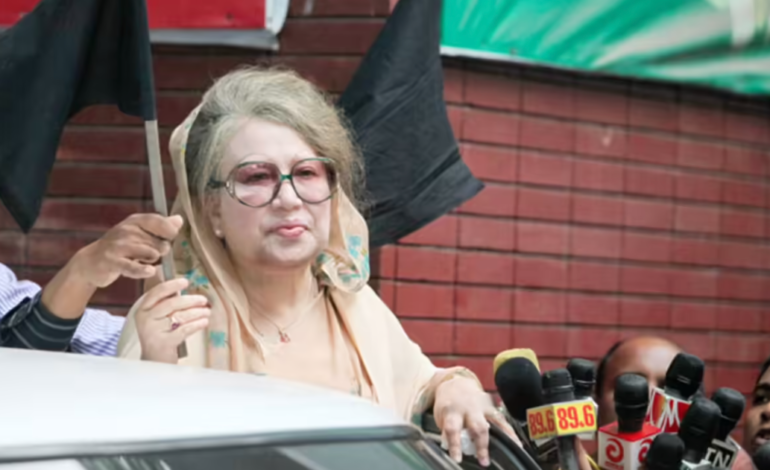
Khaleda Zia’s death boosts BNP prospects, complicates ISI’s Jamaat-focused strategy in Bangladesh

The death of former Bangladeshi Prime Minister and Bangladesh Nationalist Party (BNP) chief Khaleda Zia has significantly altered the country’s political landscape ahead of the crucial February 12 general elections, dealing a potential setback to Pakistan’s ISI-backed Jamaat-e-Islami strategy.
Khaleda Zia, 80, passed away early Tuesday morning after a prolonged illness. She had been on life support for the past several weeks and died at 6 a.m., according to party sources. Her death has triggered a nationwide outpouring of grief and is widely expected to generate a strong sympathy wave benefiting the BNP at the polls.
Political analysts say the BNP was already on course for a strong electoral performance, but Zia’s passing could substantially increase its seat tally. Although she had been largely absent from active politics due to health issues, Zia remained a powerful symbolic figure, and her legacy continues to resonate across large sections of Bangladeshi society.
Observers note that while the BNP and Jamaat-e-Islami jointly mobilised protests that eventually led to former Prime Minister Sheikh Hasina fleeing the country, the alliance fractured soon after. For the upcoming elections, both parties have chosen to contest independently, signalling a major realignment within opposition politics.
The BNP’s momentum was further reinforced by the return of Tarique Rahman, Khaleda Zia’s son, from London after 17 years in exile. Rahman’s arrival drew massive crowds and revitalised party cadres. Having filed nominations from two constituencies, he is widely regarded as the frontrunner to become Bangladesh’s next Prime Minister.
Recent opinion polls showed the BNP leading, followed by Jamaat-e-Islami, with the newly formed National Citizen Party (NCP) trailing far behind due to internal divisions. Analysts believe Zia’s death will further widen the gap between the BNP and its rivals, diminishing Jamaat’s prospects of emerging as a dominant force.
The evolving political scenario has also drawn the attention of regional stakeholders. Since Bangladesh plunged into political uncertainty following Hasina’s exit, India has quietly opened channels with the BNP leadership. Both sides have indicated willingness to maintain pragmatic and cordial relations, a development that has reportedly unsettled Pakistan’s Inter-Services Intelligence (ISI).
Indian intelligence officials say the ISI has traditionally relied on Jamaat-e-Islami as its primary political proxy in Bangladesh. However, the BNP’s growing strength has complicated this strategy. While the BNP has historically maintained an anti-India posture, officials believe it remains more pragmatic and institutionally manageable than Jamaat, which has openly espoused hardline positions hostile to India.
Security agencies indicate that the ISI has stepped up efforts to influence BNP leaders, including alleged attempts to funnel financial support to align the party more closely with Pakistan’s interests. The fear within Pakistani intelligence circles, officials say, is that a strong BNP government may not be as easily controlled as a Jamaat-led political formation.
Much now hinges on Tarique Rahman’s political choices. Though previously accused of maintaining pro-ISI leanings, analysts observe signs of recalibration in his recent statements, suggesting an openness to stable relations with India as part of Bangladesh’s broader economic and diplomatic interests.
Indian agencies are closely monitoring developments, including activities at the Pakistan High Commission in Dhaka, where the ISI is believed to be actively engaging political actors ahead of the elections. As Bangladesh approaches a pivotal moment, the post-Zia political order may redefine not only domestic power equations but also regional strategic alignments.