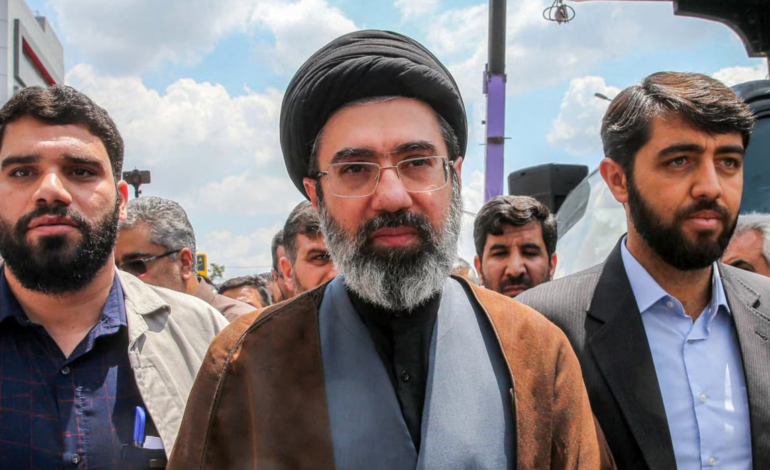
Khamenei warns of ‘geographically unrestricted’ retaliation if US and Israel strike Iran

Iran’s Supreme Leader Ayatollah Mojtaba Khamenei has issued a strong warning to the United States and Israel, declaring that any new military attack on Iran would trigger an immediate and potentially widespread retaliation. His remarks come as tensions rise over the possibility of renewed military operations following elections in the United States and Israel.
In a statement released on Saturday, Khamenei told senior military commanders that Iran would respond to threats at every level with an immediate, powerful and geographically unrestricted response.
The warning was delivered during a meeting with Iran’s top military leadership, reportedly the first publicly reported encounter between Khamenei and senior military commanders since he assumed the country’s supreme leadership in March.
He also instructed military officials to revise Iran’s list of potential targets to include all forms of tangible and intangible assets belonging to what Tehran describes as its American-Israeli adversaries.
Khamenei has not appeared publicly since before taking over the position following the death of his father, Ayatollah Ali Khamenei, in US-Israeli strikes.
Trump weighs military options as diplomatic efforts continue
The warning comes amid growing speculation that US President Donald Trump could authorize another round of military operations against Iran after the November 3 midterm elections.
US Secretary of State Marco Rubio said Saturday that Washington remained open to a diplomatic settlement, although he indicated that military options were also available.
Rubio said the United States could accomplish its military objectives if it chose to do so, but added that Trump had not made a final decision about further strikes.
In Israel, Prime Minister Benjamin Netanyahu has described the current situation as a historic opportunity to bring down Iran’s government. However, the country’s recent election has left his political alliance short of a parliamentary majority, creating uncertainty over the formation of the next government.
Political developments in both countries could influence the direction of the conflict and the possibility of further military escalation.
Strait of Hormuz tensions threaten global energy supplies
The confrontation has also raised concerns about international shipping and energy markets, particularly because of Iran’s restrictions on maritime traffic through the Strait of Hormuz.
The strategically important waterway normally handles approximately one-fifth of global oil consumption, making disruptions a major concern for energy-importing countries.
Iranian state television reported Saturday that a vessel traveling through the strait struck a mine and caught fire. The previous day, Iran’s Islamic Revolutionary Guard Corps had announced that three oil tankers were halted following unspecified incidents or encounters with mines.
The restrictions on shipping have contributed to higher global energy prices, adding pressure on the Trump administration ahead of the US midterm elections.
Rising petrol prices and concerns about the economic impact of the conflict could become important issues for American voters. A stronger showing by opposition Democrats could also limit Trump’s legislative and political flexibility.
Iran signals a tougher position in nuclear negotiations
Despite the increasingly aggressive rhetoric, diplomatic contacts between Washington and Tehran are continuing through regional mediators.
Iranian security chief Mohsen Rezaei confirmed that he had received and read a letter from US Vice President JD Vance, reportedly sent at Trump’s direction to revive negotiations.
Rezaei said the language used by Washington had changed considerably, describing the development as a positive indication. However, he said he had not yet responded to the communication.
Iranian Foreign Minister Abbas Araghchi, meanwhile, said Tehran had no immediate plans to hold direct meetings with American officials.
In an interview with Al Jazeera, Araghchi maintained that Iran’s conditions were clearly defined and that discussions were continuing through intermediary countries.
He also warned that Iran would no longer observe what he described as previous red lines if further attacks were launched.
Qatar steps up mediation efforts
Diplomatic efforts led by Qatar and Pakistan are continuing in an attempt to prevent the conflict from entering another phase of military confrontation.
Iranian negotiators arrived in Doha on Saturday for discussions with Qatari mediators. The meetings followed more than 12 hours of talks between Iranian and Qatari representatives in Tehran on Friday.
According to an official familiar with the negotiations, Qatar has maintained regular communication with American representatives throughout the process.
However, the discussions have yet to produce an agreement that could establish a lasting settlement.
Iranian Army spokesman Mohammad Akaraminia warned that any renewed military confrontation would spread beyond the existing conflict zone.
He said the consequences of another round of fighting would affect a much wider geographical area, reinforcing Tehran’s warning that retaliation would not necessarily remain confined to Iran’s immediate surroundings.
Iran reports missing fishermen found after alleged US attack
Separately, Iranian state television reported that two fishermen from Qeshm Island who had gone missing following an alleged American attack on their fishing boat in the Strait of Hormuz had been located.
Earlier reports from Iranian state media said two fishermen were missing and two others had been injured in the incident.
Tehran accused US forces of targeting the vessel, although the allegation had not been independently verified. The US Central Command, which oversees American military operations in the region, was contacted by AFP for comment.
With military warnings intensifying, maritime security deteriorating and diplomatic negotiations still unresolved, the situation remains highly volatile. The possibility of renewed US-Israeli strikes and Iran’s threat of geographically unrestricted retaliation have heightened fears that another confrontation could have consequences far beyond the Middle East.